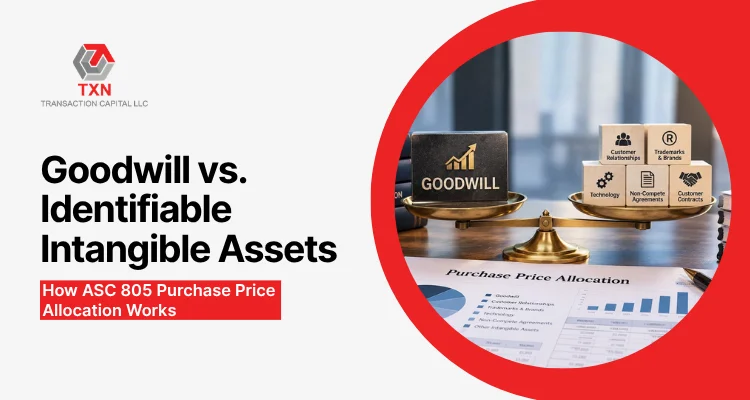
Goodwill vs. Identifiable Intangible Assets: How ASC 805 Purchase Price Allocation Works
 Dr. Gaurav B. (ABV®, ASA, CVA®, MRICS)
on
Dr. Gaurav B. (ABV®, ASA, CVA®, MRICS)
on

Dr. Gaurav B.
Founder & Principal Valuer, Transaction Capital LLC
Specialist in IRS-Compliant 409A & Complex Valuation Matters
Dr. Gaurav B. is the Founder and Principal Valuer of Transaction Capital LLC, a valuation and financial advisory firm providing independent, standards-based valuation opinions for startups, growth-stage companies, and established enterprises.
Why Goodwill Is the Last Number in an ASC 805 Allocation
Goodwill is never valued on its own. Under ASC 805, it is simply what is left after every other asset is measured. The buyer first records tangible assets, identifiable intangible assets, and liabilities at acquisition-date fair value. Whatever remains of the price becomes goodwill. So the split between goodwill vs. identifiable intangible assets is decided by the work that happens before goodwill is ever calculated.
A business combination does not park the purchase price on the balance sheet as one line. The money buys many things. ASC 805 forces the buyer to name them.
That sequence explains why purchase price allocation, or PPA, draws so much attention. Audit committees watch it. Auditors test it. Regulators review it. Because goodwill is a residual, every miss earlier in the split flows straight into it.
The hard questions are rarely about math. They are about judgment. What did the buyer really acquire? Does an asset meet the recognition test? Which method fits its economics? How long will the benefits last? Do the assumptions agree with each other?
This guide walks through the line between goodwill and identifiable intangibles. It covers the two tests, the methods used for each asset type, and the calls that reviewers probe hardest. For the full mechanics of the allocation itself, see our complete guide to purchase price allocation under ASC 805. Transaction Capital LLC prepares these allocations for buyers across more than 35 industries.
Goodwill vs. Identifiable Intangible Assets: Key Takeaways
- Goodwill is a result, not an input. It is the plug that makes the deal math balance.
- An intangible is recorded apart from goodwill if it meets the contractual-legal test or the separability test. Only one is needed.
- The target’s own books are a weak guide. Brands, customer bases, and code are often expensed by the seller, yet still recognized by the buyer.
- Miss an intangible and goodwill grows. But it grows by less than the asset’s value, because the deferred tax liability shrinks too.
- Each asset gets the method that fits it. MPEEM for customers. Relief from royalty for brands. With-and-without for non-competes.
- Economic life rules useful life, not legal life. The life in the model must match the life used for amortization.
- The WARA test checks that cash flows, values, and rates fit together across the whole split.
- A high goodwill balance is not a finding by itself. An unexplained one is.
Need an ASC 805 Allocation That Holds Up in Audit?
Speak with an ABV®, ASA, CVA® and MRICS credentialed appraiser about your transaction.
Book a free 15-minute consultation → How Does the ASC 805 Acquisition Method Work, Step by Step?
ASC 805 sets out a fixed order. The buyer follows it in sequence.
- Identify the acquirer and the acquisition date.
- Recognize and measure the identifiable assets acquired, the debts taken on, and any noncontrolling interest.
- Recognize goodwill, or in rare cases a gain on a bargain purchase.
Fair value here follows ASC 820. It reflects what market participants would assume, not what the buyer plans to do. The two are often not the same.
Say a buyer means to retire an acquired brand within a year. The brand may still be recorded at fair value. A hypothetical market participant would keep using it, so the asset has value. The same logic covers defensive intangible assets, which are bought mainly to keep rivals from using them.
What Is the ASC 805 Measurement Period?
Deals often close before the work is done. ASC 805 allows for that. The buyer reports provisional amounts and refines them during the measurement period.
That window closes when the buyer gets the facts it was after. It can never run past one year from the acquisition date. Adjustments must reflect facts that existed on the acquisition date. Later events do not count. Mix the two and a routine tweak turns into a restatement.
Is It a Business Combination or an Asset Acquisition Under ASC 805?
This question comes first, and buyers often get it wrong. ASC 805 applies only when the buyer gains control of a business. Buying a group of assets is not the same.
A business needs inputs and a process that together can create outputs. If the deal clears that bar, the buyer runs a full fair value split and may record goodwill. If it does not, the buyer spreads the cost across the assets on a relative basis. No goodwill arises in an asset acquisition.
Buyers often assume they bought assets. Auditors often disagree. Settle this early, because the answer changes all the accounting.
What Does Goodwill Represent Under ASC 805?
Goodwill captures the future gains of the bought business that were not named on their own. It is real value. It is just value that is hard to measure on its own.
Typical pieces include:
- Going-concern value, meaning the business works as an assembled whole.
- The assembled workforce, the trained team already in place.
- Synergies that market participants would pay for.
- Growth beyond the assets already named.
How Is Goodwill Calculated in a Purchase Price Allocation?
The math is simple:
Goodwill = consideration transferred + fair value of any noncontrolling interest + fair value of any previously held equity interest, minus the fair value of identifiable net assets acquired.
Two points deserve weight. First, goodwill is an output. Its quality depends entirely on the work before it. Second, the assembled workforce sits inside goodwill. That often surprises buyers, since the team is often the reason they paid a premium. ASC 805 still does not allow it as a separate asset.
What if identifiable net assets exceed the price paid? The buyer does not book a gain right away. It first checks again that every asset and debt was found and measured right. Only a gap that lives through that check is booked in earnings as a bargain purchase gain.
What Makes an Intangible Asset Identifiable Under ASC 805?
An acquired intangible is recorded apart from goodwill if it meets either of two tests. Meeting one is enough.
- Contractual-legal criterion. The asset comes from contractual or other legal rights. This holds even when those rights cannot be sold apart from the business. Licenses, franchise rights, and facility permits are common examples.
- Separability criterion. The asset can be separated from the entity and sold, transferred, licensed, rented, or exchanged. It may go alone or alongside a related contract, asset, or liability. The test is capability, not intention. Proof that like assets trade in the market is enough, even if the buyer would never sell it.
This is why the target’s historical balance sheet is a poor guide. Internally built brands, customer bases, and technology are often expensed as incurred under the seller’s accounting. They still must be recorded at fair value by the buyer when either test is met.
Goodwill vs. Identifiable Intangible Assets: What Is the Difference?
The table below sets the two side by side.
| Feature | Identifiable Intangible Assets | Goodwill |
| How it is measured | Valued directly, asset by asset | Residual, after everything else |
| Recognition test | Contractual-legal or separability | None. It is what is left |
| Examples | Customer relationships, developed technology, trade names, non-competes | Going-concern value, assembled workforce, synergies |
| Can it be sold alone | Often yes, at least in principle | No. It travels with the business |
| After-acquisition treatment | Finite-lived assets amortized, indefinite-lived tested | Tested for impairment, or amortized if a private company elects |
| Effect on earnings | Creates ongoing amortization expense | No expense unless impaired |
| Deferred tax effect | Write-up often creates a deferred tax liability | Excluded from the deferred tax calculation |
| Typical audit question | Was the value and life supported? | Is the residual explainable? |
The practical takeaway is short. Every dollar you can support as an identifiable asset is a dollar that leaves goodwill and enters amortization.
What Are the Common Categories of Identifiable Intangible Assets Under ASC 805?
Most acquired intangibles fall into five families.
- Customer-related: customer relationships, contracts, lists, order backlog, and subscriber bases.
- Technology-related: developed technology, software, databases, trade secrets, and in-process research and development. IPR&D is recorded as an indefinite-lived asset until the project is finished or dropped.
- Marketing-related: trademarks, trade names, product names, domain names, and non-compete agreements.
- Contract-based: licenses, franchise and distribution agreements, supply contracts, and favorable lease terms.
- Artistic and other: content libraries, publishing rights, permits, and regulatory approvals.
No universal list exists. The mix follows how the firm makes money.
A subscription software business often holds most of its identifiable value in customers and technology. A consumer products company leans on brands and distribution. A life-sciences target leans on patents, licensed technology, and IPR&D. Start from one question. How does this business earn revenue and defend it? Our guide to intangible asset valuation methods covers each family in more depth.
Worked Example: How Does Missing an Intangible Asset Change Goodwill?
Assume a buyer pays $80 million in cash for a private company in a stock purchase. The acquired intangibles carry no tax basis. The tax rate is 25 percent.
| Item | Fair value ($ millions) |
| Cash | 4 |
| Receivables, inventory and other assets | 9 |
| Property, plant and equipment | 12 |
| Customer relationships | 16 |
| Developed technology | 11 |
| Trade name | 5 |
| Liabilities assumed | (14) |
| Deferred tax liability on intangibles (25% x $32m) | (8) |
| Net identifiable assets | 35 |
| Goodwill ($80m less $35m) | 45 |
Now suppose the customer and technology assets are overlooked. Only the trade name is recorded.
| Scenario | Net identifiable assets | Goodwill |
| Full identification | 35.00 | 45.00 |
| Customer and technology omitted | 14.75 | 65.25 |
Goodwill rises by $20.25 million. It does not rise by the $27 million of omitted assets. The reason sits in the tax line. The deferred tax liability falls from $8.00 million to $1.25 million.
So each dollar assigned to a non-deductible intangible cuts goodwill by less than a dollar. The tax effect is part of the allocation, not a footnote to it.
Which Valuation Approaches Apply to Identifiable Intangible Assets?
ASC 820 recognizes three approaches. The choice follows the asset and the data available.
- Income approach. Value equals the present value of the benefits the asset is expected to produce. Most big intangibles use this route, because buyers acquire them for cash flows.
- Market approach. Value comes from prices of comparable assets. Direct comparables are scarce. Market evidence often supports single inputs, such as royalty rates, rather than giving a standalone answer.
- Cost approach. Value equals the cost to replace the asset’s utility, less obsolescence. It suits software, assembled databases, and internal systems where income cannot be isolated. Past development spend informs the work. It is not fair value.
Our broader guide to valuation for financial reporting under ASC 805 and ASC 820 explains how these approaches interact across reporting standards.
How to Match Valuation Methods to Each Intangible Asset
The choice of method is where most PPA quality is won or lost.
How Does the MPEEM Value Customer Relationships?
The multi-period excess earnings method, or MPEEM, is the usual tool. Revenue from existing customers is projected net of attrition. Operating costs and taxes come out. A return is then charged for every other asset that helps produce those earnings. What remains is discounted over the relationship’s life.
Attrition is often the most sensitive input. A base that keeps 92 percent of customers a year is not the same as one that keeps 80 percent. A model with thin proof on churn can be flawless on paper and still unreliable.
Cohort data, renewal history, contract terms, and how concentrated the customer base is should drive the number. The implied customer life must also agree with the life used for amortization.
What Are Contributory Asset Charges in a Purchase Price Allocation?
Customer relationships do not earn money alone. Working capital, fixed assets, workforce, technology, and trade names all support the same revenue.
The charges deducted inside MPEEM pay those assets for their help. Only then is residual profit assigned to the customer asset. If technology is essential to serving customers, the customer valuation must carry a charge for it. Skip it and the same benefit is counted twice. A thin set of charges overstates the primary asset and understates goodwill.
How Is Developed Technology Valued Under ASC 805?
How the tech makes money drives the choice. Relief from royalty fits technology that could plausibly be licensed, where licensing evidence exists. The cost approach fits cases where a market participant would think in terms of rebuilding. Direct income methods fit where extra gains can be isolated. Picking a method off a template is a common weak spot. Our guide to software and technology IP valuation under ASC 805 works through these trade-offs.
How Are Trademarks and Trade Names Valued in a PPA?
Relief from royalty is standard here. Projected revenue is multiplied by a royalty rate a market participant would pay to license the mark. The result is taxed and discounted over the brand’s economic life.
Comparability needs more than a shared industry. Brand strength, profitability, geography, exclusivity, rights conveyed, and contract duration all change what a license is worth. See our breakdown of the relief from royalty method for trade name valuation for benchmark detail.
How Are Non-Compete Agreements Valued Under ASC 805?
A with-and-without analysis fits best. The business is modeled twice, once with the restriction and once without it. The difference is discounted.
The key call is about human behavior. Would the restricted party actually compete if free to do so? Ability, incentive, whether it can be enforced, duration, and geography all matter. A restriction has value only if its absence would change outcomes.
How Are IPR&D and Acquired Contracts Valued?
IPR&D is most often valued with income methods. The odds that the science works go either into the cash flows or into the discount rate. It must never be reflected in both. That double count is a common audit finding.
Favorable and unfavorable contracts are valued by setting contract terms against market terms for the time left.
Which Intangibles Is Your Deal Leaving on the Table?
Our ABV® and ASA credentialed team has completed more than 2,500 valuations across 35+ industries.
Request a PPA quote → How Is Useful Life Determined for Identifiable Intangibles?
After recognition, each intangible is put in one of two groups under ASC 350. It is either finite-lived or indefinite-lived.
Finite-lived assets are amortized over the period they are expected to contribute to cash flows. Indefinite-lived assets are not amortized. They are tested for impairment at least once a year.
Economic life governs, not legal life. A patent with eighteen years of protection left may contribute for six if a rival technology is likely to displace it. A customer relationship may outlast its first contract when renewals are probable.
Good proof includes attrition and renewal history, technology replacement cycles, competitor activity, legal and regulatory terms, and how management intends to use the asset.
The valuation and the accounting must agree. The life in the model should equal the life used for amortization. The amortization pattern should track how benefits are consumed. Straight-line is acceptable only where no better pattern can be reliably determined.
How Do Discount Rates and the WARA Test Work in a PPA?
The rate applied to an intangible’s cash flows reflects the risk of those cash flows. It need not match the target’s weighted average cost of capital.
Early-stage technology and IPR&D often warrant a premium over the overall rate. Customer relationships backed by contracts and long retention records may warrant less. The parts have to fit. The risks built into the forecast must be the risks priced into the rate. Our explainer on how a discount rate is built covers the mechanics.
The weighted average return on assets, or WARA, tests that fit across the whole split. Each asset gets a required return, weighted by its fair value. Goodwill is assigned a rate at or above that of the riskiest identified asset.
The result should reconcile closely to the deal’s internal rate of return and to the target’s cost of capital. WARA does not set any asset’s value. It flags when cash flows, values, and rates do not line up. A big gap with no clear cause points back to what you assumed.
How Do Deferred Taxes Affect Goodwill vs. Identifiable Intangible Assets?
Book basis for an acquired intangible is fair value. Tax basis depends on how the deal was structured.
In a stock deal with no step-up, tax basis tends to carry over from the target. A fair value write-up then makes a taxable temporary gap and a deferred tax liability. In an asset deal, or a deal treated as one for tax reasons, a step-up may remove or reverse that difference.
Deferred taxes reduce identifiable net assets, so they lift goodwill. The worked example above showed this. Goodwill itself is left out of the deferred tax calculation, which stops the math from looping.
The tax team and the valuation team must work from one structure. The model has to match the deal papers.
How Does Book Allocation Differ from Tax Allocation?
One trap deserves its own flag. The ASC 805 allocation for financial reporting is a job apart from the tax split.
In a taxable asset deal, buyer and seller allocate the price across asset classes on IRS Form 8594. That allocation drives the buyer’s future deductions and the character of the seller’s gain. A Section 338 election can create a tax basis step-up in certain stock deals.
Both jobs use fair value thinking. They often start from the same appraisal. They follow separate rules and can land on separate numbers. Treat them as related but distinct.
Which Private Company Alternatives Change the Goodwill Analysis?
Private firms may elect two shortcuts that reshape the work.
Under the goodwill alternative, goodwill is amortized over ten years or less in most cases. Impairment is tested only when a triggering event occurs, not every year.
A related alternative allows an entity to fold certain customer-related intangibles into goodwill. This applies to those that cannot be sold or licensed independently of the business. Non-compete agreements may be folded in as well.
These choices apply to future deals. Less valuation work is the gain. The cost is years of amortization expense and a weaker match with peers. Settle this with your auditor first, not after.
Where Do Auditors Focus When Reviewing Goodwill and Intangibles?
An auditor treats a PPA as an accounting estimate. Under PCAOB standards, and AU-C 540 for private entities, the auditor evaluates the method, the data, and the significant assumptions. A specialist may be brought in. Where management engaged its own specialist, the auditor checks how good that specialist is, how free of bias, and how sound the work is.
A large goodwill balance is not a finding by itself. Big strategic deals can fairly hold a lot of synergy and growth value. The real question is whether the residual is explainable once everything identifiable has been considered.
Picture a target with recurring customers, software it built, and a known brand. Now picture a result that assigns almost nothing to those assets. That gap invites an obvious question. Were they ever fully evaluated?
The recurring areas of challenge are:
- Completeness of identification. Does the asset population match the target’s business model, contracts, intellectual property, and diligence findings?
- Forecast consistency. Do projections reconcile to those used for deal pricing, financing, board materials, and later budgets?
- Attrition. Is it supported by actual customer behavior and consistent with the concluded life?
- Royalty rates. Are the underlying licenses genuinely comparable?
- Contributory asset charges. Does every material supporting asset receive a return?
- Discount rates. Are asset-specific premiums justified, and does WARA reconcile?
- Useful lives. Do they track the expected pattern of benefit rather than convention?
- Residual goodwill. Does it match benefits, such as workforce and synergies, that cannot be recognized separately?
The aim is never to steer goodwill toward a target percentage. It is to show that the residual is the product of a split you can stand behind.
What Happens to Goodwill After the ASC 805 Allocation?
The split is not the end of the story. Goodwill sits on the balance sheet as a standing risk of a write-down.
If the acquired business underperforms, the carrying value may exceed fair value. The buyer then writes goodwill down, and that charge hits the income statement. No cash goes out. The hit is still real.
Finite-lived intangibles behave differently. They feed a steady amortization expense through earnings over their useful lives. Assign more value to a five-year technology asset and less to goodwill, and you pull expense forward. That tension is exactly why auditors examine the split so closely. Our guide to goodwill impairment testing covers annual and interim requirements.
What Documentation Supports a Goodwill and Intangible Asset Allocation?
A tight work file lets a reviewer trace the path from the purchase agreement to the goodwill balance. It often records:
- the deal structure, acquisition date, and consideration, including contingent amounts at fair value;
- the assets and liabilities considered, and why each one was booked or not;
- the method chosen for each asset, and why the other options were turned down;
- forecasts, tied back to the forecasts management signed off;
- how the churn, royalty, and discount rates were built, with sources;
- useful life conclusions, tax structure assumptions, and deferred taxes; and
- sensitivity analysis and the WARA reconciliation.
Support recorded as the decisions are made carries far more weight than a story pieced back together once questions start.
What Is the Role of an Independent Valuation Specialist in ASC 805?
PPA work mixes accounting rules with financial and valuation judgment. Neither side can be skipped.
Management holds essential knowledge of the acquired business. The valuation specialist turns that into market-participant assumptions and asset-specific values.
For material or complex deals, selection criteria often include experience with ASC 805, intangible asset expertise, professional credentials, independence, documentation quality, and the ability to support the work through audit review.
Transaction Capital LLC offers independent business valuation and intangible asset services, including ASC 805 purchase price allocations. Its professionals hold credentials including ABV®, ASA, CVA® and MRICS. Work is done under the standards that fit each job, with reference to USPAP, SSVS, and NACVA requirements.
The objective is not to produce a preferred goodwill percentage. It is to build an allocation that reflects what the deal really was.
Planning an Acquisition or Closing One Now?
Get an audit-ready ASC 805 allocation from ABV®, ASA, CVA® and MRICS credentialed appraisers, with flat-fee pricing and a 3 to 5 business day turnaround.
Talk to a valuation specialist → Final Thoughts on Goodwill vs. Identifiable Intangible Assets
Goodwill is the end of the allocation, not the start of it.
A supportable analysis works in order. It determines what was acquired. It recognizes the assets and liabilities that qualify. It measures each one with a method suited to its economics. It aligns useful lives and tax effects. It tests the assumptions for internal consistency. Only then does goodwill emerge as the residual.
Neither a high nor a low goodwill percentage proves whether a PPA is reasonable. The real test lies elsewhere. Does the analysis form a coherent bridge from the consideration transferred, through the identifiable net assets, to the resulting goodwill? Proof, open assumptions, and notes made at the time have to sit behind every step.
Frequently Asked Questions About Goodwill and Identifiable Intangible Assets
1. What is the difference between goodwill and identifiable intangible assets?
Identifiable intangibles are recognized separately when they meet either the contractual-legal criterion or the separability criterion. Goodwill is the residual economic benefit that cannot be recognized on its own. One is measured directly, the other is what remains.
2. Can an asset be recognized if the target never recorded it?
Yes. What counts is the two tests at the deal date, not on how the seller booked it before. Internally developed brands, customer bases, and software are often put on the books by the buyer even though the target expensed them.
3. Which method is commonly used for customer relationships?
The multi-period excess earnings method, or MPEEM. It isolates the earnings attributable to existing customers after charging a fair return on every asset that helps. The remaining cash flow is discounted over the relationship’s expected life.
4. Is goodwill amortized?
Public business entities and most other entities test goodwill for impairment without amortizing it. Private companies that elect the accounting alternative amortize it instead, over ten years or less in most cases, and test only when a triggering event occurs.
5. When must a PPA be finalized?
Within the measurement period, which ends no later than one year after the acquisition date. Adjustments during that window must relate to facts that existed on the acquisition date, not to later developments.
6. Why does missing an intangible asset increase goodwill?
Goodwill is calculated as a residual. Any value not assigned to an identifiable asset falls into it by default. The increase is often smaller than the omitted value, because the related deferred tax liability falls at the same time.
7. Is the assembled workforce recognized as a separate intangible asset?
No. ASC 805 treats the assembled workforce as part of goodwill, even when the team is the main reason a buyer paid a premium. It fails the separability test because it cannot be sold apart from the business.
8. Does a bargain purchase gain get recorded immediately?
No. When identifiable net assets exceed the consideration and other components, the buyer first checks again that every asset and debt was found and measured right. Only a gap that lives through that check is booked in earnings.
About Transaction Capital LLC
Transaction Capital LLC (TXN Capital LLC) is an independent business valuation firm registered in Delaware and led by Dr. Gaurav B. (ABV®, ASA, CVA®, MRICS). The firm has completed more than 2,500 valuations across 35+ industries, with work done under USPAP, SSVS, NACVA, and IVS standards.
Services include ASC 805 purchase price allocations, intangible asset valuation, 409A valuations, goodwill impairment testing, business valuation, and litigation support. Jobs are quoted at a flat fee from $500. Clients also get a Pay After Draft Review guarantee, a 3 to 5 business day turnaround, and post-valuation audit support.
This article is provided for general information only. It does not constitute accounting, tax, or legal advice. Consult qualified professionals regarding your specific circumstances.