
What Is a Discount Rate in Valuation and How to Calculate It
 Dr. Gaurav B. (ABV®, ASA, CVA®, MRICS)
on
Dr. Gaurav B. (ABV®, ASA, CVA®, MRICS)
on


Dr. Gaurav B.
Founder & Principal Valuer, Transaction Capital LLC
Specialist in IRS-Compliant 409A & Complex Valuation Matters
Dr. Gaurav B. is the Founder and Principal Valuer of Transaction Capital LLC, a valuation and financial advisory firm providing independent, standards-based valuation opinions for startups, growth-stage companies, and established enterprises.
The business valuation discount rate is the single most powerful variable in determining what a company is worth right now. It translates projected future earnings into present-day dollars by accounting for risk, inflation, and opportunity cost. Even a half-percentage-point miscalculation can shift a company’s estimated value by hundreds of thousands or millions of dollars.
Whether you are a startup founder pricing stock options through a 409A valuation, a CFO preparing for a merger, or an investor evaluating a deal, grasping how discount rate function gives you a strategic edge. It separates informed decision-makers from those relying on guesswork.
In this comprehensive guide, Transaction Capital LLC explains everything you need to know about the discount rate in valuation from the core formulas (WACC, CAPM, and the build-up approach) to the individual components that drive each calculation. We walk through real-world worked examples, address current 2026 market conditions including the impact of the One Big Beautiful Bill Act (OBBBA), and highlight the most common mistakes that lead to audit failures.
Key Takeaways
- A business valuation discount rate is the required rate of return investors’ demand to compensate for risk and time value of money.
- Typical rates range from 8% to 25% for operating companies – early-stage startups often face 25–50%.
- Three primary methods exist: WACC, CAPM, and the build-up approach. The right choice depends on company size, data availability, and valuation purpose.
- A 1% change in the discount rate can shift enterprise value by 8–15% or more.
- The current (as of September 2025) recommended U.S. ERP stands at 5.0%, paired with a 3.5% normalized risk-free rate or the spot 20-year Treasury yield – whichever is higher, per leading cost of capital research.
- The OBBBA, signed July 4, 2025, affects DCF modeling through permanent 100% bonus depreciation, EBITDA-based interest deductions, and expanded estate/gift exemptions.
What Is a Business Valuation Discount Rate and Why Does It Matter?
A business valuation discount rate is the expected rate of return an investor requires to justify the risk of placing capital into a particular business. It captures the time value of money – the principle that a dollar in hand today carries more value than a dollar promised a year from now, because of inflation, investment alternatives, and uncertainty.
In practice, valuators apply this rate to a company’s projected future cash flows through a discounted cash flow (DCF) analysis to calculate their present value. The greater the perceived risk, the higher the discount rate – and the lower the company’s estimated worth.
Understanding Future Value (FV)
Understanding the future value (FV) concept helps illustrate why these matters are important. If you invest $100 today at a 10% annual return, it grows to $110 in one year (FV = PV × (1 + r) ^n). The discount rate works in reverse – it tells you what a future $110 payment is worth in today’s dollars. A higher discount rate means that future dollars are worth less right now, which is why getting this number right is so critical.
It is worth noting that the term “discount rate” has a second meaning in finance. The Federal Reserve also uses a “discount rate” to refer to the interest rate it charges depository institutions for borrowing from its discount window. That context relates to monetary policy and banking liquidity, not business valuation. Throughout this guide, we focus exclusively on the investment and valuation definition.
Typical discount rates for business valuations range from 8% to 25%, influenced by factors such as:
- Company size and maturity stage
- Industry risk profile and regulatory environment
- Current market conditions and interest rate levels
- Capital structure (the ratio of debt to equity)
- Management quality and depth of leadership
- Customer and revenue concentration
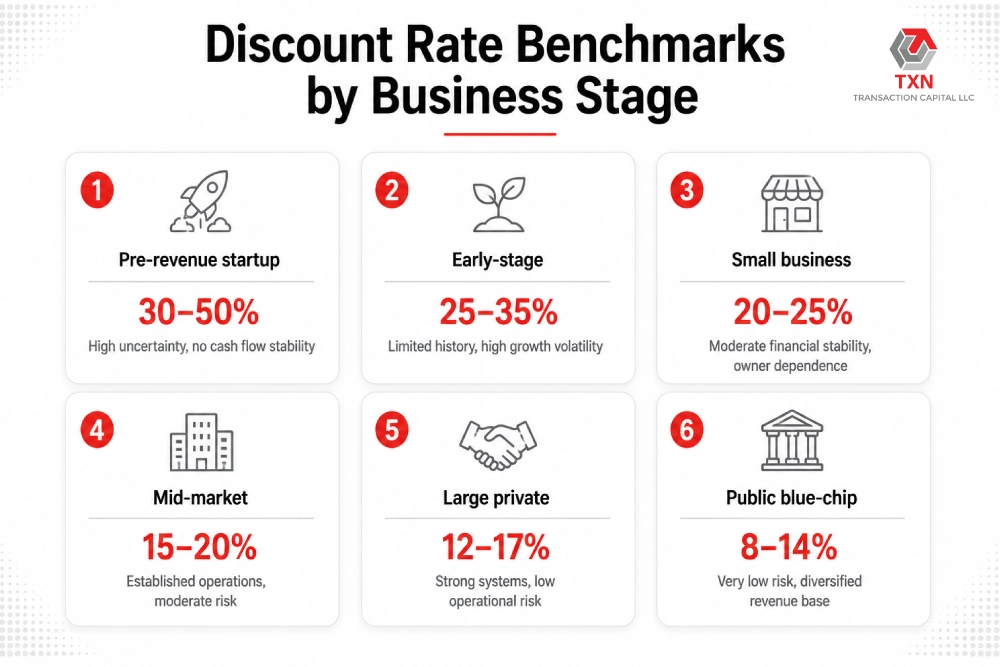
For early-stage startups, rates frequently fall between 25–50% because of limited operating history and execution uncertainty. Established mid-market companies with predictable cash flows typically use rates in the 12–18% range. Large, publicly traded blue-chip firms may have rates as low as 8–12%.
You may encounter several related terms – cost of equity, required rate of return, cost of capital, and hurdle rate. While each has technical nuances, they all connect to the fundamental concept of pricing risk into a valuation.
How Do You Calculate the Discount Rate in Business Valuation?
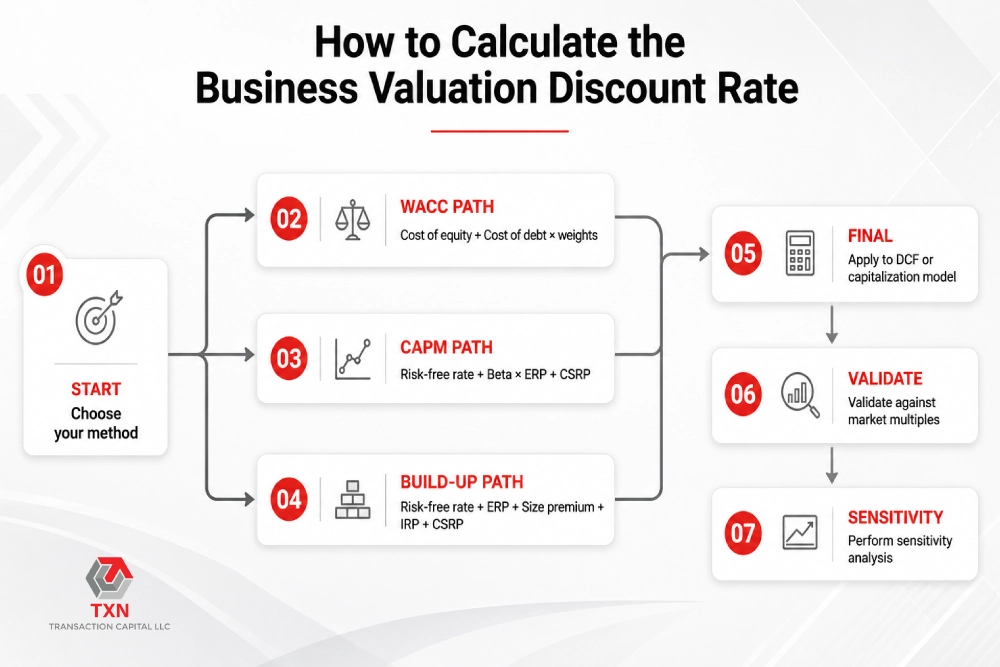
Professional valuators rely on several analytical frameworks to determine the appropriate discount rate for business valuation. The right approach depends on the company’s structure, available data, and the purpose of the engagement. Four primary methodologies dominate modern practice.
1. The WACC Method: Blending Debt and Equity Costs
The Weighted Average Cost of Capital (WACC) represents the blended return required by all capital providers – both lenders and shareholders. It is the most widely used discount rate for enterprise-level valuations and DCF analyses.
WACC = (E/V × Re) + (D/V × Rd × (1 – T))
Where:
- E = Market value of equity
- D = Market value of debt
- V = Total value of capital (E + D)
- Re = Cost of equity
- Rd = Cost of debt (interest rate)
- T = Corporate tax rate
Worked Example: Consider a SaaS company with 60% equity financing (cost of equity: 12%) and 40% debt financing (interest rate: 6%, corporate tax rate: 21%):
WACC = (0.60 × 12%) + (0.40 × 6% × 0.79) = 7.2% + 1.90% = 9.10%
This 9.1% rate becomes the benchmark for discounting the company’s projected free cash flows. If the company’s internal rate of return exceeds 9.1%, the investment creates value. If it falls below, the business destroys value from the investor’s perspective.
Important consideration: While adding debt can initially lower the overall WACC (because debt is cheaper than equity after tax savings), excessive leverage raises the cost of equity as financial risk increases. Beyond a certain threshold, more debt actually pushes WACC higher. Note that under the OBBBA (effective 2025), the Section 163(j) business interest limitation now uses an EBITDA-based calculation rather than EBIT, which is more favorable for capital-intensive businesses and may reduce the effective cost of debt.
2. The CAPM Method: Pricing Systematic Risk
The Capital Asset Pricing Model (CAPM) estimates the cost of equity by measuring a company’s exposure to market-wide risk:
Re = Rf + β × (Rm – Rf) + CSP
Where:
- Rf = Risk-free rate (typically 10- or 20-year U.S. Treasury yield)
- β (Beta) = A measure of the company’s volatility relative to the overall market
- Rm – Rf = Equity risk premium (the extra return investors demand for stocks over risk-free bonds)
- CSP = Company-specific risk premium
CAPM works best when reliable beta data is available – typically for publicly traded companies or private firms with strong comparable sets. For small private companies where beta data is unreliable or unavailable, the build-up method is preferred.
3. The Build-Up Method: Stacking Risk Premiums
The build-up method is widely used for valuing small and mid-sized private companies. Instead of relying on beta, it constructs the discount rate by layering individual risk components:
Equity Discount Rate = Risk-Free Rate + Equity Risk Premium + Size Premium + Industry Risk Premium + Company-Specific Risk Premium
Based on our experience at Transaction Capital LLC working with industries, the build-up method often produces the most defensible rates for private company valuations, especially in litigation and IRS audit contexts where each component must be independently justified with published data sources.
4. Adjusted Present Value (APV)
The Adjusted Present Value method separates the base-case value of a company (as if it were all-equity financed) from the value created by financing decisions – particularly tax shields from debt:
APV = NPV (All-Equity Financed) + NPV (Tax Shield from Debt)
APV uses the cost of equity as the discount rate for base cash flows and is particularly useful in highly leveraged transactions such as private equity buyouts. When a company’s capital structure is expected to change significantly over the projection period, APV often provides more accurate results than WACC, which assumes a constant capital structure.
Need expert guidance?
Schedule a free 15-minute consultation with our certified appraisers to discuss your specific valuation needs.
Schedule Free Consultation →Key Parts That Build Your Discount Rate
Each component captures a distinct category of risk. Understanding them individually strengthens your ability to assess, challenge, and defend valuation conclusions.
1. Risk-Free Rate: The Foundation
The risk-free rate compensates investors purely for the time value of money, stripping away all default risk. It sets the absolute floor for any discount rate.
Common sources include:
- Primary benchmark: 20-year U.S. Treasury bond yield (in the 4.2–4.8% range as of early 2026)
- Alternative: 10-year Treasury for shorter projection horizons
- Normalized risk-free rate: 3.5% as recommended by leading cost of capital data providers (used when spot yields appear temporarily elevated or depressed)
For international valuations, practitioners start with the U.S. Treasury baseline and layer on country risk premiums to account for sovereign default risk, currency volatility, and political instability.
2. Equity Risk Premium (ERP)
The equity risk premium captures the additional return of investors’ demand for holding stocks rather than risk-free government bonds. It reflects broad market volatility and economic uncertainty.
As of last year, the widely accepted U.S. ERP recommendation stands at 5.0% when developing USD-denominated discount rates, per authoritative cost of capital research. This rate was temporarily raised to 5.5% in April 2025 due to trade conflict uncertainty before being lowered back as tensions eased.
Historical ERP estimates typically range between 4.0% and 7.0%, depending on the data source and methodology. The two main approaches are:
- Historical method: Calculates the average premium stocks have earned over bonds across decades of market data
- Forward-looking (implied) method: Derives the premium from current market pricing and earnings expectations
3. Beta Coefficient: Measuring Market Sensitivity
Beta quantifies how much a company’s returns move relative to the broader market:
- Beta = 1.0: The company moves in lockstep with the market
- Beta > 1.0: More volatile than the market (e.g., airlines, technology startups)
- Beta < 1.0: Less volatile (e.g., grocery stores, utilities)
For private companies without publicly traded stock, practitioners use proxy betas from comparable public companies, then adjust for capital structure differences:
- Unlevered Beta = Levered Beta ÷ [1 + (1 – Tax Rate) × (Debt/Equity)]
- Re-levered Beta = Unlevered Beta × [1 + (1 – Tax Rate) × (Target Debt/Equity)]
Best practices for beta selection:
- Source peer data from Bloomberg, Capital IQ, or established cost of capital platforms
- Use 2-year weekly or 5-year monthly return data for statistical stability
- Apply adjustments for thin trading in smaller-cap stocks
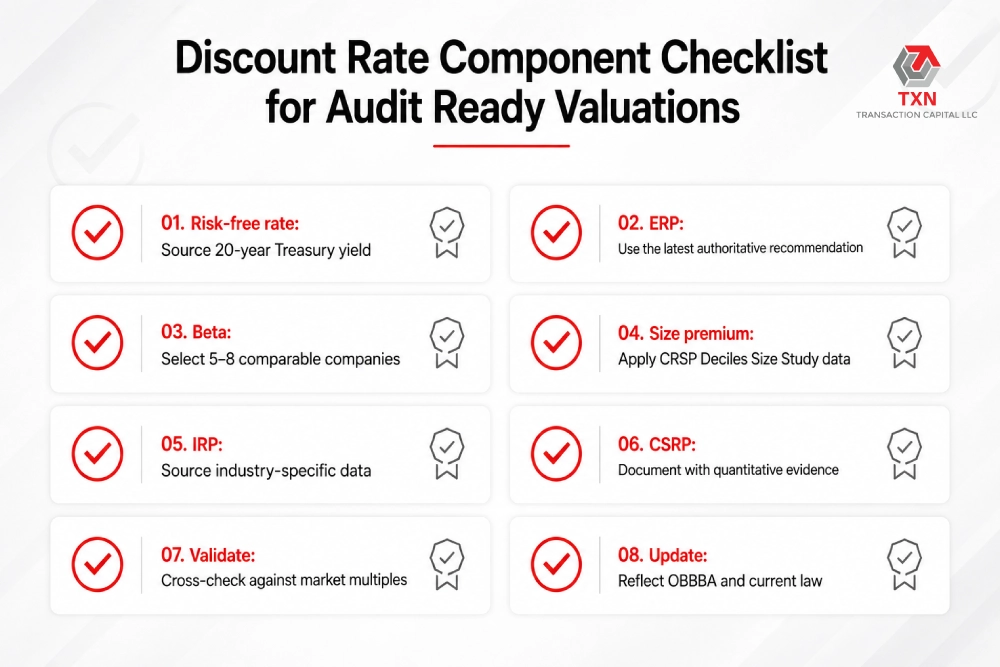
- Select at least 5–8 comparable companies to reduce individual company noise
4. Size Premium: The Small Company Effect
Smaller companies face additional risk factors that the equity risk premium and beta alone do not capture. They tend to have less access to capital, higher failure rates, lower liquidity, and greater management dependence.
Industry-Standard Size Premium Data:
Company Size Category | Approximate Size Premium |
Micro-cap (under $300M market cap) | 5.2% – 6.8% |
Small-cap ($300M – $2B) | 3.8% – 4.5% |
Mid-cap ($2B – $10B) | 2.1% – 2.8% |
Large cap (over $10B) | 0.5% – 1.2% |
For very small private businesses (under $10M in revenue), size premiums can reach 7% or higher. These premiums are sourced from the CRSP Deciles Size Study published by leading cost of capital researchers and updated annually.
5. Company-Specific Risk Premium (CSRP)
The CSRP captures unique risks that are specific to the individual business and not reflected in market-wide data. This is the most subjective component, yet it often has the largest impact on the final discount rate.
In our valuation practice, our ABV® and ASA certified appraisers have found that these risk factors most commonly drive CSRP adjustments:
Risk Factor | Typical Premium Range | What It Captures |
Key person dependency | 1% – 3% | Revenue tied to a single executive |
Customer concentration | 1% – 4% | Over-reliance on one or few clients |
Regulatory uncertainty | 2% – 5% | Pending legislation, compliance exposure |
Revenue volatility | 1% – 3% | Inconsistent year-over-year earnings |
Product concentration | 1% – 3% | Dependence on a single product line |
Geographic concentration | 0.5% – 2% | Operations limited to one region |
Competitive environment | 1% – 3% | Low barriers to entry, intense competition |
How to defend CSRP to auditors: Document each risk factor with quantitative evidence rather than subjective opinions. Use SWOT analysis frameworks, customer concentration percentages, revenue stability metrics, and management succession documentation. Vague justifications such as “the company is risky” will not survive IRS or Big 4 audit scrutiny.
6. Industry Risk Premium (IRP)
Different industries carry varying levels of market-correlated risk. The IRP adjusts for sector-specific exposures that beta alone may not fully capture.
Key reference sources:
- Industry beta benchmarks from established cost of capital platforms
- Risk assessments from authoritative risk premium reports
- Sector-focused data from Bloomberg and S&P Capital IQ
For instance, technology companies may carry a higher IRP due to rapid disruption cycles, while regulated utilities tend to have lower premiums reflecting stable cash flows.
Transaction Capital’s ABV® and ASA certified professionals deliver audit-ready valuation reports in 2–5 business days, starting at $500.
Get Your Quote →What Is the Difference Between Discount Rate and Capitalization Rate?
A frequent source of confusion in business valuation is the distinction between the discount rate and the capitalization rate. While related, they serve different purposes:
- Discount rate is applied to a series of projected future cash flows (multi-period model) in a DCF analysis
- Capitalization rate is applied to a single normalized cash flow (single-period model) in a direct capitalization approach
The relationship is straightforward:
Capitalization Rate = Discount Rate – Long-Term Sustainable Growth Rate
For example, if the discount rate is 18% and the expected long-term growth rate is 3%, the capitalization rate equals 15%.
The DCF approach is preferred for companies with fluctuating or high-growth cash flows. The direct capitalization method works best for stable businesses with predictable, steady earnings. Choosing the wrong method—or misaligning the rate with the cash flow type—is a common audit failure point.
How Do Discount Rates Differ Across Valuation Methods?
The selection of valuation methods and discount rates depend on company characteristics, available data, and the purpose of the engagement.
1. Discounted Cash Flow (DCF) Analysis
The discounted cash flow method suits businesses with established cash flows and reliable financial projections. It requires:
- Multi-year free cash flow forecasts (typically 5–10 years)
- An appropriate discount rate (WACC for enterprise value, cost of equity for equity value)
- Terminal value calculation (representing value beyond the projection period)
- Sensitivity analysis testing different discount rate assumptions
Multi-Year DCF Worked Example: Suppose a mid-market manufacturing company projects the following annual free cash flows with a WACC of 14%:
Year | Projected FCF | Discount Factor (14%) | Present Value |
1 | $1,200,000 | 0.8772 | $1,052,632 |
2 | $1,350,000 | 0.7695 | $1,038,816 |
3 | $1,500,000 | 0.6750 | $1,012,500 |
4 | $1,650,000 | 0.5921 | $976,865 |
5 | $1,800,000 | 0.5194 | $934,868 |
Sum of PV (Years 1–5) | $5,015,681 |
Add a terminal value (using a 3% perpetual growth rate): Terminal Value = $1,800,000 × (1.03) ÷ (0.14 – 0.03) = $16,854,545. Discounted five years: $16,854,545 × 0.5194 = $8,752,890. Total enterprise value ≈ $13,768,571.
Transaction Capital LLC frequently uses DCF for mature companies seeking valuations for M&A transactions, financial reporting, and tax compliance.
2. Market-Based Approaches
Market multiples serve as reality checks for discount rate assumptions. By comparing a subject company’s metrics against similar businesses, valuators can validate whether their income approach conclusions are reasonable.
Common multiples include price-to-earnings (P/E) ratios, enterprise value-to-EBITDA, revenue multiples, and book value multiples. Implied discount rates can be reverse engineered from market multiples, providing an independent benchmark.
3. Asset-Based Methods
For companies with significant tangible assets or limited operating history, asset-based approaches may supplement income methods. These typically require lower discount rates reflecting asset-specific risks rather than business operational uncertainty.
Discount Rate vs. IRR vs. Capitalization Rate: What’s the Difference?
These three metrics are frequently confusing. Here is how they compare:
Attribute | Discount Rate | Internal Rate of Return (IRR) | Capitalization Rate |
Definition | Required rate of return for an investment | Rate at which NPV equals zero | Discount rate minus long-term growth |
Purpose | Valuation benchmark | Investment yield measurement | Single-period income capitalization |
Focus | Risk-adjusted cost of capital | Cash flow profitability | Stabilized income conversion |
Inputs | Risk components, capital structure | Actual cash inflows/outflows | Discount rate, growth rate |
Typical Use | DCF analysis, M&A, tax valuation | Venture capital, ROI analysis, hurdle rates | Stable business valuation, real estate |
Decision Rule | Compare IRR to discount rate | Accept if IRR > discount rate | Apply to single normalized cash flow |
In value-creating investments, the IRR should exceed the calculated discount rate. This relationship guides investment acceptance decisions for private equity firms, venture capitalists, and corporate development teams.
What Are Current Discount Rate Benchmarks for Business Type?
Understanding typical ranges helps validate calculations and supports defensible conclusions. Based on our practice experience across 2,500+ engagements:
Business Type | Discount Rate Range | Key Risk Factors |
Pre-Revenue Startup | 30% – 50% | No operating history, concept stage, maximum execution risk |
Early-Stage Startup (some revenue) | 25% – 35% | Market uncertainty, limited track record, cash burn |
Small Business ($5M–$50M revenue) | 20% – 25% | Size premium, key person dependency, customer concentration |
Mid-Market ($50M–$500M revenue) | 15% – 20% | Operational scalability, market competition, management depth |
Large Private Firm ($500M+ revenue) | 12% – 17% | Market position, financial resources, professional management |
Public Blue-Chip Company | 8% – 14% | Market liquidity, regulatory compliance, diversified operations |
An equity discount rate in the 12% to 20% range is generally considered reasonable for a typical private company. Rates below 10% or above 25% deserve additional scrutiny and documentation, though they may be justified by specific facts and circumstances.
How Do 2026 Market Conditions Affect Discount Rate Selection?
Market conditions in 2026 create a unique environment for discount rate determination. Industry analysts have characterized this period as “a discount-rate year, not an earnings year” – meaning the cost of capital, rather than earnings growth, has become the binding constraint on valuations.
1. Interest Rate Environment
The Federal Reserve’s monetary policy directly influences the risk-free rate foundation. With 20-year Treasury yields in the 4.2–4.8% range and the normalized risk-free rate holding at 3.5%, the baseline for discount rates remains elevated compared to the historically low rates of 2020–2021.
Rising interest rates increase discount rates across the board, leading to higher borrowing costs, increased investor return expectations, downward pressure on business valuations, and more challenging fundraising conditions for startups.
2. The One Big Beautiful Bill Act (OBBBA) and Its Impact on Valuation
The OBBBA, signed into law on July 4, 2025, introduced several provisions that directly affect DCF modeling and discount rate considerations:
- Permanent 100% bonus depreciation: Companies can immediately expense qualifying capital investments, boosting near-term free cash flows. For capital-intensive industries, this translates directly into higher present values under DCF.
- EBITDA-based interest deduction (Section 163(j)): The business interest limitation now uses EBITDA rather than EBIT, making debt financing more favorable and potentially lowering the after-tax cost of debt in WACC calculations.
- Corporate tax rate confirmed at 21%: No change, providing stability for C-corporation cash flow modeling.
- Section 199A QBI deduction made permanent (20%): Pass-through entities retain a 20% qualified business income deduction, stabilizing after-tax income assumptions for S-corporations, LLCs, and partnerships.
- Estate and gift tax exemption permanently set at $15M ($30M for couples): Effective January 1, 2026, indexed for inflation thereafter. This eliminates the previously anticipated 2026 “sunset” cliff and changes the urgency calculus for gift and estate tax valuations.
- QSBS asset cap raised from $50M to $75M: Expands eligibility for the capital gains exclusion under Section 1202.
These changes collectively alter both the numerator (cash flows) and denominator (risk/discount rates) of the valuation equation. Valuators must update their models to reflect the current legislative environment.
3. Trade Policy and Economic Uncertainty
The trade tensions and tariff fluctuations of 2025 prompted leading cost of capital researchers to temporarily raise the recommended U.S. ERP from 5.0% to 5.5% in April 2025. While the premium returned to 5.0% by September 2025 as tensions eased, this episode illustrates how quickly geopolitical risk can flow through to discount rates.
4. Industry-Specific Dynamics
Different sectors face distinct risk profiles requiring adjusted discount rates in the current environment:
- Technology/AI companies: Higher growth potential but elevated uncertainty around monetization and capital discipline
- Healthcare/Biotech: Regulatory risk from changing federal policy; extended development timelines
- Real estate: Heightened interest rate sensitivity driving cap rate expansion
- Manufacturing: Trade policy exposure and supply chain restructuring costs, partially offset by permanent bonus depreciation benefits
- Energy: Transition risk and commodity price volatility
5. ESG Integration
Environmental, Social, and Governance factors increasingly influence discount rate selection. Companies with strong ESG profiles may justify lower discount rates due to reduced regulatory exposure, enhanced access to capital, and improved operational resilience.
Transaction Capital LLC incorporates ESG principles into its valuation methodology where relevant, reflecting modern investment priorities.
What Are Common Mistakes in Discount Rate Calculation?
Errors in discount rate selection represent one of the most frequent reasons valuations fail under audit or litigation scrutiny. Our ASA and CVA® certified experts have identified these recurring pitfalls:
1. Using Outdated Market Data
Stale risk-free rates or equity risk premiums can materially distort valuations. The risk-free rate should reflect market conditions as of the valuation date, not a date from months earlier. Professional valuators update these inputs for every engagement.
2. Ignoring Company-Specific Risks
Generic industry discount rates miss what makes each business unique. A medical device company with FDA approval is fundamentally different from one still in clinical trials. Each business requires individual assessment of management quality, customer concentration, competitive position, financial stability, and growth sustainability.
3. Inconsistent Cash Flow and Discount Rate Pairing
The discount rate must match the risk profile of the cash flows being discounted. Optimistic revenue projections paired with a conservative discount rate produces inflated valuations. Conservative forecasts paired with high discount rates understate value. Consistency between assumptions is critical.
4. Neglecting Terminal Value Sensitivity
Terminal value typically represents 60–80% of total business value in a DCF analysis. A 0.5% change in the terminal growth rate can shift terminal value by 8–15%. Conservative terminal growth rates aligned with long-term GDP growth (2–3%) are essential for credibility and audit defensibility.
5. Double-Counting Risk
This occurs when a risk factor is captured in both the cash flow projections and the discount rate. For example, if a valuator reduces projected revenue to reflect customer concentration risk AND adds a CSRP for the same risk, the impact is counted twice, artificially deflating the valuation.
6. Selecting Artificially Low Rates to Inflate Value
A discount rate that does not genuinely reflect investment risk may produce a higher valuation on paper, but it will not survive scrutiny from auditors, the IRS, or opposing counsel in litigation. Credibility always matters more than a flattering number.
7. Failing to Update for Legislative Changes
With the OBBBA now in effect, models that still assume the pre-2025 interest deduction rules (EBIT-based) or phase-down of bonus depreciation are using stale assumptions. Valuators should confirm that their tax rate assumptions, depreciation schedules, and interest deductibility calculations reflect current law.
How Do You Choose the Right Discount Rate Step by Step?
Selecting the right discount rate is not guesswork—it follows a structured, evidence-based process. Here is how Transaction Capital LLC professionals approach it.
Step 1: Start with the Risk-Free Rate
Begin with the current 10-year or 20-year U.S. Treasury yield as of your valuation date. This sets the absolute floor for your discount rate. As of early 2026, the 20-year Treasury yield sits in the 4.2%–4.8% range, while the normalized risk-free rate holds at 3.5%. Use whichever is higher.
Step 2: Add the Market Risk Premium
Layer on 4%–7% based on long-term equity market performance. Most professionals use 5%–6%, with the current widely accepted U.S. recommendation at 5.0% as of September 2025.
Step 3: Apply the Beta Adjustment
Multiply the market risk premium by your company’s beta—a measure of how your business moves relative to the broader market. This captures industry-specific volatility. A beta above 1.0 means higher-than-market risk; below 1.0 means lower risk.
Step 4: Add the Size Premium
Smaller companies carry compounding risks that broader market data does not capture. Add 3%–5% for small firms. Very small businesses with limited diversification and management depth may require even more.
Step 5: Assess Company-Specific Risks
This is where the discount rate becomes uniquely yours. Evaluate and assign premiums for:
- Key person dependency: 2%–4%
- Customer concentration: 1%–3%
- Limited operating history: 2%–5%
- Regulatory uncertainties: 1%–3%
- Financial instability: 2%–4%
Use a SWOT analysis framework to quantify these risks systematically rather than relying on subjective judgment. Document each factor with data auditors, and the IRS expect evidence, not opinions.
Step 6: Validate Against Industry Benchmarks
Before finalizing, cross-check your calculated rate against real-world expectations. Compare to:
- Similar transactions in your industry
- Private equity returns expectations
- Venture capital hurdle rates
- Public company cost of equity in your sector
If your number falls significantly outside the typical range for comparable businesses, revisit your assumptions and document why the deviation is justified.
How Do Discount Rates Impact Specific Valuation Scenarios?
1. 409A Valuations and Stock Option Pricing
For 409A valuations, the discount rate directly affects the fair market value of common stock, which determines the minimum strike price for employee stock options. An improperly calculated rate can result in either overvalued options (attracting IRS penalties including a 20% excise tax on employees) or undervalued shares that create compliance risks during fundraising.
2. Fundraising and Investor Due Diligence
Sophisticated investors scrutinize discount rate assumptions during due diligence. Appropriate rates help justify valuation multiples, support growth projections, demonstrate market awareness, and build investor confidence.
3. Tax and Compliance Reporting
IRS and audit requirements demand supportable discount rate methodologies. Professional valuations that comply with Revenue Ruling 59-60, USPAP, and SSVS standards ensure audit firm acceptance, regulatory scrutiny resistance, and documentation completeness.
4. Litigation and Disputes
Court proceedings require defensible discount rate selections backed by market evidence, published data sources, and professional judgment. Expert testimony in divorce proceedings, shareholder disputes, and damages cases frequently center on methodology appropriateness, data source credibility, and calculation of transparency.
What Trends Are Shaping Discount Rate Practices in 2026?
1. The Cost-of-Capital Constraint
Market analysts increasingly describe 2026 as a year where the cost of capital acts as the primary gatekeeper for valuations. With inflation remaining above pre-pandemic norms and term premiums elevated, higher risk-free yields raise the hurdle rate for all asset classes.
2. Technology and AI Disruption
Digital transformation continues to reshape business risk profiles. Companies that have successfully integrated AI and automation may justify lower discount rates due to improved scalability, operational efficiency, and competitive positioning. Conversely, companies facing AI-driven disruption may require higher rates.
3. Advanced Risk Modeling
Professional valuators now employ more sophisticated analytical tools, including Monte Carlo simulations for probability-weighted discount rate scenarios, scenario analysis testing multiple economic environments, real options valuation for businesses with significant optionality, and dynamic discount rate modeling that varies rates across projection periods.
4. Data Accessibility
Established cost of capital platforms and data services have made industry-specific cost of capital data more accessible and standardized. This reduces subjectivity in discount rate selection and improves consistency across valuations but also raises the bar for practitioners who must demonstrate they have used current, authoritative data.
Conclusion
Mastering the business valuation discount rate is not merely an academic exercise. It directly shapes investment decisions, fundraising outcomes, tax compliance, and legal dispute resolutions. The difference between a well-supported rate and a carelessly chosen one can mean millions of dollars in value and the difference between passing and failing an IRS audit.
Professional valuation firms bring the expertise, data access, and methodological rigor needed to produce defensible discount rates. From selecting the right model (WACC, CAPM, or build-up) to documenting every component with market evidence, the process requires both technical skill and practical judgment.
Why Choose Transaction Capital LLC?
Transaction Capital LLC is a trusted provider of 409A valuations and comprehensive business valuation solutions, supporting startups and growth enterprises across many industries. Our credentialed professionals produce audit-ready valuations that satisfy IRS examination requirements while supporting equity compensation initiatives and fundraising activities.
Professional Credentials:
- ABV® (Accredited in Business Valuation) – AICPA
- ASA (Accredited Senior Appraiser) – American Society of Appraisers
- MRICS – Royal Institution of Chartered Surveyors
- CVA® (Certified Valuation Analyst) – NACVA
What sets us apart:
- 15+ years’ experience in investment banking and venture capital
- Turnaround in 2–5 business days
- Pricing starting at $500
- Pay After Draft Review – no payment until you verify the quality
Frequently Asked Questions (FAQs)
1. What is a good discount rate for a private business valuation?
Most private companies fall within a 12%–20% equity discount rate range. Smaller, riskier businesses may require 20–25%, while larger, stable firms may justify 10–15%. The right rate depends on company size, industry, capital structure, and documented risk factors.
2. How often should a business valuation discount rate be updated?
At minimum annually, or whenever significant changes occur—such as Federal Reserve rate shifts, capital structure changes, new legislation (like the OBBBA), or major economic developments. For 409A valuations, the rate must reflect conditions as of the specific valuation date.
3. What is the difference between WACC and cost of equity at a discount rate?
WACC blends debt and equity costs to discount free cash flows to the firm (enterprise value). Cost of equity discounts cash flows available to equity holders only. WACC is the standard choice for most business valuations involving the entire capital structure.
4. Can I lower my company’s discount rate to get a higher valuation?
No. An artificially low rate inflates value on paper but will fail IRS audit review, Big 4 scrutiny, and legal challenges. The rate must accurately reflect investment risk—credibility always matters more than a flattering number.
5. How does the terminal growth rate affect the discount rate’s impact?
Significantly. Terminal value represents 60–80% of total business value, and a 0.5% change in growth rate can shift it by 8–15%. Conservative rates of 2–3% aligned with long-term GDP growth are essential for audit defensibility.
6. Why is the build-up method preferred for small private company valuations?
Small private companies lack publicly traded stock data needed for reliable CAPM betas. The build-up method stacks independently sourced risk components—each documentable and defensible with published market data from authoritative cost of capital research firms.
7. How do I justify a Company-Specific Risk Premium (CSRP) to auditors or the IRS?
Document each risk factor with quantitative evidence: customer concentration percentages, revenue stability metrics, SWOT analysis, and succession planning data. Tie each risk element to a specific premium supported by market evidence. Vague justifications will not survive scrutiny.
8. What is the recommended cost of capital inputs for 2026?
As of September 2025, leading cost of capital researchers recommend a U.S. ERP of 5.0% paired with the higher of a 3.5% normalized risk-free rate or the spot 20-year Treasury yield as of the valuation date. These inputs are updated periodically based on market conditions.