Patent Valuation Methods: Income, Market and Cost Approaches Explained (2026 Guide)
 Dr. Gaurav B. (ABV®, ASA, CVA®, MRICS)
on
Dr. Gaurav B. (ABV®, ASA, CVA®, MRICS)
on

Dr. Gaurav B.
Founder & Principal Valuer, Transaction Capital LLC
Specialist in IRS-Compliant 409A & Complex Valuation Matters
Dr. Gaurav B. is the Founder and Principal Valuer of Transaction Capital LLC, a valuation and financial advisory firm providing independent, standards-based valuation opinions for startups, growth-stage companies, and established enterprises.
Why Patent Valuation Methods Matter in 2026
A patent has no price tag. No screen quotes it. Its value comes from the money it helps a company earn or save.
That is the purpose of patent valuation. It turns a legal right into a number you can defend.
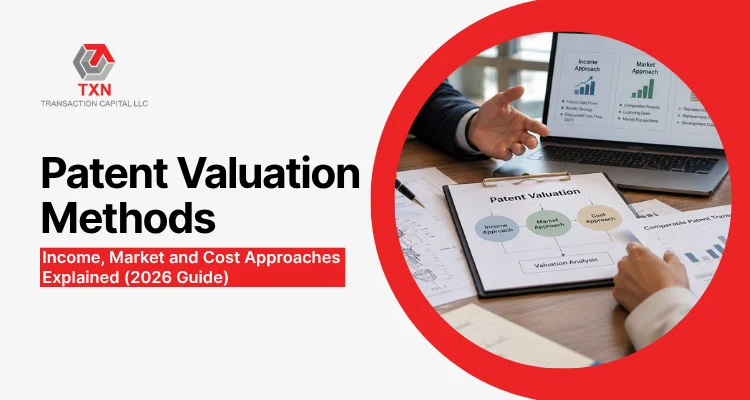
Three paths lead there. One looks ahead at future benefits. One looks at observed transactions. One asks what it would cost to build the same thing again.
The stakes keep rising. Ocean Tomo’s 2025 study found that intangible assets made up about 92% of S&P 500 market value by the end of 2025. In 1975, the share was just 17%. Patents sit at the heart of that shift.
This guide walks through each patent valuation method in plain terms. You will learn when to use it, where it breaks down, and how to pick the right one.
Transaction Capital LLC prepares this analysis for deals, audits, tax filings and disputes.
Need a Patent Value You Can Defend?
Our ABV®, ASA, CVA® and MRICS appraisers value patents for audits, deals and tax filings
Request a Flat-Fee Quote → Patent Valuation Methods: Key Takeaways
- Patents have no set price. Value rests on the benefits a patent is likely to deliver. The legal right alone adds no value. Nor does the money spent creating it.
- The field uses three approaches, set out in WIPO’s guidance on IP valuation. These are income (future benefits), market (comparable transactions) and cost (replacement economics).
- No one method fits every patent. The choice depends on the commercial maturity of the patent, the quality of the data, the purpose of the valuation, and the valuation date.
- Weak reports tend to fail the same way. Royalty rates lack support. Legal life gets used as economic life. The same profit gets split across more than one asset.
- Economic life is often shorter than the 20 year term. Forecasts should track the market, not the statute.
- Purpose drives it all. Fair value in a merger and damages in a court case are not the same question.
What Does Patent Valuation Actually Measure?
Patent valuation estimates the value of a patent, or a portfolio, at a specific date and for a specific purpose.
A patent lets its owner stop others from using an idea. That right runs for a fixed term. It is worth something only if it makes a buyer or a licensee want to pay.
Those benefits usually take one of five forms:
- Fees from a license, or fees you no longer pay out.
- Extra sales or a higher price per unit.
- Lower build or running costs.
- Protection of a market position from imitation.
- Leverage in a deal or a dispute.
Two things follow.
First, a granted patent with no real use can be worth very little. The grant is not the value.
Second, a patent with no revenue today can still be worth a lot. An early-stage pharmaceutical is the classic example. Buyers expect returns later, so value exists today.
The task is simple to state. Tie the legal right to cash flows that evidence can back.
What Factors Drive Patent Value?
Two patents in one industry can be worth very different amounts. These factors explain the difference:
- Claim breadth. Wide claims are hard to design around.
- Enforceability. A patent that holds up in review beats one with a questionable file history.
- Remaining term. A US patent runs 20 years from the first filing date. Less runway means less value.
- Jurisdiction coverage. A family filed in the US, Europe and China covers more revenue than one US filing.
- Maintenance status. US maintenance fees fall due at 3.5, 7.5 and 11.5 years. A lapsed patent protects nothing.
- Market size. A narrow claim in a huge market can beat a wide claim in a tiny one.
- Substitutes. If competitors have a cheap workaround, pricing power fades.
- Commercial proof. Revenue, licenses and adoption all lift confidence in the forecast.
Note the pattern. Legal strength and market pull both count. One without the other builds little value.
When Is a Patent Valuation Needed?
The purpose of the engagement sets the standard of value. It also sets how much evidence the file needs and which assumptions pass review.
| Situation | What the patent valuation supports |
| Business combination | Fair value of acquired technology under ASC 805 and IFRS 3 |
| Impairment testing | Carrying-value assessments for intangibles and goodwill |
| Licensing | Royalty rates, upfront fees, milestones and exclusivity terms |
| Intercompany transfers | Arm’s-length pricing of rights moved between related entities |
| Financing | Collateral or investment analysis for IP-heavy businesses |
| Disputes | Reasonable royalty or lost-profit analysis |
One warning counts here. Do not reuse a report built for one purpose on another without review.
A fair value figure for the books answers one question. A damages figure for litigation answers a second. The standards behind them are not the same.
Related work often sits beside these jobs, such as purchase price allocation under ASC 805 and transfer pricing IP valuation.
What Are the Three Patent Valuation Approaches?
Here is how the three stack up side by side.
| Patent Valuation Criteria | Income approach | Market approach | Cost approach |
| Core question | What benefits will the patent produce? | What have comparable rights sold or licensed for? | What would it cost to replace the patent’s utility? |
| Orientation | Forward-looking | Observed evidence | Input-based |
| Strongest when | Revenue, licensing or savings can be forecast | Genuine, arm’s-length comparables exist | Benefits cannot yet be isolated |
| Main weakness | Sensitive to assumptions | Patents are rarely truly comparable | Cost does not equal worth |
The three work as a set. Most appraisers lead with the one the evidence backs best. They then apply a second as a reasonableness test.
What Is the Income Approach to Patent Valuation?
The income approach treats value as the present value of the risk-adjusted benefits attributable to the patent.
The mechanics are simple. The hard part is deciding which benefits belong to the patent. The second is judging how uncertain those benefits are.
1. What Is the Relief-from-Royalty Method?
This is the most widely used income method for patents. It asks you to pretend you do not own the patent. You would then have to license the same rights from a third party.
Owning it wipes out that bill. The royalties avoided represent the benefit.
The analysis normally proceeds as follows:
- Forecast the revenue base that uses the patented technology.
- Select a market-supported royalty rate.
- Calculate the implied royalty for each period.
- Deduct tax at the appropriate rate.
- Determine the remaining economic life.
- Select a discount rate that reflects the risk of the royalty stream.
- Discount the after-tax savings and sum them. Add any tax amortization benefit if it applies.
The royalty rate and the revenue base move the answer most. A rate taken from a database without scrutiny is a frequent weakness.
Compare reference agreements on five criteria:
- Scope of rights, which covers exclusivity, territory and field of use.
- Technology maturity and regulatory status.
- Remaining term of protection.
- Profitability of the licensed product.
- How the royalty was structured alongside upfront or milestone payments.
A rate set for a proven, high-margin product tells you little about an untried one. Many appraisers also test the rate against the share of operating profit it implies. The royalty should stay fair next to what the product truly earns.
For a closer look at this method in a brand setting, see our guide to the relief-from-royalty method for trademarks.
Relief-from-Royalty: A Worked Patent Valuation Example
Numbers make this patent valuation method clear. Here is a short five year illustration.
| Input | Assumption |
| Year 1 revenue using the technology | $20 million |
| Annual growth | 10% |
| Royalty rate | 4% |
| Tax rate | 21% |
| Remaining economic life | 5 years |
| Discount rate | 18% |
Year 1 produces a royalty of $800,000. After tax, that is $632,000. Discount it one year and you get about $536,000.
Run the same steps for years two through five. The after-tax savings total about $3.2 million before discounting. Once you discount them, the value lands close to $2.1 million.
Now shift one assumption. Drop the rate to 3% and the conclusion falls by about a quarter. Cut the economic life to three years and it falls further.
That is why support for the rate and the life matters more than model detail.
2. How Does DCF Value a Patent?
A direct DCF fits when you can separate the patent’s cash flows from the rest of the business.
The forecast covers revenue or savings, operating costs, taxes, working capital and capital investment. You then discount at a rate that matches the risk.
Attribution is the central issue. Revenue rarely comes from one source. Patents, software, brand, customer relationships, distribution, equipment and people all play a part.
Give it all to the patent and you overstate value. Each asset that helps must earn a fair return first. Only what is left belongs to the patent.
Your choice of discount rate drives the answer, so read our guide on how a discount rate is built.
3. When Does the With-and-Without Method Fit?
This method runs two cases. One scenario includes the patent. The second does not, and assumes the next best realistic alternative.
The gap between the two cash flow streams shows what the patent adds.
It suits cases where the benefit is a clear cost saving or margin gain. A patented process that cuts unit cost is a good example. You compare it with the best unpatented alternative.
The hard part is building a credible “without” case. The alternatives must be commercially feasible. The time and expense of switching to them belong in the model too.
4. Should You Use MPEEM for a Patent?
MPEEM isolates the earnings of one primary intangible. It then deducts charges for the other assets that help produce them.
Appraisers apply it most often to customer relationships. It can still fit a patented technology that drives most of what a business earns.
Watch for one trap. When a few intangibles draw on one revenue stream, charging excess earnings to each one risks counting the same profit twice.
For most patent engagements, the three methods above provide a more direct route.
5. Where Do Option-Based Patent Valuation Methods Fit?
Some patents act more like a bet than a business. Think of a drug in early trials.
Option methods treat the patent as a call option. The owner may spend more later, but has no obligation to do so.
Binomial models and Monte Carlo simulation both appear here. They capture the value of waiting for better facts.
Use them with care. They need more assumptions. Auditors also question them more often than a plain income model.
Is Your Patent Value Built on Evidence or Guesswork?
We test each royalty rate, economic life and discount rate against market evidence.
Speak With a Certified Appraiser → How Does the Market Approach Value a Patent?
The market approach reads value from deals in comparable rights.
Evidence can come from patent sales, portfolio acquisitions, licenses, royalty agreements and milestone terms that are made public.
Its appeal is clear. It rests on what parties did, not on a forecast.
Its limit is comparability. Two patents in one sector can differ a lot in value. A 7 percent royalty on one drug license says little about the next. The products must sit at similar development stages. They must face similar markets, carry similar regulatory risk and transfer similar rights.
Under the comparable transaction method, the appraiser:
- Identifies candidate transactions from license databases, public filings and other sources.
- Checks that the parties were not linked and the terms were arm’s length.
- Analyzes price, royalty base, upfront and contingent payments, exclusivity, territory, remaining life and margins.
- Adjusts for material differences, or weights the evidence qualitatively.
- States how much weight the evidence should carry.
Where few comparables exist, use market evidence to back up the answer. Let a second approach drive it.
Terms made public are often incomplete. Side agreements and cross-licenses may never surface. Treat missing detail as a limit of the work.
When Does the Cost Approach to Patent Valuation Apply?
The cost approach asks what a buyer would spend today to create an asset of equivalent utility.
Typical components include:
- Research and development.
- Engineering labor.
- Prototyping and testing.
- Regulatory development.
- Patent filing and prosecution.
- Project management.
Some add an allowance for developer profit. Some add the time value of money during development.
Here is the catch. Historical expenditure is not the same as value. A business may spend heavily on technology with no market. Another may achieve a commercially important result at modest cost.
So the approach helps most with early-stage patents and supporting technology. It often sets a reference point rather than the final answer.
Reproduction Cost vs Replacement Cost: Which Applies?
- Reproduction cost is today’s cost of recreating an essentially identical asset.
- Replacement cost is today’s cost of building an asset with equivalent function, using modern methods.
Replacement cost tends to fit better in fast-moving fields. A smart buyer would not rebuild an old design. Not when the same capability can be built more cheaply today.
How Do Obsolescence Adjustments Work in Patent Valuation?
Estimated cost should be reduced for loss of utility. Three types apply:
- Functional obsolescence shows up when the technology works less well than what rivals now offer.
- Technological obsolescence shows up when newer solutions make it less useful to the market.
- Economic obsolescence comes from the outside. Weaker demand, new rules and poor industry margins all count.
Legal factors also matter. A patent close to the end of its useful cover is worth less than comparable technology with more cover left.
The same logic runs through intangible asset valuation work, not just patents.
Economic Life vs Legal Life: Which Drives Patent Value?
Legal life is the statutory term of protection. In the US, that is 20 years from the first filing date.
Economic life is the period over which the patent actually produces incremental benefits. The two often differ. Forecasts should track economic life.
A patent can stay in force long after the product it protects has been superseded. In software, semiconductors, AI and some medical devices, economic life can be a fraction of the legal term.
Five factors shorten economic life:
- The likely arrival of competing or substitute technology.
- Product refresh cycles.
- Regulatory or standards changes.
- Shifts in customer requirements.
- Planned discontinuation by the owner.
The flip side can happen too. A patent can remain commercially useful beyond its own expiry. Linked patents, know-how or regulatory exclusivity may still restrict competitors.
Base the life assumption on evidence from the product and the market. Do not fall back on the term left in the statute.
How to Choose the Right Patent Valuation Method
Match the patent valuation method to the asset and the evidence. This table shows the usual pairings.
| Patent profile | Usual starting point | Typical cross-check |
| Commercialized product with identifiable revenue | Relief-from-royalty | DCF or market royalties |
| Process patent that reduces costs | With-and-without | Relief-from-royalty |
| Patent already licensed to third parties | Income approach using actual license terms | Market approach |
| Pre-revenue or early-stage technology | Risk-adjusted income analysis | Cost approach |
| Supporting or defensive patent | Cost approach | Strategic or qualitative review |
Five questions drive the decision:
- How mature is the patent? It may be granted, in development, commercialized, licensed or approaching expiry.
- Can the benefits be isolated? If revenue or savings cannot be separated from other assets, income methods lose reliability.
- Is there credible comparable evidence? Genuine comparables add weight to the market approach.
- How long is the economic life? Short lives make timing and obsolescence much more important.
- What is the purpose and standard of value? The answer shapes assumptions, evidence and what will pass review.
How Is a Patent Portfolio Valued?
Most engagements cover a portfolio of patents, not one filing.
A patent portfolio valuation is rarely the sum of its parts. A few patents carry the revenue. Many only block competitors or add negotiating weight.
A practical approach runs in three steps:
- Sort the patents into core, supporting and dormant categories.
- Value the core ones with an income method.
- Treat the rest with a cost or qualitative review.
Watch for overlap. If two patents protect the same product, do not count the same profit twice.
How Is Patent Valuation Used in Deals, Licensing and Disputes?
How Are Patents Valued in a Business Combination (ASC 805 and IFRS 3)?
A buyer books identifiable intangible assets apart from goodwill when the recognition criteria are met. It books them at fair value.
For patented technology, the work tends to cover:
- Projected revenue.
- Royalty rates.
- Useful life.
- Expected technology migration.
- Discount rates and tax effects.
- Contributory asset charges.
- The views of a market participant, not the specific buyer.
The same revenue is often credited to technology, brands, customer relationships and workforce at once. So the split must tie back to the full price paid. It must also avoid double-counting.
Appraisers tend to cross-check the discount rates against two benchmarks. One is the transaction’s internal rate of return. The other is the weighted average cost of capital.
Work like this also feeds later goodwill impairment testing.
How Does Patent Valuation Support Licensing Negotiations?
Value depends on the rights actually granted.
A global exclusive license in a broad field is not the same as a non-exclusive one in a single country. The difference is material.
Upfront payments, running and minimum royalties, milestones, sublicensing rights and duration all affect the economics. Judge a royalty rate alongside the full deal structure, never on its own.
How Are Patents Valued in Infringement Disputes?
Patent valuation for litigation follows its own rules. Courts look for a reasonable royalty from a deal that never took place.
The 15 Georgia-Pacific factors remain the standard checklist. They cover comparable licenses, exclusivity, the relationship between the parties, and the profit the invention makes possible.
One shortcut is now unavailable. In Uniloc USA, Inc. v. Microsoft Corp. (2011), the Federal Circuit ruled that the “25 percent rule of thumb” was fundamentally flawed and inadmissible. Rates must tie to the facts of the case.
Apportionment is the other theme. Damages should reflect the patented feature, not the whole product, unless the facts back the wider base. Our litigation valuation services address these standards directly.
Which Patent Valuation Errors Weaken a Conclusion?
Most weak patent valuation reports fail for a handful of familiar reasons.
| Error | Why it matters |
| Treating development cost as value | Cost shows investment, not return |
| Using a royalty rate without comparability analysis | The result may rest on an unrepresentative benchmark |
| Assuming economic life equals legal life | Inflates the forecast period |
| Ignoring competing technology | A strong patent can still be commercially weak |
| Double-counting benefits | The same profit is credited to several assets |
| Accepting management forecasts untested | Optimism raises value without evidence |
| Applying the wrong standard of value | Fair value, investment value and damages differ |
| Using hindsight | Only information known or knowable at the valuation date belongs in the analysis |
Sensitivity testing exposes these weaknesses fast. Show how the conclusion moves with the royalty rate, the discount rate and the economic life. Readers then know how much confidence the result deserves.
How Does the Patent Valuation Process Work? 7 Steps
- Define the engagement. Fix the purpose, valuation date, subject asset and standard of value.
- Gather information. Collect patent records that cover claims, jurisdictions, ownership and expiry. Add product and market information, forecasts, existing licenses, and the technical and regulatory status. Early-stage assets depend heavily on technical and regulatory evidence, since little financial history exists.
- Analyze the market. Study demand, competition, substitutes and the path to market.
- Select the methods. Match them to the data and the purpose.
- Develop assumptions. Document support for each one: forecasts, royalty rates, life, obsolescence and discount rate.
- Calculate and test. Run the models and test sensitivity.
- Reconcile and report. Weigh the indications from each method. State the conclusion, scope, assumptions and limitations clearly.
The aim is not the most complex model. The aim is a conclusion where method, evidence and assumptions fit the economics of the patent and the purpose of the work.
What Documents Do You Need for a Patent Valuation?
Collect these before the engagement starts. It shortens the timeline:
- Patent grants, claims and file history.
- A list of jurisdictions and renewal status.
- Ownership and assignment records.
- Existing license or settlement agreements.
- Revenue data for products that use the technology.
- Forecasts and the assumptions behind them.
- Research and development expenditure records.
- Notes on rivals and substitute technology.
Looking Ahead: Patent Valuation Trends for 2026
Intangible assets keep taking a bigger share of enterprise value. The Ocean Tomo research makes that plain.
In AI and software, competition moves fast. Economic life then becomes the most sensitive assumption in the model.
In biotech, timelines run long and many projects fail. Careful probability weighting carries the work.
Two further shifts are worth watching. Auditors now press harder for royalty rate support. Buyers also look more closely at whether a patent family covers the markets that count.
How Do You Choose a Patent Valuation Specialist?
Some engagements call for an independent appraiser. Purchase price allocations, audited accounts, tax filings and court cases all qualify.
Firms such as TXN Capital LLC (txncapitalllc.com) list intangible and patent valuation among their services. Credentials often sought in this field are ABV®, ASA, CVA® and MRICS.
Whichever adviser you choose, ask for four things:
- A stated valuation date.
- A stated purpose and standard of value.
- Assumptions backed up in writing.
- A sensitivity test of the key assumptions.
If a provider cannot supply all four, the report may not hold up under review.
Ready to Put a Defensible Number on Your Patents?
Transaction Capital LLC delivers USPAP and SSVS compliant patent and intangible asset reports for audits, deals, tax filings and disputes.
Book a Free 15-Minute Consultation → Final Thoughts on Patent Valuation Methods
Patent valuation is an analysis of what an asset adds. Nothing more exotic than that.
The income approach measures future benefits. The market approach tests them against observed transactions. The cost approach shows what a rebuild takes.
A sound answer does four things well. It links the legal right to demonstrable economic benefit. It uses an economic life drawn from the market, not the statute. It counts no profit twice. And it writes down each assumption, so a reader can follow it and push back.
Get those four right and the number will hold. With an auditor, with the IRS, with a buyer, and in court.
Frequently Asked Questions About Patent Valuation
1. What is the best method for valuing a patent?
No method wins in every case. The choice depends on how mature the patent is, the information available, the benefits you expect, remaining economic life and the purpose of the valuation. Most appraisers lead with one approach and check it with a second.
2. Can a patent with no revenue be valued?
Yes. Value can be estimated from risk-adjusted benefits, from comparable transactions, or from what a rebuild would cost. The appropriate route depends on the facts and on how much evidence you hold.
3. Does development cost equal value?
No. Cost can feed a cost approach, but it does not set what the patent is worth. A large research and development budget with no demand creates little value.
4. What is the difference between fair value and litigation damages?
Fair value is what a buyer in the market would pay for the asset. Damages are what it takes to make good a harm under a legal test. They use different assumptions and should not stand in for one another.
5. How long is a patent valuation valid?
There is no fixed shelf life. Most reports get a refresh when a material event occurs, such as a new license, a funding round, a sale or a change in the technology. Financial reporting and tax filings usually need a value close to the date in question.
6. How much does a patent valuation cost?
Fees depend on scope, portfolio size, the purpose and how much audit support you need. A single patent with clear revenue information costs far less than a large portfolio in a contested transaction. Transaction Capital LLC quotes a flat fee before work starts.
7. Who should perform a patent valuation?
An independent appraiser who holds a recognized credential such as ABV®, ASA, CVA® and MRICS. Independence matters when the report goes to an auditor, the IRS or a court. Internal estimates rarely satisfy those reviewers.
About Transaction Capital LLC
Transaction Capital LLC (TXN Capital LLC) is an independent valuation firm based in Wilmington, Delaware. The firm serves clients across all 50 states and more than 35 industries.
Work spans patent and intangible asset valuation, purchase price allocation, 409A valuations, business valuation, gift and estate tax valuation, and litigation support. Reports follow USPAP, SSVS and NACVA standards. They are signed by ABV®, ASA, CVA® and MRICS holders.
Note: This article is for general information only. It is not legal, tax or accounting advice. Patent valuation outcomes depend on the facts of each engagement. Please consult a qualified adviser about your specific situation.