ROBS 401(k) Valuation: Annual Fair Market Value and Form 5500 Reporting in 2026
 Dr. Gaurav B. (ABV®, ASA, CVA®, MRICS)
on
Dr. Gaurav B. (ABV®, ASA, CVA®, MRICS)
on
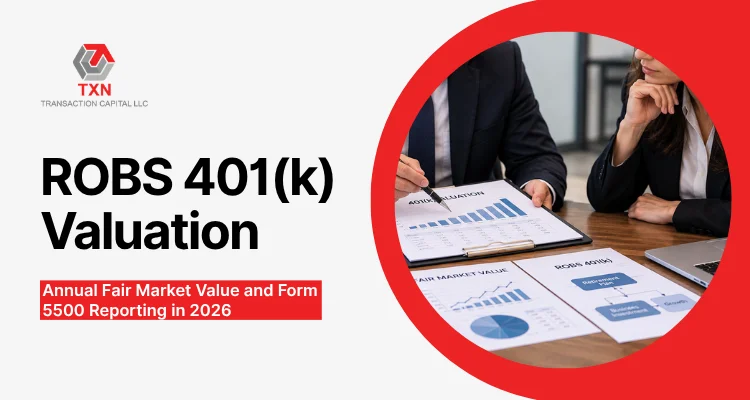

Dr. Gaurav B.
Founder & Principal Valuer, Transaction Capital LLC
Specialist in IRS-Compliant 409A & Complex Valuation Matters
Dr. Gaurav B. is the Founder and Principal Valuer of Transaction Capital LLC, a valuation and financial advisory firm providing independent, standards-based valuation opinions for startups, growth-stage companies, and established enterprises.
What Is a ROBS 401(k) Valuation and Why Does It Matter Every Year?
A ROBS 401(k) valuation is a written estimate of what your plan’s stock is worth on one date. A Rollover as Business Start-Up (ROBS) lets you move eligible retirement savings into a new 401(k) plan. The plan then buys stock in a C corporation that runs your business. No tax is due at the rollover. But the plan now owns shares that no exchange prices.
Someone must set what those shares are worth each year. That number shapes plan reports and fiduciary risk. It also decides how the setup holds up in a review.
This guide shows how the yearly fair market value (FMV) process works for ROBS plans. You will see how it ties to Form 5500. You will also learn what a sound valuation needs and how to pick an appraiser. Transaction Capital LLC (TXN Capital LLC) is an independent valuation firm. Its ABV®, ASA, CVA®, and MRICS professionals prepare these ROBS business valuations for plan sponsors.
ROBS 401(k) Valuation: Key Takeaways
- A ROBS plan owns private C corporation stock. That stock needs a fair market value each plan year.
- Plan assets are shown at current value, not cost. The purchase price only proves value on day one.
- Form 5500 asks for year-end asset values. For a ROBS plan, the stock is often the main entry.
- No blanket rule demands an outside appraisal each year. Still, an outside value is the safer path when the sponsor also owns the business.
- Each value ties to one date. For yearly reports, that is often plan year-end, such as December 31, 2026.
- Appraisers weigh the income, market, and asset approaches. They then bridge from firm value to the plan’s shares.
- Discounts for lack of control or sale ease are never automatic. Each needs a clear reason.
- A calendar-year plan’s Form 5500 series return is due July 31. Start once the year-end books close.
- A report shows value. It does not prove the ROBS setup follows the tax code or ERISA.
Need a Supportable Year-End Value for Your ROBS Plan?
Speak with an ABV®, ASA, or CVA® certified appraiser about the employer stock your plan holds.
[Get a Free 15-Minute Consultation →] Why a ROBS Plan Has a Valuation Obligation
A typical ROBS setup has four steps. The owner forms a C corporation. The corporation adopts a 401(k) plan. The owner rolls pre-tax savings into that plan. The plan then buys new stock. The corporation uses the cash to start or buy a business.
After that buy, employer stock may be the plan’s biggest asset. Sometimes it is the only one. In a normal 401(k), each holding has a daily price. Here, the holding is a minority or majority stake in a private business. It has no quoted price and no regular trades. Often there is no recent outside sale, either.
Plan assets are shown at current value, not at cost. The purchase price is good proof of value on the day of the purchase. Each year after that, the number must reflect how the business is really doing.
What the Rules Require
Several sets of rules apply here. People often blur them together. Taking them one at a time helps.
How Does Current Value Reporting Work?
Defined contribution plans must value their assets at least once a year. They must use a method that is applied the same way each time. The Form 5500 series asks for year-end asset values. For a ROBS plan, the stock is often the main entry.
According to the Form 5500 instructions, current value means fair market value where it is known. The instructions also say most assets do not need an outside appraiser each year. That point matters for the appraisal question below.
What Does ERISA Say About Adequate Consideration?
For an asset with no known market, ERISA §3(18) treats adequate consideration as a price set in good faith. The plan’s trustee or named fiduciary sets it. Good faith takes more than picking a number. It calls for a wise process, sound data, and a reasoned result.
How Do the Prohibited Transaction Rules Apply?
A plan that buys employer stock from or through a disqualified person raises issues under IRC §4975 and ERISA §406. ERISA §408(e) offers an exemption for buying qualifying employer securities at adequate consideration. That is why the first price, and each later value, needs written support.
What Has the IRS Said About ROBS Plans?
The IRS has said in public that ROBS setups are not automatically abusive. It has also said they raise real compliance questions. In its ROBS compliance project, it checked three things. Was the stock valued well? Did the plan act like a real plan? Were the needed returns filed? The IRS also posted ROBS guidelines for its examiners.
The agency has also hinted at a limit. ROBS plans often cannot use the small one-participant plan exception from Form 5500 filing. Check the current view with the plan’s ERISA counsel or third-party administrator (TPA).
Is an Independent Appraisal Mandatory Every Year?
Not as a blanket rule. The reporting rules call for a current value. They do not always call for an outside firm to set it.
In practice, though, the risk differs. A fiduciary who reports a private stake from an in-house guess takes on more risk. One who holds a written outside value takes on less. In a ROBS plan, the stock is the core asset and the sponsor also owns the business. So being outside and neutral has real weight.
When Does a ROBS Plan Need a Valuation Besides the Annual Report?
The yearly value is the most common one. It is not the only one. Several events can call for a fresh, written value.
Initial Valuation
Say you fund an existing business through a ROBS. This is often called a recap. The plan buys stock in a business that already has value. A value check helps show the price paid was fair. Check the exact rule with ERISA counsel and your TPA.
Annual Valuation
The value of the stock must be shown on the yearly Form 5500 series return. This routine step is the focus of this guide.
One-Time Valuations
Some events need a value on their own clock. These include:
- Added plan money put into the stock.
- A stock buyback, also called a redemption.
- Plan distributions, like required minimum distributions.
- A plan termination or ROBS unwind.
- A sale of the business.
Each event moves stock or cash between the plan, the owner, and the business. That is where related-party risk sits. Get a current value before you act, not after.
Defining Fair Market Value
Fair market value is the price a willing buyer would pay a willing seller. Neither is forced to act. Both know the facts.
The IRS has long-held rules on closely held stock. Revenue Ruling 59-60 lists the factors appraisers weigh:
- The nature and history of the business.
- General economic and industry outlook.
- Book value and financial condition.
- Earning capacity.
- Dividend-paying capacity.
- Goodwill and other intangibles.
- Prior sales of the stock and the size of the block being valued.
- Prices of similar public firms.
Those factors still guide most private-business work. Revenue Ruling 59-60 was written for estate and gift tax. Even so, appraisers use it widely, even for 401(k) plan assets.
Two terms are worth knowing. The standard of value is the kind of value being measured, here fair market value. The premise of value is the view of the business, either a going concern or a sale of assets. Good reports state both.
The Valuation Date
Each valuation must be tied to one date. For yearly ROBS reports, that date is often the plan year-end, such as December 31, 2026.
The work should reflect what was known on that date, or could be known. Say a top customer gave notice in February 2027. Whether that hits a December 31, 2026 value depends on whether the risk was clear at year-end.
Appraisers do not use hindsight. They should also never re-date last year’s report and copy its result. Each year’s work must show what changed.
The Three Valuation Approaches
Professional standards call for weighing three approaches. One example is AICPA Statement on Standards for Valuation Services No. 1 (SSVS No. 1). The approaches are income, market, and asset. The appraiser may rely on one or blend several.
1. Income Approach
The income approach sets value by the cash the business should earn. A discounted cash flow (DCF) model maps out future free cash flow. It then discounts that cash at a rate that shows the risk of getting it.
For a mature business with steady profit, one normalized earnings figure may work better. The result is only as sound as the inputs. A detailed model built on weak growth guesses looks precise but is not accurate. Reviewers test forecasts against past results, backlog, and industry data.
2. Market Approach
The market approach looks at prices paid for similar businesses. It uses public trading multiples or closed private deals. Common measures are enterprise value to revenue, enterprise value to EBITDA, and price to earnings.
Small private firms differ from public comparables in several ways. Size, range, staff depth, access to cash, and customer mix all vary. Multiples must be adjusted with those gaps in mind. Using a public multiple with no change is a common flaw in weak reports.
3. Asset Approach
The asset approach restates assets and debts to fair value. It then finds the gap. It suits holding firms, real estate entities, and businesses whose profits do not support a value above their assets. It is also the usual fallback for a firm that loses money but holds real assets.
Book value and FMV are not the same. Equipment can be worth more or less than its cost after wear. Brand and know-how built in-house may show no value on the balance sheet at all.
What Is Normalized EBITDA and Why Does It Matter?
EBITDA means earnings before interest, taxes, depreciation, and amortization. Appraisers “normalize” it. They remove one-time items and reset owner pay to a market level. The result shows what the business earns in a normal year.
Owner-run firms need this step most. An owner may pay themselves far above or below market rates. Personal costs may also run through the books. A multiple applied to raw EBITDA can then overstate or understate value.
Income vs. Market vs. Asset Approach: Comparison Table
| Approach | What it measures | Best fit for a ROBS company | Common weakness |
| Income (DCF or capitalized earnings) | Present value of expected cash flow | Stable or growing business with credible forecasts | Speculative projections and unsupported discount rates |
| Market | Prices paid for similar companies | Industries with reliable comparable data | Public multiples used with no adjustment |
| Asset | Assets minus liabilities at fair value | Start-ups, asset-heavy or low-earning companies | Copying book value with no adjustment |
Want an Audit-Ready ROBS Valuation in 2-5 Business Days?
Our ABV®, ASA, CVA®, and MRICS professionals prepare reports under USPAP, SSVS, and NACVA standards.
[Request a ROBS Valuation Quote →] From Enterprise Value to the Plan’s Shares
The methods above often produce a value for the whole operating business. The plan, but, owns shares. So the next step is a bridge from enterprise value to the value of the plan’s stake.
Here is a worked example. The numbers are made up.
A ROBS plan put $350,000 into Northline Logistics Inc. three years ago. It now holds 80% of the firm’s single class of common stock. At December 31, 2026:
| Item | Amount |
| Revenue | $2,800,000 |
| Normalized EBITDA | $420,000 |
| Selected EV/EBITDA multiple | 4.0x |
| Indicated enterprise value | $1,680,000 |
| Less: interest-bearing debt | ($250,000) |
| Add: excess cash | $120,000 |
| Indicated equity value | $1,550,000 |
| Plan’s 80% pro rata share | $1,240,000 |
The $350,000 first stake plainly is not close to FMV here. Say the business had lost customers and taken on debt. The figure could just as easily fall below cost. Either way, the value shown should follow from the facts.
Before calling $1,240,000 final, the appraiser would test for changes. These cover the plan’s control and marketability. They also cover whether all shares carry the same rights.
Discounts Are Not Automatic
A discount for lack of marketability (DLOM) reflects how hard it is to sell a stake with no ready market. Whether it applies depends on a few points. So does its size:
- The level of value already set.
- Transfer restrictions on the shares.
- The expected holding period.
- Odds of a sale or exit.
A discount for lack of control depends on what the plan’s shares let it do. A plan with 80% of the votes has more power than one with 30%. Reports that use a stock percentage with no reason invite challenge.
Preferred Stock and Complex Capital Structures
Say the business later issues preferred stock, options, warrants, or convertible notes. The price a new investor pays does not set the value of the plan’s common shares. Preferred holders often get payout priority, the right to convert, or shield from dilution.
So total equity value must be split across the classes first. Only then can the plan’s stake be valued. Appraisers often use a payout waterfall or an option-pricing model for this step.
When the Company Is Losing Money
Losses do not mean the stock is worthless. A young business may be spending to grow. An older one may face a short dip. An asset-rich one may hold real value despite weak profit.
The appraiser should find out why the business is losing money. Methods should then fit those facts. Steady losses can push value far below what the plan put in. So can thin working capital, heavy debt, or falling demand.
Information a Valuation Requires
The result is only as good as the data. A typical yearly ROBS job needs:
- Formation documents, ownership records, and the cap table.
- ROBS plan documents and the original stock purchase records.
- Prior reports.
- Three or more years of financial statements and tax returns, plus recent interim statements.
- Debt schedules and details of any open options, warrants, or convertibles.
- Management forecasts, if they exist.
- Customer and supplier mix data and key contracts.
- Details on lawsuits or contingent debts.
- A summary of significant events since the last report.
Franchise deals and leases also help. So does a clear note on owner pay. Missing or mismatched records are a top reason these jobs run late. A cap table that does not match the plan’s share count is a classic case.
What a Supportable Report Contains
A reviewer should be able to follow the work without calling the appraiser. Reviewers may be plan auditors, CPAs, lawyers, or agency staff. A sound report states:
- The purpose and intended use of the report.
- The exact interest valued and the valuation date.
- The standard of value (fair market value) and the premise (going concern or liquidation).
- Business and industry background, and the economy at the value date.
- Past financial results and normalizing changes.
- The approaches considered, those applied, and the reasons for excluding any.
- Support for the discount rate or multiple, with peer data.
- How the results were blended, and the bridge from enterprise to equity value.
- Any adjustments set to the plan’s interest.
- Assumptions, limiting conditions, and the appraiser’s certification.
Length is not the goal. The reader should see how each result ties to its proof.
Timing and Filing Considerations
For a calendar-year plan, the Form 5500 series return is due seven months after year-end. That date is July 31. Form 5558 can extend it by two and a half months. July 31, 2027 falls on a Saturday, so the due date rolls to the next business day. Check the exact date with your administrator.
Late filing can bring large IRS penalties. The IRS can charge $250 per day, up to $150,000 per plan year, for a late return. The Department of Labor has its own penalties. Amounts change, so check latest figures with your plan administrator.
Many sponsors start only weeks before the deadline. That is a mistake. Data gaps, mismatches, and odd deals take time to fix. A rushed value is rarely a good one. Begin as soon as the year-end books are closed.
Full Appraisal or Update: Which One Fits?
| Situation | Usual scope |
| First annual valuation after ROBS setup | Full appraisal |
| Major growth, losses, or ownership change | Full appraisal |
| Redemption, sale, or plan termination ahead | Full appraisal, with counsel and TPA input |
| Stable operations and a strong prior report | Documented update with current financials |
Even an update needs support. “Nothing changed” is rarely enough unless the records show it.
Common ROBS Valuation Mistakes
- Carrying the first stake forward year after year.
- Treating book value as fair market value.
- Re-dating the prior year’s report without updating the facts.
- Ignoring debt, extra cash, or gaps in capital structure.
- Using a preferred financing price as the value of common stock.
- Relying on forecasts the business cannot back up.
- Applying marketability or control discounts with no stated reason.
- Treating the value as a filing chore, not a year-end fiduciary record.
Two more shortcuts deserve a warning. One is reporting zero because the business lost money. The other is using a number from a promoter with no outside check. Both are hard to defend.
Ready to Replace Guesswork With a Defensible ROBS Value?
Get an outside value from appraisers who price private stock held by 401(k) plans.
[Speak With a Certified Appraiser →] Selecting a Valuation Professional
No one credential fits every job. Reviewers often look at four things. First, skill in valuing private businesses. Second, know-how with employer stock held by 401(k) plans. Third, distance from the sponsor. Fourth, the skill to write a clear report that meets professional standards.
Well-known credentials for valuing a business include:
- ABV® (Accredited in Business Valuation), issued by the AICPA.
- ASA (Accredited Senior Appraiser), issued by the American Society of Appraisers.
- CVA® (Certified Valuation Analyst), issued by NACVA.
- MRICS, membership of the Royal Institution of Chartered Surveyors.
Common standards include USPAP, AICPA SSVS No. 1, the NACVA Professional Standards, and International Valuation Standards.
What Questions Should You Ask a ROBS Valuation Provider?
- Who signs the report, and what credentials do they hold?
- Have you valued employer stock held by 401(k) plans before?
- Can I see a sample report structure?
- How do you stay neutral toward the plan sponsor?
- What is your turnaround time, and what does the fee include?
- Will you support questions from my auditor, TPA, or the IRS later?
Transaction Capital LLC is an independent valuation firm. It values private businesses, including employer stock held by ROBS 401(k) plans. Its professionals hold the ABV®, ASA, CVA®, and MRICS designations. The firm states that it has completed more than 2,500 jobs across more than 35 industries. Turnaround is often 2-5 business days.
Reports follow known standards and are signed by credentialed appraisers. The approach fits the business’s health, capital structure, and the rights of the shares the plan holds. As with any provider, ask for a sample report layout. Confirm credentials with the groups that issue them. Also check that the appraiser knows your industry.
An outside appraisal also has limits. It records value. It does not prove that the ROBS setup meets the Internal Revenue Code or ERISA. Plan eligibility, nondiscrimination tests, prohibited-transaction checks, and filings need their own review. Qualified tax and retirement plan advisors should do it. For the tax side of the structure, see our guide on ROBS rollovers and Sections 351 and 367.
Conclusion
A ROBS plan holds private stock, and private stock has no year-end price unless someone sets one. That duty falls on the plan’s fiduciaries. The shown figure should rest on a defined valuation date and current financial data. It should use fitting methods and a clear bridge from enterprise value to the plan’s shares. It also needs enough records for an outside reader to follow the logic.
Sponsors who treat the ROBS 401(k) valuation as a routine year-end record tend to fare better. They start early and back it with an outside professional. Those who rebuild it after a question comes up are in a weaker spot. Transaction Capital LLC can help you put that record in place.
Frequently Asked Questions
1. Does a ROBS 401(k) need a valuation every year?
Plan assets must be shown at current value each year. For privately held employer stock, that means a documented, sound process for finding FMV as of the plan year-end. Ask your TPA to confirm the details for your plan.
2. Is an independent appraisal required annually?
There is no universal rule that demands an outside appraisal of each hard-to-value asset each year. Employer stock is often the plan’s principal asset. For that reason, most advisors treat an outside value as wise support.
3. Can we keep reporting the original investment amount?
Only if the proof shows the value has not changed, which is odd. Operating results, debt, cash, and market conditions all move value over time. Carrying cost forward is a common mistake.
4. What valuation date should be used?
Usually the plan year-end, such as December 31. Confirm this against the plan document.
5. Can a loss-making company still have value?
Yes. Assets, expected cash flows, and the reasons for the losses all matter. A supported analysis, not a slogan, should drive the number.
6. Does a recent funding round set FMV?
It is useful proof. But the rights attached to the securities sold must be weighed first, mainly for preferred stock. Only then can the price inform the value of common shares.
7. What happens if a ROBS plan skips the annual valuation?
Skipping it can leave plan records and Form 5500 values without support. It can also raise fiduciary questions. The IRS, the DOL, a TPA, or an auditor may ask how the stock value was set. Talk to your advisors promptly if a year was missed, since options may exist.
8. How much does a ROBS valuation cost?
Cost depends on the firm’s size, records, and capital structure. Some providers publish entry prices under $500 for simple reports, and complex structures cost more. Ask for a written scope and fee before you begin.
9. Can one valuation serve the annual report, a sale, and an SBA loan?
Sometimes, but the use and date matter. A report built for plan filings may not satisfy a lender or buyer as written. Ask the appraiser whether it can be updated or expanded for the new purpose.
About Transaction Capital LLC
Transaction Capital LLC (TXN Capital LLC) is an independent valuation firm in Wilmington, Delaware. It serves clients in all 50 states. Its ABV®, ASA, CVA®, and MRICS professionals have done more than 2,500 valuations across more than 35 industries. Services cover 409A, business, and ROBS stock valuations.
This article is for general purposes only. It is not legal, tax, or investment advice. ROBS arrangements involve complex rules, so ask qualified ERISA counsel, a CPA, and your TPA about your own facts.