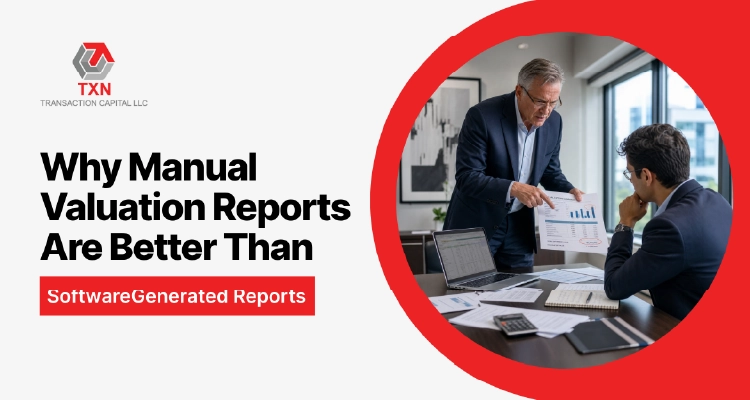
Why Manual Valuation Reports Are Better Than Software-Generated Reports
 Dr. Gaurav B. (ABV®, ASA, CVA®, MRICS)
on
Dr. Gaurav B. (ABV®, ASA, CVA®, MRICS)
on

Dr. Gaurav B.
Founder & Principal Valuer, Transaction Capital LLC
Specialist in IRS-Compliant 409A & Complex Valuation Matters
Dr. Gaurav B. is the Founder and Principal Valuer of Transaction Capital LLC, a valuation and financial advisory firm providing independent, standards-based valuation opinions for startups, growth-stage companies, and established enterprises.
In today’s market, many companies consider automated valuation tools because they are fast and low-cost. The appeal is understandable – instant outputs, minimal effort, and a price point that seems hard to argue with.
But when a valuation is required for tax, regulatory, or financial reporting purposes, speed and cost are secondary concerns.
Accuracy alone is not enough.
Compliance, documentation, and professional judgment are equally critical – and often, they are what determine whether a report holds up or falls apart.
A valuation is not just a calculation. It is a professional opinion that must meet established standards such as USPAP, International Valuation Standards (IVS), and guidance under Revenue Ruling 59-60.
It must be prepared by a qualified professional, documented with sufficient depth, and structured to withstand scrutiny from the IRS, auditors, investors, and legal counsel.
At Transaction Capital LLC, we emphasize manual, expert-led valuation reports because they are designed to be defensible, compliant, and audit-ready – not just numerically reasonable on the surface.
The Core Limitation of Automated Valuation Tools
Automated valuation tools rely on predefined models and standard inputs such as revenue, growth rates, and industry multiples. While this may produce a quick estimate that looks convincing, it does not reflect the complexity of real-world businesses or the nuance required for compliance purposes.
These tools generally fail to capture:
- Company-specific risks and uncertainties that materially affect value
- Complex capital structures, including SAFEs, preferred shares, and liquidation rights
- Lack of financial history in early-stage or pre-revenue companies
- Industry-specific dynamics, market cycles, and execution risk
As a result, the output may appear precise but lacks analytical depth and professional reliability. When that output is submitted for IRS review, presented to an auditor, or used in a legal proceeding, it often fails to hold up – leaving companies exposed to penalties, restatements, or the cost of redoing the valuation entirely.
Why Manual Valuation is More Reliable
1. Compliance with Recognized Valuation Standards
A professionally prepared valuation is conducted in accordance with recognized frameworks that define how valuations must be structured, documented, and concluded. These include:
- USPAP – Uniform Standards of Professional Appraisal Practice
- IVS – International Valuation Standards
- Revenue Ruling 59-60 – The foundational IRS guidance for valuing closely held business interests
These frameworks require proper analysis of both financial and non-financial factors:
- Careful consideration of economic and industry conditions
- Application of the most appropriate valuation methods for the circumstances
- Clear documentation supporting each conclusion
Automated tools typically do not meet these requirements in any comprehensive manner. They may apply a methodology, but they cannot document the judgment behind it – and that documentation is precisely what regulators and auditors look for.
2. Qualified Valuation Professional Requirement
For tax-related valuations – including 409A, gift tax and estate tax – the IRS expects the valuation to be performed by a qualified appraiser. A qualified appraiser generally has:
- Relevant professional credentials such as ABV, ASA, CVA, or MRICS
- Demonstrated experience conducting business valuations
- Independence from the subject company
- Working knowledge of established valuation methodologies and professional standards
Software tools do not meet the definition of a qualified appraiser.
They cannot provide the same level of credibility, professional accountability, or regulatory compliance – regardless of how sophisticated their models may appear.
Beyond credentials, a professionally prepared valuation report must include specific mandatory sections that automated outputs consistently omit:
- Independence and Compliance Statement – confirming the valuer has no financial interest in the outcome
- Management Representations – documenting that key inputs were provided by management and accepted in good faith
- Valuer Qualifications and Credentials – establishing the professional standing of the individual responsible for the conclusion
- Signature of the Qualified Valuation Professional – the formal act of professional accountability
These sections are not formalities. They establish the independence of the valuer, the reliability of information used in the analysis, and the professional accountability of the person issuing the report. Without them, the valuation may not be considered compliant or defensible for IRS, audit, or legal purposes.
3. Professional Judgment and Analytical Depth
Valuation is not a mechanical process. It involves significant professional judgment at every stage of the engagement, including:
- Assessing the reliability and reasonableness of financial projections
- Selecting appropriate valuation methodologies based on the facts of the case
- Determining discount rates and risk premiums specific to the company and industry
- Evaluating the quality and relevance of market comparables
Two companies with nearly identical financial metrics can arrive at very different valuations based on their risk profile, management quality, customer concentration, competitive position, and growth visibility.
This level of contextual analysis – built on professional experience and judgment – simply cannot be replicated through automated models. A software tool inputs variables and applies a formula. A qualified professional interprets the business behind the numbers.
4. Proper Method Selection and Application
Under recognized standards such as USPAP and IVS, a valuer is required to determine the most appropriate valuation approach based on the specific facts and purpose of the engagement. In some situations, certain methodologies may not be applicable at all – and applying them would produce a misleading or non-compliant result.
A qualified professional has the training and judgment to make those determinations on a case-by-case basis.
Automated tools, by contrast, typically apply a fixed or default methodology regardless of whether it is suitable for the business to be valued. This rigidity is not just an analytical limitation – it can be a compliance failure.
5. Detailed Documentation and Disclosures
A compliant valuation report is a comprehensive document that includes:
- Scope of work – what was analyzed and why
- Purpose of valuation – the intended use and standard of value applied
- Methodology and assumptions – how the value was derived and on what basis
- Limiting conditions and disclaimers – important constraints on the conclusion
- Sources of information – data relied upon in the analysis
- Valuer qualifications and independence disclosure – the professional credentials and objectivity of the analyst
Each of these elements serves a purpose. Together, they create a record that auditors, tax authorities, investors, and legal professionals can review and rely upon with confidence.
Automated reports typically provide limited explanation, minimal supporting documentation, and lack of the depth of disclosure required under professional standards. When challenged, they have little to stand on.
6. Audit and Regulatory Defensibility
Valuation reports are routinely reviewed by auditors, tax authorities, investors, and legal professionals – often in high-stakes situations where the conclusions are directly challenged. A manual valuation report is structured to meet that challenge by:
- Clearly explaining the assumptions underlying the valuation
- Providing supporting evidence and data for each conclusion
- Demonstrating consistency with recognized valuation standards
- Establishing the professional credibility of the person who signed the report
Software-generated outputs frequently fail under scrutiny because they cannot adequately explain how the value was derived or justify the assumptions that drove the result.
When an auditor or IRS examiner asks “why,” the report must provide a defensible, well-documented answer. Automated outputs rarely can.
Risks of Relying Only on Software
Using automated tools for official valuation purposes carries real and significant risks:
- Non-compliance with IRS requirements, resulting in the valuation being rejected outright
- Incorrect Fair Market Value conclusions that misrepresent the true value of the business or its equity
- Audit challenges or rejection by auditors who find the methodology or documentation insufficient
- Mispricing of equity or stock options, creating legal and tax exposure for founders and employees
- Tax penalties and interest arising from an understated or unsupported valuation conclusion
In many cases, companies that rely on automated tools for official purposes are required to commission a new valuation from a qualified professional – often under time pressure and at a higher cost than the original engagement would have required.
When Automated Tools May Be Used
Automated valuation tools are not without value. They can be appropriate for:
- Internal estimates and preliminary financial analysis
- Early-stage planning where precision is not critical
- Quickly benchmarking value ranges before engaging a professional
However, they should not be relied upon for:
- IRS filings or 409A compliance
- Financial reporting under ASC 805, ASC 820, or ASC 350
- Legal, dispute, or litigation-related valuations
- Gift and estate tax planning and compliance
When the stakes are high – legally, financially, or regulatorily – the risk of relying on software alone is simply not worth taking.
Final Thoughts
A valuation is not just a number. It is a well-supported professional conclusion built on analysis, judgment, and strict compliance with established standards.
When a valuation is being used for tax, regulatory, or investor purposes, it must be prepared by a qualified professional, supported by proper documentation, and fully aligned with frameworks such as USPAP, IVS, and IRS guidance. Cutting corners at this stage – in favor of speed or cost savings – often results in greater expense, greater risk, and greater disruption down the line.
This is why companies across industries rely on Transaction Capital LLC. Every valuation we prepare is tailored to the specific facts and circumstances of the business, conducted by credentialed professionals with real-world expertise, and built to withstand scrutiny – from auditors, investors, and regulators alike.
If you need a valuation that is accurate, compliant, and defensible, we are ready to help. Request a Free Consultation
Frequently Asked Questions
1. What is the main difference between manual and automated reporting?
Manual reporting involves human-driven data analysis and report creation, while automated reporting uses software to generate reports automatically based on predefined rules.
2. Which reporting method is better for financial valuation?
Manual reporting is better for valuation because it involves professional judgment, compliance, and detailed analysis.
3. Can automated reporting replace manual reporting completely?
No. Automation can support reporting processes, but it cannot replace human expertise, especially in complex or regulatory scenarios.
4. Is manual reporting outdated in 2026?
Not at all. While automation has improved efficiency, manual reporting remains essential for high-stakes and compliance-driven tasks.
5. What are the risks of relying on automated reporting?
The main risks include lack of flexibility, poor contextual understanding, and potential compliance issues.
6. Why is professional judgment important in reporting?
Because data alone cannot capture real-world complexities. Professional judgment ensures that reports reflect accurate and meaningful insights.