Goodwill Impairment FAQs: Key Questions That Impact Business Valuation
 Dr. Gaurav B. (ABV®, ASA, CVA®, MRICS)
on
Dr. Gaurav B. (ABV®, ASA, CVA®, MRICS)
on

Dr. Gaurav B.
Founder & Principal Valuer, Transaction Capital LLC
Specialist in IRS-Compliant 409A & Complex Valuation Matters
Dr. Gaurav B. is the Founder and Principal Valuer of Transaction Capital LLC, a valuation and financial advisory firm providing independent, standards-based valuation opinions for startups, growth-stage companies, and established enterprises.
Goodwill impairment can silently drain your company’s perceived worth, raise red flags during audits, and rattle the confidence of investors-often striking when you are least prepared for it.
Whether you are a CFO managing financial reporting obligations, a startup founder preparing for your next funding round, or a business owner navigating a post-acquisition environment, understanding how goodwill impairment testing intersects with your overall business valuation is not optional-it’s essential for long-term financial stability and regulatory compliance.
This in-depth FAQ guide tackles the most critical questions about goodwill impairment in 2026, delivering actionable answers that protect your balance sheet and keep your valuation defensible.
What Is Goodwill and Why Does It Matter for Your Business?
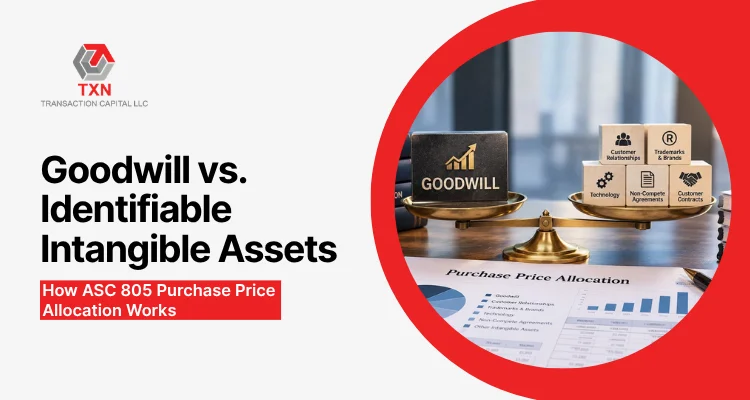
Goodwill is the premium an acquirer pays for a business beyond the fair value of its identifiable net assets. It’s an intangible asset-invisible on a factory floor but very real on a balance sheet-representing factors like brand strength, customer loyalty, proprietary technology, skilled workforce, and anticipated synergies that make a company worth more than its physical books suggest.
Practical example: Suppose Company A acquires Company B for $10 million. If B’s identifiable net assets-equipment, receivables, inventory minus liabilities-are independently worth $7 million, the remaining $3 million gets recorded as goodwill on A’s consolidated balance sheet.
What makes goodwill uniquely complex is that it doesn’t depreciate the way a piece of machinery does. Under U.S. GAAP (ASC 350), public companies cannot amortize goodwill-they must instead subject it to annual impairment testing to confirm the recorded value still reflects economic reality.
Private companies, however, may elect an accounting alternative under ASU 2014-02, allowing them to amortize goodwill on a straight-line basis over a period of up to 10 years and test at the entity level rather than the reporting unit level.
Ignoring goodwill health is a costly mistake. Investors, lenders, and acquirers scrutinize goodwill balances closely oversized or unreviewed goodwill signals poor acquisition discipline and can suppress your company’s exit valuation.
How Does Goodwill Impairment Impact Your Company’s Financial Health?
Goodwill impairment occurs when the fair value of recorded goodwill falls below its carrying amount on the balance sheet, forcing a non-cash write-down that flows directly through the income statement.
The consequences ripple further than most executives anticipate:
- Reduced net income: Even though impairment is a non-cash charge, it depresses reported earnings-affecting EPS, executive compensation metrics tied to profitability, and market sentiment.
- Compressed asset base: Total assets shrink when goodwill is written down, altering debt-to-asset ratios and potentially violating loan covenants.
- Degraded valuation multiples: EV/EBITDA, P/E, and other commonly used valuation ratios can deteriorate when impairment signals deeper operational issues.
- Investor perception damage: Repeated or large-scale impairments telegraph poor acquisition judgment or failure to realize anticipated synergies-a story no CFO wants to tell during a fundraise or exit process.
U.S. public companies recorded goodwill impairment charges totaling approximately $67.5 billion, underscoring how financially consequential this issue remains. Proactive monitoring-not reactive scrambling after an audit flag-is the strategy that preserves stakeholder confidence.
Ready to protect your business from goodwill impairment risks?
Contact Transaction Capital LLC today for a FREE 15-minute consultation.
Schedule Free Consultation →What Events Trigger Mandatory Goodwill Impairment Testing?
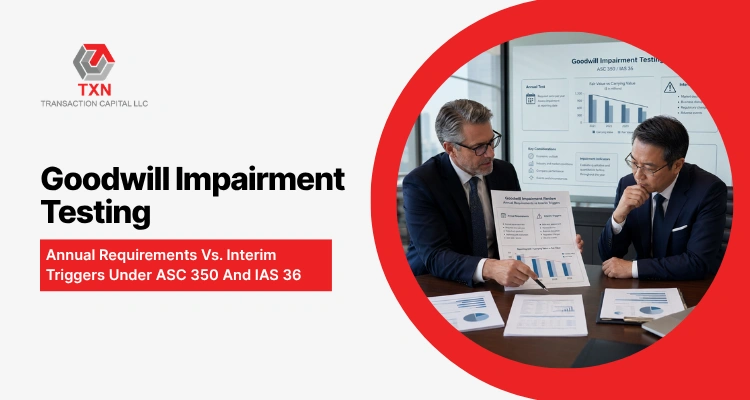
Under ASC 350, companies must test goodwill at least once a year. But certain internal and external developments demand immediate interim testing regardless of where you are in the calendar year. Identifying these triggers early is the difference between a planned write-down and a surprise restatement.
Internal Triggering Events Include
- Sustained decline in revenues, margins, or cash flows within an acquired business unit
- Departure of key executives, anchor customers, or strategic alliance partners
- Significant organizational restructuring, cost-reduction programs, or workforce reductions
- Downward revisions to forward-looking financial projections
- Material changes in business strategy, go-to-market approach, or core product focus
- Negative or declining operating cash flows that indicate the business can no longer support its recorded goodwill
External Market Triggers Include
- Macroeconomic downturns or sector-specific recessions affecting the acquired company’s industry
- Competitive disruption from new entrants, substitute technologies, or pricing pressure
- Regulatory shifts that impair operations, revenue potential, or market access
- A meaningful drop in the parent company’s stock price or market capitalization relative to book value
- Rising interest rates that increase discount rates used in DCF models, thereby compressing fair value estimates
- Adverse developments in credit markets that affect the cost and availability of capital
One important update for 2026: under ASU 2021-03, private companies and not-for-profit entities that elected the goodwill accounting alternative are only required to evaluate triggering events as of the end of each annual or interim reporting period-not continuously throughout the period. This reduces administrative burden while maintaining compliance integrity.
What’s the Step-by-Step Process for Testing Goodwill Impairment?
Goodwill impairment testing follows a structured sequence under U.S. GAAP (ASC 350) that requires both technical expertise and sound judgment. Here’s exactly how the process unfolds:
Step 1: Qualitative Assessment (Optional Under U.S. GAAP)
Before running quantitative models, companies may conduct a “Step Zero” qualitative screen. The central question is whether it’s more likely than not (greater than 50% probability) that goodwill is impaired. If the answer is no, quantitative testing can be bypassed entirely for that period-saving significant time and cost. If yes, you proceed to the quantitative step.
Step 2: Define the Testing Unit
The unit of account for goodwill testing differs by reporting framework:
- U.S. GAAP (ASC 350): Testing is conducted at the reporting unit level-an operating segment or one level below, provided it constitutes a business and discrete financial information is available.
- IFRS (IAS 36): Testing occurs at the cash-generating unit (CGU) level-the smallest identifiable group of assets generating cash inflows that are largely independent of other assets.
Correctly defining reporting units is where many companies stumble. Misidentification leads to under- or over-estimation of impairment and is one of the most frequently cited errors in regulatory reviews.
Step 3: Determine Fair Value Using Professional Methods
Professional valuers apply a combination of approaches to estimate the fair value of each reporting unit:
- Income Approach: Discounted Cash Flow (DCF) analysis projects free cash flows over a forecast horizon and discounts them to present value using a risk-adjusted Weighted Average Cost of Capital (WACC). The Capitalization of Earnings method may also be applied for stable businesses.
- Market Approach: Applies valuation multiples derived from the Guideline Public Company Method (comparable publicly traded firms) or the Guideline Transaction Method (recent M&A deal data).
- Asset Approach: The adjusted net asset method is occasionally used, though rarely the primary method in goodwill scenarios.
- Specialized Methods: For companies with complex capital structures or recent venture financing rounds, Option Pricing Models (OPM) and the Backsolve Method may be incorporated.
Using multiple approaches and reconciling the results is not just best practice-it’s what sophisticated auditors and the Big 4 expect to see in a defensible impairment analysis.
Step 4: Compare Values and Calculate Impairment
Under the simplified single-step model introduced by FASB ASU 2017-04 (which eliminated the legacy Step 2 calculation), the impairment loss is straightforward: if the reporting unit’s carrying amount exceeds its fair value, the excess is the impairment charge-capped at the total goodwill allocated to that unit. No more implied fair value calculations are required.
Step 5: Record and Disclose Results
Impairment losses hit the income statement as a separate line item. Financial statement footnotes must detail the impairment amount, the triggering circumstances, the affected reporting unit, the valuation methodology employed, and the critical assumptions underlying the fair value estimate.
Need expert assistance navigating goodwill impairment testing for your next audit cycle?
Contact Transaction Capital LLC →How Does Goodwill Impairment Affect Your Overall Business Valuation?
A goodwill write-down doesn’t stay contained in a single accounting entry. Its effects cascade across your financial statements, valuation multiples, and stakeholder relationships.
Direct Financial Statement Impacts
- Income Statement: The impairment charge reduces reported net income, which can compress earnings-based multiples (P/E, EV/EBITDA) and may breach financial covenants in credit agreements.
- Balance Sheet: Total assets and shareholders’ equity declines. Lenders that monitor debt-to-equity or debt-to-assets ratios may trigger technical defaults.
- Cash Flow Statement: Operating cash flow is unaffected-impairment is non-cash-but analysts will add it back in adjusted EBITDA calculations, creating a disconnect between reported earnings and adjusted operating performance that requires clear communication.
Investor and Market Perceptions
When sophisticated investors or potential acquirers see material or recurring goodwill impairments, they interpret it as evidence of:
- Insufficient due diligence during the original acquisition
- Management’s failure to capture expected synergies or execute post-merger integration
- Structural weaknesses in the underlying business model or competitive positioning
- Potentially inflated future growth assumptions that couldn’t withstand market reality
These signals can compress valuation multiples in subsequent fundraising rounds, reduce the pool of qualified buyers during M&A processes, and introduce friction in IPO readiness reviews.
Can Goodwill Impairment Be Reversed?
No-under both U.S. GAAP (ASC 350) and IFRS (IAS 36), goodwill impairment is permanent and cannot be reversed. Even if business performance recovers dramatically and the underlying fair value subsequently exceeds the original carrying amount, the written-down goodwill cannot be reinstated.
This conservative accounting principle-codified in ASC 350-20-35-78-protects financial statement users from volatile swings in asset values. It also reinforces one of the most important lessons in acquisition strategy: get the valuation right the first time.
This irreversibility makes professional expertise during both intangible asset valuation at acquisition and ongoing annual testing a financial necessity, not a luxury.
What Are the Tax Implications of Goodwill Write-Downs?
Goodwill impairment creates intricate tax consequences that frequently surprise companies-particularly those with complex acquisition histories or multi-entity structures.
Key Tax Considerations
- Deductibility: Goodwill impairment losses are generally not tax-deductible under U.S. tax law. However, if goodwill arose from a taxable asset acquisition (rather than a stock purchase), the amortization and write-down may carry different tax treatment.
- IRC Section 197 Compliance: Goodwill acquired in a business combination is treated as a Section 197 intangible, amortizable over 15 years for tax purposes regardless of book impairment. Book and tax treatment often diverge, and that divergence must be carefully tracked.
- Deferred Tax Effects: A book of impairment may create or modify deferred tax assets or liabilities, depending on the company’s existing temporary differences. The interaction between book write-downs and tax amortization schedules can materially affect effective tax rates.
- Documentation Requirements: The IRS expects thorough contemporaneous documentation supporting both the impairment conclusion and the tax position taken. Companies that lack this documentation face heightened scrutiny in audit situations.
The bottom line: any material goodwill impairment event should prompt immediate consultation with both your valuation provider and your tax advisors to ensure proper alignment across book, tax, and regulatory reporting.
What Best Practices Ensure Accurate and Defensible Impairment Testing?
In our experience working with over 2,500 clients across 35+ industries, Transaction Capital’s ABV® and ASA certified appraisers have found that the companies best positioned to defend goodwill conclusions share three consistent practices.
1. Establish Consistent Testing Protocols
- Lock in an annual testing date: Most companies choose a specific date in Q3 or early Q4 to allow adequate time for year-end audit preparation. Consistency matters-changing testing dates requires disclosure and, for SEC registrants, may require a preferability letter filed with the Commission.
- Implement quarterly trigger monitoring: Establish a formal internal process for reviewing economic and operational conditions each quarter. Identifying a potential trigger in Q2 and addressing it immediately is far less disruptive than discovering it during year-end audit fieldwork.
- Document everything contemporaneously: Auditors scrutinize the timing of documentation. Assumptions, discount rate selections, comparable company choices, and management overlays should all be documented at the time of testing-not reconstructed afterward.
2. Employ Multiple Valuation Approaches
No single valuation method captures the full picture. Cross-validating a DCF model against market-derived multiples adds credibility to your conclusions and guards against model-specific assumptions that auditors might challenge. Companies that present only one methodology typically face more pushback during audit review.
3. Engage Professional Valuation Experts
Independent, credentialed valuation firms bring objectivity and technical depth that internal finance teams-however capable cannot fully replicate. For audit-ready reporting, look for professionals holding ABV®, ASA, CVA®, or MRICS designations. These credentials signal adherence to USPAP, SSVS, and NACVA standards that Big 4 auditors recognize and accept.
Real-World Examples: When Goodwill Impairment Goes Wrong
Learning from high-profile write-downs is one of the most direct ways to internalize why rigorous impairment testing and realistic acquisition assumptions matter.
1. Microsoft-Nokia ($7.6 Billion Write-Down)
Microsoft’s 2014 acquisition of Nokia’s handset business rested on assumptions about smartphone market positioning that market dynamics quickly invalidated. Declining sales volumes and eroding market share forced Microsoft to write off nearly the entire acquisition value within 12 months-a textbook case of overly optimistic acquisition projections colliding with a rapidly evolving competitive landscape.
2. General Electric-Alstom ($22 Billion Impairment)
GE’s power division bet heavily on traditional energy demand continuing to grow. The accelerating global transition toward renewable energy sources compressed demand projections far below expectations, triggering one of the largest corporate goodwill impairments on record. The Alstom case is frequently cited in business schools as a failure of industry foresight in acquisition underwriting.
3. Kraft Heinz Brand Impairment ($15.4 Billion)
The 2019 Kraft Heinz write-down revealed just how quickly consumer preferences can erode the value of once-iconic brands. A structural shift toward healthier, fresher food options diminished the pricing of power and growth prospects of legacy brands like Oscar Mayer and Kraft, forcing a massive goodwill and intangible asset revaluation. The case underscores that even financially stable, profitable brands require continuous fair value monitoring.
Each of these situations shares a common thread: insufficient ongoing monitoring and excessive reliance on acquisition-date assumptions that were never updated to reflect changing realities.
When Should Your Company Hire Professional Valuation Services?
Some goodwill testing can be managed internally with adequate expertise. But certain circumstances make independent professional valuation not just beneficial but essential.
Consider Professional Help When
- Triggering events have occurred and internal teams are uncertain whether impairment is likely
- Your internal team lacks the DCF modeling depth or market comparable database required for defensible conclusions
- Audit-ready documentation and regulatory compliance are non-negotiable (e.g., Big 4 auditor review)
- Independence and objectivity are required for board-level credibility or investor reporting
- M&A transactions, pre-IPO readiness reviews, or significant fundraising rounds are on the horizon
- Your capital structure involves multiple classes of equity, complex preferences, or recent financing events
Benefits of Professional Valuation Services
- Technical Methodology Depth: Credentialed professionals stay current with evolving FASB guidance-including ASU 2017-04, ASU 2021-03, and the FASB’s December 2024 invitation to comment on intangible asset recognition reform-ensuring your testing framework reflects the latest standards.
- Audit Readiness: Independent reports include comprehensive documentation packages that satisfy Big 4 reviewers for financial reporting and tax audit purposes.
- Regulatory Compliance: Expert valuers align testing with ASC 350, IAS 36, SEC reporting requirements, and IRS audit expectations. Reports from Transaction Capital LLC are court-acceptable for litigation of matters and meet institutional investor standards.
- Strategic Intelligence: Beyond compliance, a well-executed impairment test generates actionable intelligence about business unit performance, acquisition integration progress, and forward-looking strategic priorities.
How Transaction Capital LLC Supports Your Goodwill Valuation Needs
At Transaction Capital LLC, we approach goodwill impairment testing as a genuine financial advisory engagement-not a checkbox exercise. Our certified team combines technical rigor with practical business context to deliver conclusions that hold up under audit scrutiny, investor diligence, and regulatory review.
Our Specialized Services Include
- Business Valuation Services: Enterprise and reporting unit valuations for annual impairment testing, M&A support, and strategic planning purposes.
- Intangible Asset Valuation: Granular assessments of goodwill, trade names, customer relationships, developed technology, and other intangibles across industries.
- Gift & Estate Tax Valuations: Professional valuations for estate planning, TCJA sunset planning, and family business succession.
- Fairness Opinions: Independent board-level assessments supporting M&A transactions and shareholder communications.
Final Thoughts: Protecting Your Business Value Through Proactive Management
Goodwill impairment is far more than a technical accounting requirement. It’s a real-time signal about whether the premium paid at acquisition is still justified by the business’s current economic reality.
Companies that treat impairment testing as a proactive risk management tool rather than an annual compliance burden-consistently emerge from audit cycles with stronger stakeholder relationships and more defensible valuations.
Use this guide to:
- Recognize early warning signs of impairment before they escalate to material write-downs
- Build systematic monitoring and testing protocols that satisfy both internal management and external auditors
- Maintain compliance with ASC 350, IAS 36, and evolving FASB guidance including the latest 2025-2026 ASU developments
- Communicate credibly with investors, lenders, and board members about goodwill health
- Make acquisition and strategic decisions grounded in rigorous, current fair value analysis
When intangible assets form a significant portion of your enterprise value, professional oversight isn’t optional-it’s the foundation of financial integrity.
Schedule your professional goodwill impairment consultation with Transaction Capital LLC today.
Our certified experts deliver the technical depth, documentation rigor, and strategic insight your business needs to navigate complex valuation challenges with confidence.
Frequently Asked Questions About Goodwill Impairment
1. What exactly is goodwill impairment and why should business owners care?
Goodwill impairment is a required accounting write-down when the fair value of recorded goodwill falls below it is carrying amount on the balance sheet. It arises from factors like business underperformance, failed acquisition of synergies, or adverse market shifts. Business owners should care because it directly reduces reported net income, shrinks total assets, compresses key valuation multiples, and can signal acquisition missteps to investors and lenders-all of which affect future fundraising and exit outcomes.
2. When are companies required to test goodwill for impairment?
Public companies must test goodwill annually under ASC 350, typically at a fixed date in Q3 or Q4. Interim testing is mandatory whenever a triggering event occurs such as a sustained revenue decline, loss of a major customer, significant market deterioration, or a drop in stock price relative to book value. Private companies using the accounting alternative under ASU 2014-02 evaluate triggering events only at the end of each reporting period, reducing continuous monitoring obligations.
3. How is the goodwill impairment loss calculated under current GAAP?
Under the single-step approach established by FASB ASU 2017-04, an impairment loss equals the excess of a reporting unit carrying amount over its fair value. The loss cannot exceed the total goodwill allocated to that reporting unit. The legacy Step 2 calculation-which required a hypothetical purchase price allocation to determine implied goodwill fair value-has been fully eliminated, simplifying the process while reducing cost and complexity.
4. What are the financial statement impacts of a goodwill write-down?
A goodwill impairment charge reduces net income and total assets simultaneously, compressing shareholders’ equity and potentially triggering loan covenant violations. While operating cash flow is unaffected (impairment is non-cash), the charge depresses earnings-based valuation multiples, may reduce available debt capacity, and can negatively affect investor and lender confidence-particularly in pre-IPO, fundraising, or acquisition scenarios.
5. Is goodwill impairment ever tax-deductible?
Generally, book goodwill impairment losses are not tax-deductible under U.S. tax law. Tax deductibility depends on whether the underlying goodwill arose from a taxable asset acquisition or a stock purchase. Goodwill from taxable acquisitions is treated as a Section 197 intangible, amortizable over 15 years for tax purposes-independent of any book impairment. Companies should coordinate with both their valuation advisor and tax counsel to properly align book and tax treatment and avoid unexpected effective tax rate impacts.
6. Which valuation approaches produce the most audit-defensible goodwill impairment conclusions?
The most defensible methodology combines the income approach (DCF analysis using a risk-adjusted WACC) with the market approach (guideline public company multiples or guideline transaction data). For companies with recent venture financing or complex capital structures, Option Pricing Models and the Backsolve Method provide additional support. Presenting a single-method conclusion without cross-validation is the most common reason impairment analyses draw auditor challenge.
7. What disclosure requirements apply to goodwill impairment in financial statements?
Under ASC 350-20-50-2, companies must disclose the facts and circumstances leading to the impairment, the total impairment charge, the affected reporting unit, the valuation methods and key assumptions used, and any required fair value disclosures under ASC 820. SEC registrants must also include relevant discussions in the MD&A section of annual filings. Robust, contemporaneous disclosure documentation is critical for audit defense and regulatory review.