IRS Form 8594 Asset Allocation: A Buyer-Seller Guide to Section 1060 Purchase Price Allocation
 Dr. Gaurav B. (ABV®, ASA, CVA®, MRICS)
on

Dr. Gaurav B.
Founder & Principal Valuer, Transaction Capital LLC
Specialist in IRS-Compliant 409A & Complex Valuation Matters
Dr. Gaurav B. is the Founder and Principal Valuer of Transaction Capital LLC, a valuation and financial advisory firm providing independent, standards-based valuation opinions for startups, growth-stage companies, and established enterprises.
Why Does Form 8594 Purchase Price Allocation Matter in a Business Sale?
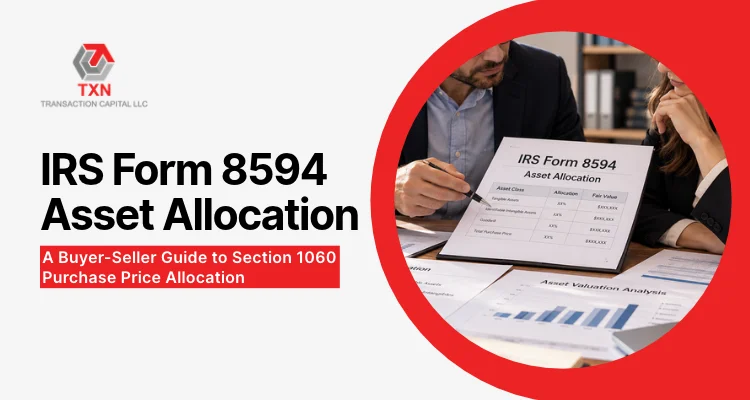
IRS Form 8594 shows how the price of a business was split among the assets bought. The buyer and the seller each file it with their tax return. That split shapes the buyer’s deductions and the seller’s tax bill for years.
A deal has two parts. First comes the price. Then comes the purchase price allocation. The price is split across cash, receivables, inventory, equipment and goodwill. The IRS taxes each one in its own way.
Buyers and sellers rarely want the same split. Buyers like assets they can write off fast. Sellers like assets that earn capital gain. Yet both report the same deal. So they need one split that is fair and that matches.
This guide from Transaction Capital LLC shows what the form asks for. It explains the residual method. And it shows how sound valuation helps a negotiated number hold up.
Key Takeaways
- Form 8594 shows how the price of an asset deal is split across seven classes under IRC Section 1060.
- Buyer and seller each generally file it with their tax return for the sale year.
- Classes I through VI get fair market value. Class VII goodwill gets what is left.
- Fair market value drives the split, not book value. Value each known asset before you reach goodwill.
- A signed written split generally binds both sides. Settle it and back it up before you sign.
- Earnouts and other price changes may need a supplemental Form 8594.
- A stock deal with a Section 338 or 336(e) election uses Form 8883.
- Late or wrong filings can bring penalties under Sections 6721 through 6724.
Need a Defensible Purchase Price Allocation Before You Sign?
Our ABV®, ASA, CVA® and MRICS credentialed valuers prepare audit-ready allocation support for buyers and sellers.
[Request a Free Consultation →] What Is IRS Form 8594?
IRS Form 8594 is the Asset Acquisition Statement Under Section 1060. Buyers and sellers use it to report how a business price was divided. It sorts the price into seven set asset classes. Both sides generally attach it to their income tax returns for the year of the deal.
The form links two numbers. One is the buyer’s tax basis. The other is the seller’s amount realized. Both relate to the same assets. So the IRS sees both sides of the deal. Reports that do not match stand out fast.
For the buyer, the split sets the tax basis of each asset. Basis sets how much the buyer can deduct each year. It also sets gain or loss on a later sale.
For the seller, the split sets the amount realized on each asset. That decides the type of gain. It may be ordinary income, recapture or capital gain.
The IRS lists the current form as the November 2021 revision. Check the IRS Form 8594 page before you file.
When Is Form 8594 Required?
You need Form 8594 when a deal is an “applicable asset acquisition” under Section 1060. Three things must be true:
- A group of assets that make up a trade or business moves from seller to buyer.
- Goodwill or going-concern value attaches, or could attach, to those assets.
- The buyer’s basis in the assets is set only by the price paid.
The tax nature of the deal decides this, not the label in the contract.
| Transaction type | Form 8594 generally required? |
| Direct purchase of substantially all operating assets | Yes |
| Stock purchase with a Section 338(h)(10) or 336(e) election | Asset treatment applies; the allocation is reported on Form 8883 |
| Ordinary stock purchase with no election | No |
| Purchase of a partnership interest | Not automatically; depends on the structure |
| Single-member LLC (disregarded entity) interest purchase | Often treated as an asset purchase |
Filing deadline: Each side attaches Form 8594 to its timely filed federal income tax return, extensions included. Use the tax year that holds the sale date.
In short, if you buy the assets of a whole business, expect to file Form 8594. The deal’s structure decides the rest. So check the tax treatment with your advisers early.
Who Must File Form 8594, and Who Is Exempt?
Both buyer and seller generally file. Each attaches the form to its own return, such as Form 1040, 1065, 1120 or 1120-S. U.S. shareholders of a controlled foreign corporation attach it to Form 5471.
The IRS instructions name two exceptions. A Section 1031 like-kind exchange needs no form for the exchanged part. A plain partnership interest transfer follows other rules. But if the IRS treats it as a purchase of partnership assets that form a business, the buyer must file.
Form 8594 vs. Form 8883: Which Applies to a Stock Deal?
An ordinary stock purchase triggers neither form. With a Section 338 or 336(e) election, the deal is treated as an asset sale. The allocation is then reported on Form 8883. Ask your tax adviser to confirm.
Why Purchase Price Allocation Matters Before Closing
Picture a maker of parts sold for $8 million. It owns machines, stock, processes, customer contracts and a known brand. Both sides agree the business is worth $8 million. That tells you nothing about what each asset is worth.
The split matters because each asset class is taxed in its own way:
- The buyer recovers inventory cost through cost of goods sold. For the seller, it is ordinary income.
- Equipment lets the buyer deduct cost over time, sometimes faster. The seller may owe tax on recapture at ordinary rates.
- The buyer writes off Section 197 intangibles, goodwill included, over 15 years. The seller often gets capital gain on goodwill built in-house.
The price stays the same. But the split changes how much tax is paid, by whom and when. Say $1,000,000 goes to a Section 197 intangible. The buyer deducts about $66,667 a year for 15 years. The same sum placed in qualifying equipment may be recovered faster.
So make the split part of the talks. Do not leave it for a rush after closing.
The Section 1060 Residual Method Explained
You must use the residual method under Section 1060. It hands out the price to seven asset classes in a fixed order. Classes I through VI each get up to fair market value, no more. Whatever is left goes to Class VII, goodwill and going-concern value.
One tie-breaker applies. If an asset fits two classes, use the lower-numbered one.
The Seven Form 8594 Asset Classes
| Class | What it includes | Common examples |
| Class I | Cash and general deposit accounts | Cash, checking and savings balances |
| Class II | Actively traded personal property and specified financial assets | Marketable securities, foreign currency, certificates of deposit |
| Class III | Mark-to-market assets and certain debt instruments | Accounts receivable |
| Class IV | Inventory and property held for sale to customers | Finished goods, merchandise, raw materials |
| Class V | All assets not in another class | Equipment, furniture, vehicles, land, buildings |
| Class VI | Section 197 intangibles other than goodwill and going concern | Customer relationships, trademarks, patents, licenses, non-competes |
| Class VII | Goodwill and going-concern value | Residual value of the business |
What Counts as a Class VI Section 197 Intangible?
The IRS instructions list these Class VI items:
- Workforce in place.
- Business books, systems, know-how and formulas.
- Ties with customers and suppliers.
- Licenses and permits granted by a government.
- A non-compete tied to the deal.
- Franchises, trademarks and trade names.
How the Residual Method Works: Step by Step
- Start with the total price. Add any debts the buyer takes on that count toward the price.
- Subtract cash and bank deposits at face value. These are Class I.
- Assign value to Classes II through VI in order. Each class gets up to fair market value.
- Inside a class, split the value by each asset’s share of fair market value.
- Put whatever remains in Class VII, goodwill and going-concern value.
Here is a short example. A buyer pays $1,000,000. Cash is $50,000. Equipment is worth $300,000. Named intangibles are worth $250,000. That leaves $400,000 for goodwill.
The fixed order is the safeguard. It stops goodwill from turning into a plug number that either side can nudge for a tax gain. Goodwill is just what remains once every named asset has a value.
Why Goodwill Is Calculated Last
A healthy business often sells for more than its listed assets are worth. The extra comes from reputation, a skilled team and steady sales. Buyers may also pay for expected savings. But not every intangible is goodwill.
Customer ties, trade names and technology are Class VI assets. They must be valued first. Skip that step and goodwill swells. That draws attention.
Fair Market Value vs. Book Value
Form 8594 uses fair market value. The IRS defines it as the gross value of the property. Mortgages, liens and other debts are not subtracted. Book value is an old accounting figure. It is not a valid stand-in.
The gap can be wide:
| Situation | Book value | Fair market value |
| Fully depreciated but working machinery | $50,000 | $250,000 |
| Internally built customer list | $0 | Potentially substantial |
| Capitalized software now becoming obsolete | High | Possibly much lower |
| Self-developed trade name | $0 | Often material |
Book values can be too low or too high. The error then slides into goodwill. A sound allocation checks each asset’s condition, life left, market data and expected gains.
Valuation Approaches Used in Purchase Price Allocation
Valuers pick from three approaches. The choice depends on the asset and the data.
- Market approach: This uses sales of similar assets. It suits equipment, vehicles and real estate.
- Income approach: This values the future gains an asset will earn. Customer ties often call for the multi-period excess earnings method (MPEEM). Trade names often use relief-from-royalty.
- Cost approach: This asks what it would cost to rebuild the asset, less wear. It is common for in-house software and a trained workforce.
Good work also avoids double counting. Cash flow credited to customer ties cannot be counted again in a trade name or in goodwill.
Want Your Allocation Backed by Independent Valuation?
Our CVA®, ASA and ABV® professionals value Class VI intangibles and goodwill to USPAP, SSVS and NACVA standards.
[Speak With a Valuation Expert →] Worked Example: Allocating a $5 Million Acquisition
A buyer purchases a distribution business for $5,000,000. After valuation work, the split on Form 8594 looks like this:
| Asset class | Allocation | Share of price |
| Class I – Cash and deposits | $200,000 | 4% |
| Class IV – Inventory | $600,000 | 12% |
| Class V – Equipment and tangible assets | $1,200,000 | 24% |
| Class VI – Identifiable intangibles | $1,000,000 | 20% |
| Class VII – Goodwill and going-concern value | $2,000,000 | 40% |
| Total consideration | $5,000,000 | 100% |
Classes II and III are left out. This sample firm holds no securities or receivables. The numbers are for illustration only.
What it means for the buyer:
- The buyer recovers the $600,000 of inventory cost as stock is sold.
- The buyer deducts the $1,200,000 of equipment cost over its set life.
- The buyer amortizes the $3,000,000 of Class VI and VII value over 15 years. That is about $200,000 a year.
What it means for the seller:
- Money from inventory is taxed as ordinary income.
- Equipment gain up to past write-offs is taxed as ordinary income.
- Goodwill gain is often capital gain. That depends on the seller and the entity type.
The $2,000,000 of goodwill is not a guess at reputation. It is what remained after Classes I through VI were backed at fair market value.
How Do You Fill Out IRS Form 8594, Part by Part?
Use Parts I and II for an original statement. Use Parts I and III for a supplement. Enter your name and taxpayer ID at the top. Then tick Purchaser or Seller.
- Part I: Enter the other party’s name, address and ID number. Add the sale date and the total sales price.
- Part II: For each class, list total fair market value and the price allocated. Report Classes VI and VII together. Then answer two questions. Did the parties set the split in a signed document? Did the buyer also get a license, non-compete, lease or work contract from the seller? If yes, attach a statement. Name the deal and the most it can pay.
- Part III: Use it only when the price changes later.
Keep your Class VI and VII totals on Form 8594 in line with your valuation report. A reviewer can spot numbers that do not match.
Why Buyers and Sellers Disagree, and How to Resolve It
Disputes start with a fair point. Different splits give different tax results.
Take a $10 million software deal. The buyer says the platform earns a large Class VI share. The seller says most value comes from brand and loyal customers. That means more goodwill. Both have a case. Neither wish sets fair market value.
| Asset class | Buyer usually prefers | Seller usually prefers |
| Class IV: Inventory | Higher, since cost is recovered quickly | Lower, since gain is ordinary income |
| Class V: Equipment | Higher, for faster depreciation | Lower, to limit recapture |
| Class VII: Goodwill | Lower, since it is amortized over 15 years | Higher, since gain is often capital gain |
Proof settles it, not pressure. Useful proof includes:
- What the technology does, what it costs to rebuild and how long it will last.
- How well customers stay, what their contracts say and how much revenue sits with a few.
- Market data on royalty rates and asset sales.
- Each asset’s share of expected cash flow.
An independent valuation gives both sides a fair starting point. It also gives paperwork that holds up on exam. Learn more about our business valuation and intangible valuation work.
Does the Purchase Agreement Control the Allocation?
Under Section 1060(a), a written deal between buyer and seller on the split is generally binding on both. That includes agreed fair market values. The IRS is not bound. It can challenge any split it finds off base.
Courts also use the Danielson rule. It holds parties to their own written terms. They escape only by proving mistake, fraud, duress or undue influence.
In practice:
- Agree on a split you can support before you sign, not after.
- Say who drafts the first allocation and by when.
- Add a way to settle disputes, such as an independent accountant.
- Set rules for price changes after closing.
A signed number binds the parties. But it holds up only if it follows the residual method and has valuation support.
Section 1060 vs. ASC 805: Tax and Book Allocations Differ
Section 1060 sets the rules for federal income tax. ASC 805 sets the rules for deal accounting under U.S. GAAP. The measuring rules differ. So you cannot move a book allocation onto Form 8594 without changes.
| Factor | Section 1060 (tax) | ASC 805 (financial reporting) |
| Purpose | Tax basis and gain character | Balance sheet recognition |
| Value standard | Fair market value | Fair value (market-participant basis) |
| Goodwill | Residual after Classes I–VI | Residual after recognized net assets |
| Contingent consideration | Generally included when paid or fixed | Measured at fair value at acquisition |
| Goodwill after closing | Amortized over 15 years | Generally tested for impairment |
Both can use the same valuation facts. But each must follow its own rules. Our purchase price allocation and ASC 805 service covers the book side.
Post-Closing Adjustments and Supplemental Form 8594
Deal value often shifts after closing. Working-capital true-ups, earnouts, escrow releases and indemnity claims can all move the price.
If the price rises or falls after the first filing, each side generally files a supplemental Form 8594 (Part III). File it for the year the change happens. It re-splits the change under the residual method. It must give the reason and name the year and return of the first filing.
Say the buyer pays a $500,000 earnout after sales targets are met. It does not default to goodwill. It moves through the classes in order, within fair market value limits. Classes I through VI are usually full already. So the increase often lands in Class VII. But the math must show that.
How Do You Allocate a Price Increase or Decrease?
The IRS instructions set the order:
- Increase: Start with Class I. Move through Classes II to VI, never above fair market value. Put the rest in Class VII.
- Decrease: Cut Class VII first. Then cut Class VI, then Classes V, IV, III and II.
In the $5 million example, the earnout lifts Class VII from $2,000,000 to $2,500,000. That holds if other classes sit at fair market value. See our contingent consideration case study.
Both sides should keep a shared log of every change. They should also time their supplemental filings so reports still match.
What Are the Penalties for Filing Form 8594 Late or Wrong?
The IRS instructions warn of penalties if you do not file a correct form by the due date. You can avoid them by showing reasonable cause. The rules sit in Sections 6721 through 6724.
Amounts change each year for inflation. For returns due in 2026, the tiers are $60, $130 and $340 per return. The amount depends on how fast you fix the error. Intentional disregard starts at $680. See the IRS information return penalties page for the latest amounts.
The bigger risk is an audit. Filings that do not match invite questions. A split with no support can be challenged. The fix is simple: file Form 8594 on time, file it right and keep your proof.
Common Form 8594 Mistakes to Avoid
- Using book value instead of fair market value.
- Dumping all intangible value into goodwill without valuing customer relationships, trade names or technology.
- Ignoring the residual method in favor of negotiated percentages.
- Filing inconsistent allocations without reconciling differences with the counterparty.
- Overlooking earnouts, assumed liabilities and transaction costs that change total consideration.
- Copying an ASC 805 allocation directly onto Form 8594.
- Failing to keep valuation reports and asset schedules to support the figures.
- Misreading deal structure and filing, or skipping, Form 8594 incorrectly.
- Using an outdated form or superseded instructions.
Two of these trip people up most. Book value hides true asset values. It pushes the error into goodwill. And a deal with a Section 338 or 336(e) election moves the allocation to Form 8883.
Buyer-Seller Coordination Checklist
Before signing
- Confirm how the deal is taxed.
- Check whether Section 1060 and Form 8594 apply.
- Test the tax effect of each split for both sides.
- Decide whether to hire an outside firm for an allocation study.
- Draft clauses for the split, disputes and later changes.
Between signing and closing
- Gather asset lists, stock counts and customer data.
- Find every intangible asset, even those not on the books.
- Hire valuers and work with your tax advisers.
- Record the price, debts taken on and open contingencies.
After closing
- Fix the final price and finish the residual split.
- Compare your schedules with the other side.
- Prepare and file matching Forms 8594.
- Track earnouts and changes for supplemental filings.
- Keep the valuation report and the records behind Form 8594.
What Is a Practical Timeline for Purchase Price Allocation?
No fixed calendar exists. But a steady pace keeps you out of trouble.
- At the letter of intent: Flag the split as a deal term.
- Before signing: Agree on the method, the values and who drafts the first version.
- At closing: Lock the final price and the split.
- After closing: Finish the valuation work and swap drafts of the form.
- By the return due date: File matching Forms 8594. Extensions count.
When Should You Hire a Valuation Firm for Purchase Price Allocation?
No law requires an outside valuation in every deal. But get one when intangibles are large or market data is thin. Get one when the sides disagree. And get one when a lender or auditor will review the numbers.
Keep your records as long as they may matter to a tax matter, as the IRS instructions advise.
Conclusion
Form 8594 turns the price split into a matched, two-sided tax filing. It affects what the buyer can write off over time. It also affects inventory costs, goodwill and the kind of gain the seller reports. The effects often last 15 years or more.
A split that holds up rests on four things. Put each asset in the right class. Support each value with fair market value data. Follow the residual method. And work together early. Buyer, seller, valuers and tax advisers should all take part. The aim is not to win. It is to reach a split that fits the deal and stands up if the IRS asks how you built it.
At Transaction Capital LLC, our team helps buyers and sellers build allocations that stand up to review.
Ready to Build an Allocation That Holds Up Under IRS Review?
Talk with ABV®, ASA, CVA® and MRICS credentialed professionals who prepare USPAP, SSVS and NACVA compliant valuation reports.
[Book Your Free 15-Minute Consultation →] Frequently Asked Questions About IRS Form 8594
1. Who must file IRS Form 8594?
Both the buyer and the seller in an applicable asset acquisition under Section 1060 generally must file Form 8594. Each attaches it to its federal income tax return for the year of the sale.
2. Is Form 8594 required for a stock purchase?
Not for an ordinary stock purchase. If the parties make a Section 338(h)(10) or 336(e) election, the deal is treated as an asset acquisition for tax, and related allocation reporting rules apply.
3. What are the seven asset classes on Form 8594?
Class I cash; Class II actively traded securities; Class III receivables and mark-to-market assets; Class IV inventory; Class V equipment, land and buildings; Class VI Section 197 intangibles other than goodwill; Class VII goodwill and going-concern value.
4. What is the residual method?
The residual method allocates purchase price through Classes I to VI in order, each capped at fair market value. Any remaining amount is allocated to Class VII, goodwill and going-concern value.
5. Must the buyer and seller report the same allocation?
If they agreed on the allocation in writing, it is generally binding on both. Even without a written agreement, inconsistent filings can draw IRS attention, so the parties should coordinate before filing.
6. How long is goodwill amortized for tax purposes?
Acquired goodwill and other Section 197 intangibles are generally amortized on a straight-line basis over 15 years.
7. Is an independent valuation required for Form 8594?
No law requires one in every case. An independent valuation is strongly advisable when intangibles are material, market evidence is limited or the parties disagree on values.
8. What happens if the purchase price changes after filing?
Both parties generally file a supplemental Form 8594 for the year of the change, reallocating the increase or decrease under the residual method.
9. Can goodwill be most of the purchase price?
Yes. In service, technology and brand-driven businesses, goodwill often makes up the largest share. It must still be the true residual after identifiable assets are properly valued.
10. Is Form 8594 the same as an ASC 805 allocation?
No. Form 8594 follows Section 1060 tax rules. ASC 805 governs GAAP financial reporting. The two may share valuation evidence but apply different standards.
11. What is the penalty for not filing Form 8594?
You may face penalties under Sections 6721 through 6724 if you skip the form or file it wrong by the due date. Reasonable cause can avoid them. Amounts change each year, so check current IRS figures.
12. Which form do I file for a Section 338 or 336(e) election?
File Form 8883, not Form 8594. It reports the deemed asset sale and its split. Confirm the right form with a tax adviser first.
13. Does Form 8594 apply to a partnership interest purchase?
Not automatically. If the deal is treated for tax as a purchase of partnership assets that form a business, Section 1060 applies. The buyer then files Form 8594.
About Transaction Capital LLC
Transaction Capital LLC (TXN Capital LLC) is a valuation firm based in Delaware. It helps owners, investors, CPAs and lawyers across the U.S. The firm’s credentials include ABV®, ASA, CVA® and MRICS. It offers purchase price allocation, business valuation and goodwill impairment testing.
Disclaimer: This article is general information only. It is not tax, legal or accounting advice. Tax rules change, so confirm your facts with a qualified tax adviser before you file.