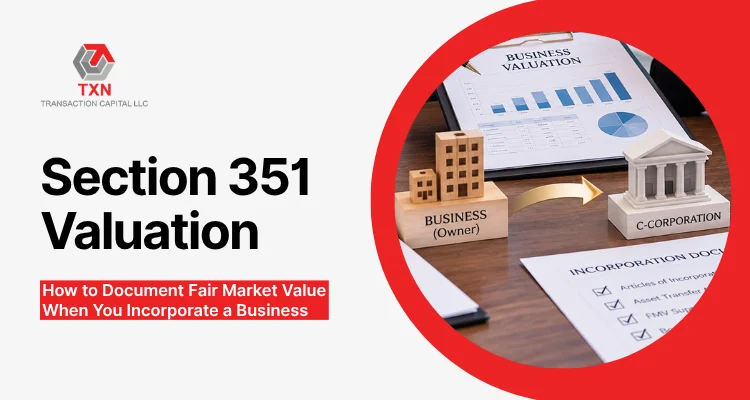
Section 351 Valuation: How to Document Fair Market Value When You Incorporate a Business
 Dr. Gaurav B. (ABV®, ASA, CVA®, MRICS)
on
Dr. Gaurav B. (ABV®, ASA, CVA®, MRICS)
on

Dr. Gaurav B.
Founder & Principal Valuer, Transaction Capital LLC
Specialist in IRS-Compliant 409A & Complex Valuation Matters
Dr. Gaurav B. is the Founder and Principal Valuer of Transaction Capital LLC, a valuation and financial advisory firm providing independent, standards-based valuation opinions for startups, growth-stage companies, and established enterprises.
What Is a Section 351 Valuation and Why Does It Matter?
A Section 351 valuation records what your business was worth on the day it moved into a C corp. Section 351 can let you make that move with no tax due right away. But the tax is only put off. It is not wiped out. The fair market value (FMV) on that day still shapes your stock basis, your cap table, your books, and any later claim for Qualified Small Business Stock (QSBS) under Section 1202.
Many owners think “tax-free” means no paperwork. That is a costly mistake. Years later, a buyer, auditor, or IRS agent may ask what the business was worth. A report made at the time is your best answer.
At Transaction Capital LLC (TXN Capital LLC), our credentialed appraisers help founders, CFOs, and tax advisors pin down value at the point of incorporation. This guide shows how Section 351 works, where value fits in, and what a sound FMV file looks like. It is general information, not tax or legal advice.
Section 351 Valuation: Key Takeaways
- Section 351 puts off tax when you move assets into a C corp for stock. It does not erase the gain.
- The owners who put in property must hold at least 80% of the stock right after the deal.
- Cash or other “boot” can trigger tax. So can debts that are larger than the basis of the assets you move.
- FMV and tax basis are not the same. A founder can have $200,000 of basis in a business worth $4 million.
- Many owners must file a statement with their tax return that shows the FMV and basis of what they moved.
- The best time to value the business is on, or very close to, the day of the transfer.
Incorporating a Business With Real Built-In Value?
Speak with an ABV®, ASA, CVA®, and MRICS credentialed appraiser before your transfer closes.
[Get a Free 15-Minute Consultation →] How Does a Section 351 Exchange Work? The 80% Control Test Explained
Section 351 of the tax code lets a business change its legal form with no tax bill on day one. Under Section 351(a), you owe no tax on gain, and take no loss, when you move property into a C corp solely for its stock. There is one catch. The owners who move property must control the company right after the swap.
“Control” comes from Section 368(c). As a group, those owners must hold at least 80% of the total combined voting power of all voting stock. They must also hold at least 80% of the total number of shares of each class of nonvoting stock. The test is run right after the swap. So a plan to sell shares that drops the group below 80% can undo the tax break.
Three points come up again and again:
- Many owners can count as one group. Several people can put in property in the same deal. Each one must move property, though. And the swaps should be part of one plan.
- Work does not count as property. Stock issued for services is not stock issued for property under the control test. Treas. Reg. §1.351-1(a)(1)(ii) also ignores a token amount of property put in mainly to let a service provider join the group.
- Investment companies are left out. Section 351(e) takes certain transfers to investment companies out of the rule. It mainly hits deals that let owners spread out their stock and bond holdings.
Does Section 351 Apply to an Existing Corporation?
Yes. Section 351 is not just for brand-new companies. An owner can add property to a C corp that has run for years. The same 80% test must be met right after that transfer.
How Can a Planned Sale Break the Control Test?
Control only has to exist right after the swap. But the IRS looks at the whole plan. Say an owner agrees, before closing, to sell shares to an outsider. The IRS may treat that sale as part of the swap and find the group fell below 80%. Rev. Rul. 2003-51 shows how the IRS uses this “step transaction” test.
Why Does a Tax-Free Section 351 Exchange Still Need a Valuation?
Section 351 answers one question. Is gain or loss taxed now? Value answers a different one. What was the property worth on the day of the deal?
Take a founder whose business has an adjusted tax basis of $200,000 and an FMV of $4 million. A qualifying swap defers the $3.8 million built-in gain. It does not erase it. Under Section 358, the founder’s stock most often takes the same basis as the property given up. Under Section 362, the C corp most often takes the founder’s basis in the assets. The gain stays baked in. It can show up in a later sale.
A report made at the time of the swap records the facts as they stood. That helps in several ways:
- It helps split ownership among founders and investors.
- It backs up the opening balance sheet and any purchase accounting work.
- It shows how much the assets had grown in value.
- It backs up later QSBS claims and gain exclusion.
- It gives you answers for lenders, investors, auditors, or the IRS.
A formal appraisal is not legally required for every Section 351 swap. The size of the deal, how complex it is, and how much of the value is intangible most often drive that choice.
How Is Basis Calculated After a Section 351 Exchange?
Basis is how the deferred gain is tracked. Here are the core rules:
- Your stock basis (Section 358): Start with the basis of what you gave. Subtract any cash or boot you got and any debts the C corp took over. Then add any gain you had to report.
- The C corp’s asset basis (Section 362): It takes your basis in the assets, plus any gain you reported.
- Holding period (Section 1223): Your stock most often picks up the holding period of the capital and Section 1231 assets you put in.
A founder puts in equipment with a basis of $300,000 and an FMV of $1,000,000. She gets $900,000 of stock and $100,000 in cash. Her realized gain is $700,000. She is taxed on just $100,000, the cash she got. Her stock basis stays at $300,000 ($300,000 minus $100,000 plus $100,000). The C corp’s basis in the equipment rises to $400,000. The other $600,000 of gain is put off. Each number starts with FMV.
Fair Market Value vs. Tax Basis in a Section 351 Exchange
These two numbers answer different questions.
- Fair market value is an economic measure. The federal tax standard comes from Rev. Rul. 59-60 and Treas. Reg. §20.2031-1(b). FMV is the price at which property changes hands between a willing buyer and a willing seller. Neither one is forced to act. Both know the key facts. Rev. Rul. 59-60 also stresses that no single formula fits every case.
- Tax basis is a figure from the past. It is used to work out gain, loss, and depreciation. A company that built its own software, brand, or customer base often has little basis in those assets. Yet they may be worth millions.
Rev. Rul. 59-60 also lists factors to weigh. These include the firm’s history, its industry outlook, book value, earning power, goodwill, past stock sales, and prices of like public companies.
| Factor | Fair Market Value (FMV) | Tax Basis |
| What it measures | Current economic worth | Historical cost, adjusted |
| Main source | Rev. Rul. 59-60; Treas. Reg. §20.2031-1(b) | Tax code (Sections 358, 362, 1016) |
| Looks at | Future cash flow, market data, risk | Price paid, upgrades, depreciation |
| Self-built intangibles | Often worth millions | Often near zero |
| Role in Section 351 | Measures built-in gain, ownership split, QSBS figures | Carries over to stock and assets |
| Example (founder above) | $4,000,000 | $200,000 |
What Counts as Property Under Section 351?
Property in a Section 351 swap can include cash, equipment, inventory, real estate, securities, patents, software, trademarks, contract rights, partnership or LLC interests, and a whole operating business. Know-how and trade secrets can also qualify in many cases. The deal papers should say plainly who is putting in what, and what each person gets back.
Mixed deals need extra care. Say one founder puts in a working business and another gets shares for future work. The second founder’s shares are treated as issued for services. That can affect the control test. It also raises a separate pay issue. Stock for work is taxed as ordinary income at its FMV under Section 83.
How Services Stock Can Sink the 80% Test
Here is a simple case. Founder A puts in a business worth $1.5 million for 75 shares. Founder B gets 25 shares for work only. The owners who put in property hold just 75%. That is below 80%, so Section 351 fails for all.
There may be a fix. If B also puts in property that is not “of relatively small value,” all of B’s shares can count toward control. For ruling purposes, the IRS has treated property worth at least 10% of the person’s other stock as enough (Rev. Proc. 77-37). Here, that means about $50,000 (10% of B’s $500,000 of stock). That 10% line is a guide, not a safe harbor. B is still taxed on the part tied to work. Each number in this fix rests on a supported value.
What If Stock Is Not Proportional to Value Contributed?
Section 351 does not require each person’s stock to match the value they put in. But a mismatch has tax effects. Say a parent puts in property worth $800,000 for 20% of the stock. The child puts in $200,000 of property for 80%. The deal can still qualify. But the IRS may treat part of the shift in value as a gift from parent to child, or as pay for work. Only a sound appraisal can measure that gap.
How Do Boot and Liabilities Affect a Section 351 Exchange?
Section 351 covers swaps “solely” for stock. An owner may also get cash or other property. This is called boot. Under Section 351(b), gain is then taxed up to the boot received. It is never more than the realized gain. A loss is never allowed, even with boot.
Debts need the same care. Under Section 357(a), when the C corp takes over a debt, that is most often not treated as boot. There are exceptions:
- Section 357(b) applies when the main purpose of taking on the debt was to avoid tax, or when there was no real business reason. Then all the debts in the swap are treated as boot, not just the problem one.
- Section 357(c) taxes gain when the debts taken on exceed the total adjusted basis of the property moved. This surprises founders whose firms carry debt but hold assets with low basis.
The appraiser should list all bank debt, shareholder loans, accounts payable, accrued expenses, deferred revenue, leases, and contingent obligations. The value expert reflects them in the value conclusion. Tax counsel decides how they are taxed.
Is Preferred Stock Always Treated as Stock?
Not always. Under Section 351(g), some preferred stock is treated as boot. This “nonqualified preferred stock” includes shares with certain buyback rights, put rights, or dividends tied to interest rates. Ask counsel to check any preferred terms first.
A Section 357(c) Example
A service firm puts in assets with a total basis of $250,000. The C corp takes on $400,000 of loans and payables. The debts exceed basis by $150,000. That $150,000 is taxed as gain, even though no cash changed hands. The founder’s stock basis also drops to zero.
One exception can help. Under Section 357(c)(3), debts that would be deductible when paid, such as a cash-basis firm’s payables, are left out of this test.
What If Section 351 Property Has a Built-In Loss?
Some owners put in assets worth less than their basis. Section 362(e)(2) can cap the C corp’s basis in those assets at FMV when total basis exceeds total value. For example, property with a $500,000 basis and a $300,000 FMV may carry only a $300,000 basis inside the C corp. The parties can elect to cut the owner’s stock basis instead. Either way, the rule can’t be applied without a supported FMV.
How to Value an LLC to C Corp Conversion Under Section 351
The most common use of Section 351 among startups is turning an LLC into a C corp before a priced funding round. The LLC may already hold software, trademarks, customer contracts, and other intangibles worth far more than their book value. It may also have SAFEs, convertible notes, or option plans that must be squared away.
The route matters. An LLC taxed as a partnership can convert in several ways:
- A state-law statutory conversion
- A transfer of its assets to a new C corp
- A transfer of the members’ LLC interests
Under Rev. Rul. 2004-59, a partnership that converts under a state formless-conversion statute is treated in two steps. First, it moves its assets into the C corp for stock. Then it hands that stock out to its partners as it winds up. Other structures can lead to different tax steps. Counsel should pick the structure before the appraisal is scoped. The structure decides what is being valued.
How Section 351 Valuation Supports QSBS Basis and Eligibility
For founders who hope to use Section 1202, the value set at incorporation can be one of the most useful records the company keeps.
Section 1202(i) has special rules for stock received in exchange for property other than money or stock. The stock is treated as acquired on the date of the swap, and the holding period starts then. That is different from the usual Section 351 tacking rule. For Section 1202 purposes, the stock’s basis is treated as not less than the FMV of the property exchanged.
This matters because the per-issuer gain exclusion limit is the greater of a dollar cap or ten times your adjusted basis in the stock. A well-supported FMV can raise the basis figure used in that math. For more on this, see our guide to the Section 351 QSBS FMV basis floor at C-corp conversion.
FMV also matters for the gross-assets test. Under Section 1202(d), the company’s total gross assets can’t exceed the legal limit when the stock is issued or right after. Property put into the company is measured at its FMV for this test.
The One Big Beautiful Bill Act changed Section 1202 for stock issued after July 4, 2025:
- A tiered exclusion of 50% after three years, 75% after four years, and 100% after five years
- A per-issuer cap of $15 million (inflation-adjusted in later years), or ten times basis if greater
- A gross-assets limit raised from $50 million to $75 million
A value report backs up the facts, but it does not prove QSBS status. Whether you qualify also turns on other tests. These include being a domestic C corp, original issuance, the active business test, excluded fields, redemption limits, and your holding period. Tax counsel should review those on their own.
Want Your Incorporation Value to Hold Up Later?
Get an audit-ready valuation from ABV® and ASA credentialed professionals, with pricing starting at $500.
[Request a Valuation Quote →] What Is Being Valued in a Section 351 Valuation?
Every Section 351 valuation starts with a clear subject. Based on the facts, that might be:
- The whole business, as enterprise value or equity value
- An LLC interest or a partnership interest
- Specific IP, such as code or patents
- Customer ties or other named intangibles
- Real estate or equipment
- A set group of assets put into the company
The engagement should state four things. These are the value date, the standard of value (FMV here), the premise of value (most often going concern), and the intended use. The value of a whole company is not just the sum of its parts. And neither figure equals the value of one class of shares.
Which Valuation Approaches Are Used for Section 351?
In a Section 351 valuation, appraisers look at three main approaches. They pick the ones that fit the subject and the data on hand.
- Income approach. This sets value by the cash the business is expected to earn. A discounted cash flow (DCF) model forecasts cash flow, estimates a terminal value, and discounts it all at a rate that reflects risk. For stable firms, a capitalization of earnings may be enough. Early-stage forecasts need a hard look. With a short track record, the forecasts carry most of the weight.
- Market approach. This uses prices from public companies or closed deals. It is most often shown as a multiple of revenue or EBITDA. Raw multiples should be adjusted for gaps in size, growth, margins, customer concentration, and capital needs. For venture-backed firms, recent rounds can count as evidence. But only once the terms are understood.
- Asset approach. This restates assets and debts at fair value. It suits holding companies, real estate firms, and asset-heavy businesses. For a software or service firm, it often misses the value of what the team built in-house. So it tends to get little weight.
The final number blends these results. It also explains why some carry more weight than others.
What About Discounts for Lack of Control and Marketability?
When the subject is a minority stake in a private firm, discounts may apply. A discount for lack of control (DLOC) reflects that a small owner can’t steer the business. A discount for lack of marketability (DLOM) reflects that private shares are hard to sell. When used, each needs data behind it.
How Is Intellectual Property Valued in a Section 351 Transfer?
When IP is the main thing put in, the appraiser most often uses one or more of these methods:
- Relief-from-royalty: today’s value of the royalties the company saves by owning the asset instead of licensing it
- With-and-without: the gap in forecast cash flow with the asset in place and without it
- Multi-period excess earnings: the cash flow tied to one intangible, after a fair return on the other assets it relies on
- Cost approach: what it would cost to rebuild the asset, which is a useful cross-check but often understates the worth of tech that works
The method should match how the asset really makes money. See our intangible asset valuation services for more.
Can a Funding Round, SAFE Cap, or 409A Report Set Section 351 FMV?
Founders often ask whether a recent funding round sets the value. It is strong evidence, but not proof on its own. Preferred stock most often carries liquidation preferences, conversion rights, anti-dilution terms, and protective provisions. Common stock lacks those rights. A SAFE’s valuation cap is a ceiling set in talks for when it converts. It is not always what the company is worth today. An appraiser has to account for these gaps.
The same logic applies to 409A reports. A 409A valuation sets the FMV of common stock so the company can price its options. A Section 351 valuation may cover the whole business, an LLC interest, or specific assets. It is often on a different date, too. A 409A report can inform the work, but it can’t take its place.
| Feature | Section 351 Valuation | 409A Valuation |
| Main purpose | Record value at incorporation or transfer | Set option strike prices |
| Typical subject | Whole business, LLC interest, or specific assets | Common stock |
| Value date | Transfer or conversion date | Before option grants |
| Key tax link | Sections 351, 358, 362, 1202 | Section 409A |
| Can one replace the other? | No | No |
What Documents Does a Section 351 Valuation Require?
A typical Section 351 valuation file includes:
- Your formation papers, operating agreement, and bylaws
- The deal papers for the transfer or conversion
- Past and current cap tables, with all SAFEs, notes, options, and warrants
- Financial statements and tax returns, plus results for this year so far
- Forecasts from the team, and the logic behind them
- Debt schedules and key contracts
- IP lists, assignments, and filings
- Details of any recent sales or new issues of shares
For early-stage firms, a few metrics carry real weight. These include recurring revenue, churn, customer growth, and product milestones.
What Should a Section 351 Valuation Report Include?
A Section 351 valuation report that another pro can follow will most often include:
- The value date, the purpose, and who will use the report
- A clear description of what is being valued
- The standard and premise of value
- A look at past financials, plus the state of the industry and economy
- A review of the forecasts
- The approaches considered, those used, and why each was chosen
- How the results were blended into one final value
- Assumptions, limits, and sources
Being open is the test. A skilled reader should be able to see how the number was reached.
What Section 351 Statement Must You File With the IRS?
Many guides skip this point. The rules ask you to put FMV on paper. Under Treas. Reg. §1.351-3, a “significant transferor” must attach a statement to its tax return for the year of the swap. For a private company, that is anyone who owns at least 1% of the stock, by vote or value, right after the swap. For public stock, the line is 5%.
The statement must show the FMV and basis of the property moved, as of just before the swap. The C corp must file its own statement, too. Both sides must also keep lasting records. These should cover the amount, basis, and FMV of all property moved, plus any debts taken on. A value report is the natural backup for these numbers.
When Should a Section 351 Valuation Be Done?
The Section 351 valuation date should match the transfer date as closely as you can. A report made at the time captures what was known, or could have been known, then. Rebuilding value years later invites hindsight bias. Forecasts, board materials, and funding records are also harder to find by then.
Bring counsel, tax advisors, and the appraiser together before closing, so the structure, tax plan, and value rest on the same facts.
Section 351 Valuation Checklist: Before, During, and After Closing
- Before: List each asset, keep property and work apart, and test debts against basis.
- Before: Confirm the 80% vote and nonvoting tests, and set the value date with a credentialed appraiser.
- At closing: Issue stock in line with value put in, limit boot, and close all transfers under one plan.
- After: Work out stock and asset basis, file the §1.351-3 statements, and store the report with company records.
How to Choose a Qualified Appraiser for a Section 351 Valuation
Owners often ask for an “IRS-qualified” or “IRS-approved” appraiser. The IRS does not keep a license or approved list for appraisers of business interests in a Section 351 swap. The phrase “qualified appraiser” does appear in the rules, most of all in Treas. Reg. §1.170A-17 for charitable gifts. There it means someone with proven training and experience in valuing that type of property, who also meets other tests. Those rules do not apply directly to Section 351. Still, they show how the IRS thinks about appraiser skill.
In practice, a sound choice looks like this:
- Known credentials. Examples include ABV (Accredited in Business Valuation, AICPA), ASA (Accredited Senior Appraiser, American Society of Appraisers), CVA (Certified Valuation Analyst, NACVA), and MRICS (Member of the Royal Institution of Chartered Surveyors).
- Following set standards. Common ones are USPAP, the AICPA’s Statement on Standards for Valuation Services No. 1 (SSVS 1), NACVA’s Professional Standards, and the International Valuation Standards.
- Independence. The appraiser should have no money riding on the result.
- The right experience. Startups and intangibles call for other skills than mature factories or real estate.
- Written reports that show their reasoning.
As one example of a firm profile, Transaction Capital LLC (TXN Capital) is an independent valuation firm based in New York City and registered in Delaware. The firm states that its work is led by pros who hold the ABV, ASA, CVA, and MRICS titles. It states that its reports follow USPAP, SSVS 1, NACVA standards, and IVS as each job requires. It reports more than 2,500 completed valuations in more than 35 industries, such as tech, SaaS, fintech, health care, and real estate. Its services include Section 351 valuations, 409A valuations, QSBS support, intangible asset valuation, and complex cap table modeling.
These are the firm’s own claims. You should check them against its published credentials and the directories of the bodies that grant them. Do the same for any firm you consider. It is also wise to ask for a sample report with names removed, and the name of the person who will sign it.
Common Section 351 Valuation Mistakes to Avoid
These are the errors we see most often in Section 351 valuation work:
- Treating book value as fair market value
- Assuming a preferred-stock round sets the value of common stock or of assets put in
- Reusing a 409A report without checking its purpose and date
- Missing software, brand, customer ties, or other intangibles
- Ignoring debts and the Section 357(c) test
- Using forecasts the team can’t back up
- Not matching the cap table to the deal papers
- Treating a service provider’s shares as if they were paid for with property
- Waiting until an exit or audit to work out what the business was worth
What Other Section 351 Issues Should You Flag Early?
Transfers to a foreign company fall under Section 367, which can override Section 351 and trigger tax. Our guide to valuation for IRS Section 367, Section 351, and 401(k) ROBS covers that case. Crypto and other digital assets count as property, but they raise hard value questions. Raise both with counsel early.
Final Thoughts on Section 351 Valuation
Section 351 lets owners change a business’s legal form with no tax due at the moment of transfer. But the value and basis facts stay with you. Setting FMV at the time of the swap, with a sound method and a clear record, is easier and cheaper than rebuilding it years later. That is doubly true when a sale, audit, or QSBS claim depends on it.
Plan the structure, tax work, and appraisal together. Then keep the report with your company records. Transaction Capital LLC helps founders and advisors with independent, audit-ready Section 351 valuations prepared under USPAP, SSVS 1, and NACVA standards.
Ready to Document Value Before You Incorporate?
Work with ABV®, ASA, CVA®, and MRICS credentialed appraisers and get an audit-ready report in 2 to 5 business days.
[Speak With a Valuation Expert →]Frequently Asked Questions About Section 351 Valuation
1. Is a valuation required for every Section 351 exchange?
No. The need depends on the size of the transfer, whether assets have grown in value or are intangible, the number of owners, and later tax goals such as QSBS. When there is large built-in value, most advisors suggest one.
2. What is the 80% rule?
As a group, the owners who put in property must hold at least 80% of the voting power and 80% of each class of nonvoting stock right after the swap. The test comes from Section 368(c).
3. Can an LLC convert to a C corporation under Section 351?
Often, yes. Whether it qualifies depends on how it converts, who owns what after the swap, what debts are taken on, and whether boot is received.
4. Can my last funding round serve as the FMV?
It is useful evidence. But it most often needs to be adjusted for the rights of the shares sold and for what is being valued.
5. Is a 409A valuation the same thing?
No. A 409A valuation prices common stock for option grants. A Section 351 valuation may cover the whole business or specific assets.
6. Does a valuation prove QSBS eligibility?
No. It backs up the value and basis facts. Whether the stock qualifies turns on legal tests that counsel must review.
7. Does the IRS certify appraisers for this purpose?
No. The IRS does not license appraisers for Section 351. Look for known credentials, set standards, independence, and the right experience.
8. When should the valuation be done?
As close to the transfer date as you can. It should use facts that were known, or could have been known, on that date.
9. Do I have to report FMV to the IRS after a Section 351 exchange?
In many cases, yes. Under Treas. Reg. §1.351-3, a significant transferor must attach a statement that shows the FMV and basis of the property moved. For a private company, this most often applies to anyone who owns 1% or more after the swap.
About Transaction Capital LLC
Transaction Capital LLC (TXN Capital LLC) is an independent, Delaware-registered valuation firm. Its ABV®, ASA, CVA®, and MRICS credentialed team has completed 2,500+ valuations across 35+ industries, with 15+ years of investment banking and venture capital experience. Its reports follow USPAP, SSVS, and NACVA standards, with audit support included after delivery.
Disclaimer: This article is for general information only and is not tax, legal, or investment advice. Section 351, Section 357, Section 362, and Section 1202 outcomes depend on the facts of each deal. Consult qualified tax and legal counsel before you complete any incorporation, conversion, or transfer of property.