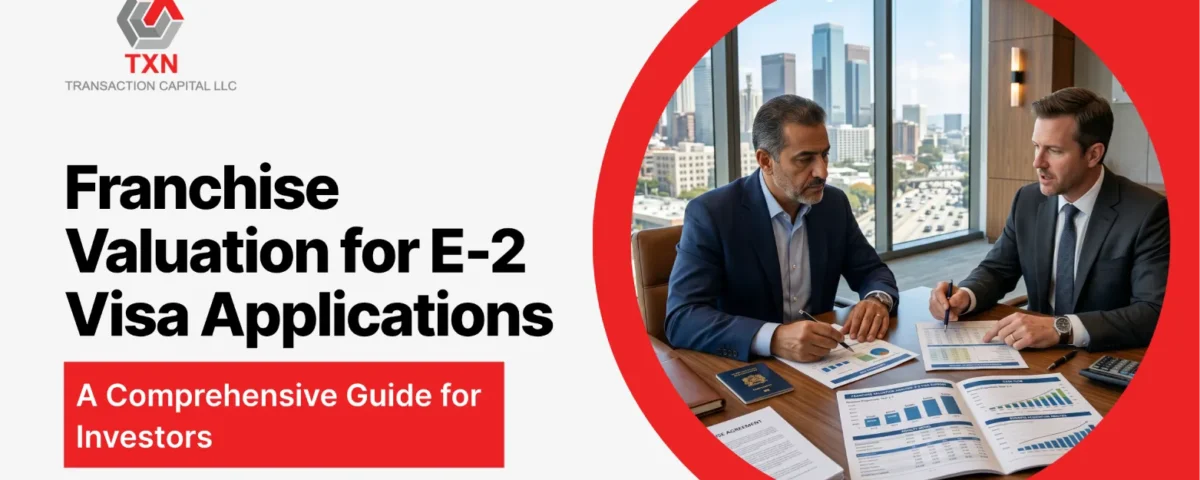
Franchise Valuation for E-2 Visa Applications: A Comprehensive Guide for Investors
 Dr. Gaurav B. (ABV®, ASA, CVA®, MRICS)
on
Dr. Gaurav B. (ABV®, ASA, CVA®, MRICS)
on

Dr. Gaurav B.
Founder & Principal Valuer, Transaction Capital LLC
Specialist in IRS-Compliant 409A & Complex Valuation Matters
Dr. Gaurav B. is the Founder and Principal Valuer of Transaction Capital LLC, a valuation and financial advisory firm providing independent, standards-based valuation opinions for startups, growth-stage companies, and established enterprises.
Foreign nationals pursuing a U.S. visa have many options. But few paths are as structured – or as investor-friendly – as the E-2 Treaty Investor route through franchise ownership.
Franchises come up with something most new businesses lack. You get a tested operating model, an established brand, hands-on training, and ongoing support before you even open your doors. For immigration purposes, this makes it considerably easier to prove commercial readiness.
Yet here is where many applicants stumble: they treat the valuation as paperwork rather than strategy.
Your E-2 visa franchise valuation is the financial spine of the entire application. It speaks directly to whether your investment is proportionate, whether your capital is genuinely at risk, and whether your business can stand on its own in the U.S. economy. A weak valuation invites a Request for Evidence (RFE). A strong one moves your petition forward.
Transaction Capital LLC (TXN Capital LLC) is among the most trusted valuation firms in the United States for E-2 investor visa purposes. Our appraisers carry ABV®, ASA®, CVA®, and MRICS® credentials – and every report is built to satisfy the evidentiary demands of U.S. consulates and USCIS adjudicators.
Key Takeaways
- The E-2 visa has no fixed investment minimum – the proportionality test decides what counts as substantial.
- Capital that sits idle in a personal account does not qualify as at-risk. It must be contractually committed.
- For brand-new franchise setups, the cost approach is the go-to valuation method – and the one adjudicator understands best.
- Mismatches between your valuation report, business plan, and financial projections are among the top causes of RFEs.
- A well-built valuation report supports not only initial approval but also visa renewals and extensions down the road.
- Franchise type changes everything – food, service, and retail concepts each carry different cost structures and valuation dynamics.
- Appraisers with ABV® or ASA® credentials provide a level of defensibility that generic reports simply cannot match.
The Role of Valuation in E-2 Visa Applications
To qualify for an E-2 visa, your application must satisfy four distinct requirements. Your valuation report must speak to every one of them – clearly and directly.
1. Substantial Investment does not mean hitting a specific dollar threshold. What matters is how your investment stacks up against the full cost of the business. That ratio – not the raw number – is what adjudicators examine. Lower-cost franchises demand a higher share of investor funding to clear this bar.
2. At-Risk Capital means money that is on the line. If the business collapses, the investor must stand to lose those funds. Cash parked in a personal savings account carries no risk. For capital to qualify, it must be formally committed – through escrow, contract, or direct expenditure.
3. Non-Marginality addresses whether the business is built to generate meaningful income. An enterprise that only supports the investor’s living expenses does not meet the standard. Adjudicators want to see a credible plan for hiring U.S. workers and producing returns beyond the owner’s subsistence needs.
4. Real and Operating Commercial Enterprise means the business is actively producing goods, services, or demonstrable preparation for operations. Passive investment structures do not qualify.
Taken together, a professionally prepared valuation bridges all four of these requirements. It connects the numbers in your Franchise Disclosure Document (FDD) to your business plan, your financial forecasts, and your source-of-funds paperwork – creating a coherent, defensible picture for the officer reviewing your case.
Is Your Country Eligible? E-2 Treaty Nations Explained
Before you evaluate franchises or prepare a valuation, there is one question that must be answered first: does your country have a qualifying treaty with the United States?
The E-2 visa is only available to nationals of countries that hold a Treaty of Commerce and Navigation — or an equivalent bilateral agreement — with the U.S. If your country is not on that list, the E-2 route is not open to you regardless of how strong your investment is.
Currently, more than 80 countries qualify for E-2 treaty status. Major treaty nations include:
- Europe: United Kingdom, Germany, France, Italy, Spain, Netherlands, Switzerland, Sweden, Poland, and Turkey
- Asia-Pacific: Japan, South Korea, Australia, Philippines, Thailand, and Taiwan
- Americas: Canada, Mexico, Colombia, Argentina, and Chile
- Middle East & Africa: Israel, Egypt, Jordan, and Ethiopia
However, there is a workaround some investors use. If you hold dual nationality — or can obtain citizenship in a treaty country — you may still qualify. This is a legal strategy but requires careful planning well in advance of the application.
Core E-2 Valuation Principles in Practice
1. The Proportionality Test
Think of this as the investment efficiency test. Adjudicators want to see that you have committed a meaningful share of the total startup cost – not left a large portion unfunded or unaccounted for.
A $130,000 commitment toward a $150,000 project – around 87% – presents a clean, compelling ratio. Full-service restaurant franchises with higher price tags may permit a slightly lower percentage. Service-based concepts with modest setup costs often require the investor to fund nearly the entire amount. The lower the total cost, the higher the proportion expected.
2. At-Risk and Irrevocably Committed Capital
Capital qualifies when it has been formally deployed – or is contractually obligated to be deployed. The following expenditures typically satisfy this standard:
- Non-refundable fees paid directly to the franchisor
- Lease deposits and contracted build-out costs
- Purchased or ordered equipment and fixtures
- Initial stock and supplies
- Payroll, rent, and marketing funds committed through binding agreements
Escrow arrangements work in your favor – provided the structure clearly defines release conditions and keeps the funds genuinely at risk until those conditions are met.
3. Non-Marginality and Economic Contribution
Projections in your valuation must show the franchise generating enough revenue to cover all expenses, repay any investor advances, and sustain employment for U.S.-based workers. A hiring roadmap spanning the first 12 to 24 months of operations strengthens this portion of the case considerably.
4. Active Management and Operational Control
Adjudicators need to see that you are running this business – not watching it from a distance while someone else manages operations. The valuation narrative should reflect an active, hands-on investor presence, not a passive ownership arrangement.
Start Your E-2 Application with Confidence
Speak with our certified valuation specialists for a free 15-minute consultation. USCIS-ready E-2 valuation reports delivered in 2-5 business days, starting at $500.
Book Your Free Consultation →E-2 Visa vs EB-5: Which Is Right for Franchise Investors?
Many foreign investors arrive at this crossroads. Both the E-2 and the EB-5 offer a legal pathway to living and working in the U.S. through business investment. But they are fundamentally different in cost, timeline, outcome, and suitability for franchise investors.
Understanding the difference helps you choose the right route — and ensures your valuation is built for the correct visa category from the start.
Factor | E-2 Treaty Investor Visa | EB-5 Immigrant Investor Visa |
Investment Minimum | No fixed minimum — proportionality-based | $800,000 (TEA) or $1,050,000 (standard) |
Visa Type | Non-immigrant (temporary) | Immigrant (leads to Green Card) |
Green Card Path | Not a direct path | Yes — conditional Green Card within 2 years |
Processing Time | 3–6 months (consular route) | 2–5+ years depending on country of origin |
Eligibility | Treaty country nationals only | Open to all nationalities |
Ownership Requirement | Minimum 50% ownership | 10–100% depending on structure |
Active Management Required | Yes — investor must direct the business | Not always — passive investment options exist |
Job Creation Requirement | Indirect — must support non-marginality | Direct — must create 10 full-time U.S. jobs |
Franchise Suitability | Excellent — fast, lower cost, proven model | Possible but complex due to job requirements |
Renewal | Renewable indefinitely in 2-year increments | Permanent once conditions are removed |
Valuation Requirement | Essential for proportionality and at-risk proof | Required for project and enterprise valuation |
Key Components Included in Franchise Valuation for E-2 Purposes
Each line item in your startup budget contributes to the overall picture of invested capital. A professional valuation accounts for all the following:
Cost Component | What It Captures | Indicative Range |
Franchise Fee | Non-refundable payment to secure the franchise license | $10,000 – $50,000+ |
Build-Out & Improvements | Renovation, interior work, signage, and permits | Location-dependent |
Equipment & Technology | Appliances, POS systems, specialized tools, vehicles | $20,000 – $150,000+ |
Opening Inventory | Product and supply stock needed before launch | $5,000 – $50,000+ |
Working Capital Reserve | Funds for rent, salaries, utilities during ramp-up | $20,000 – $100,000+ |
Professional & Setup Fees | Legal, accounting, licensing, and training expenses | $5,000 – $25,000+ |
The FDD’s Item 7 sets the standardized cost benchmark for your franchise category. A credible valuation stays consistent with those figures – while incorporating real quotes, signed agreements, and location-adjusted estimates to reinforce accuracy.
Valuation Methodologies Appropriate for E-2 Franchise Investments
Three recognized approaches apply to E-2 franchise valuations. Which combination is used depends on the specific investment and the evidence available.
1. Cost Approach (Most Common for New Franchises)
This method builds value from the ground up – adding every verified cost associated with launching the business. Franchise fees, construction costs, equipment purchases, inventory, and working capital all go into the calculation.
It is the most transparent of the three methods and maps directly onto what adjudicators are looking for: proof that specific, documented dollars have been committed. For new franchise developments, this is typically the lead method.
2. Income Approach
Rather than looking at what has been spent, this method looks forward – estimating how much the business will generate over time, then discounting those future earnings to a present-day value.
This approach suits franchise resales better than startups, since historical revenue data makes the projections far more defensible. When applied to a new setup, the assumptions must be conservative and grounded in franchisor-provided benchmarks. Inflated forecasts are a common trigger for RFEs.
3. Market Approach
This method compares the subject of franchise to recent arm-length sales of similar businesses. Adjustments are made for differences in size, location, and operating conditions.
For brand-new franchise setups, this approach plays a supporting role rather than a primary one. In resale transactions, however, it can be central – particularly when recent comparable sales data is available and reliable.
Most E-2 valuations lead with the cost approach and layer in one or both other methods to add analytical depth. A well-reasoned hybrid report is typically more persuasive than any single approach in isolation.
Valuation Considerations: New Franchises vs. Existing (Resale) Businesses
The stage and nature of your franchise investment change the entire valuation strategy. Here is how the two scenarios compare across the dimensions that matter most:
Dimension | New Franchise | Resale / Existing Franchise |
Lead Valuation Method | Cost approach | Income + Market approach |
Primary Focus | Startup costs, capital commitment, and business plan | Historical revenues, goodwill, and operational track record |
Core Documents Referenced | FDD Item 7, cost estimates, development timeline | Tax filings, P&L statements, purchase agreement |
Revenue Support | Franchisor averages and market-based projections | Verified historical income data |
Intangible Value Considered | Minimal – limited to brand license | Goodwill, client relationships, transferable contracts |
Proof of At-Risk Capital | Contracts, invoices, deployment schedule | Purchase price, escrow, and transfer fee documentation |
Typical Application Strength | Relies on quality of the business plan | Bolstered by proven commercial performance |
Common Adjudicator Concern | Demonstrating viability without operating history | Justifying a price that exceeds tangible asset value |
For new developments: the application lives and dies on the business plan. The stronger your projections – and the better they align with FDD benchmarks – the more convincing the valuation becomes.
For resales: historical performance is your biggest asset. Actual revenue, real job creation, and a track record of operations make the substantial and non-marginal arguments far easier to support. Just ensure the acquisition price reflects fair market value – otherwise it becomes a weakness rather than a strength.
What Makes an E-2 Valuation USCIS-Compliant?
Generic appraisals prepared for tax filings or bank financing do not satisfy E-2 adjudication requirements. Consular officers look for specific elements that most standard reports do not address.
A USCIS-compliant E-2 franchise valuation must check every one of these boxes:
- Signed by a credentialed appraiser – ABV®, ASA®, CVA®, or MRICS® designation required
- Directly addresses all four E-2 criteria – substantial investment, at-risk capital, non-marginality, and active business operations
- Consistent with FDD figures and all supporting documentation submitted in the petition
- States the methodology clearly with a professional opinion of value – not just a number
- Free of internal contradictions with the business plan, financial projections, or source-of-funds evidence
An adjudicator who finds a mismatch between the valuation and another document in the packet will flag it. An RFE or denial often follows. There is no recovering that credibility gap easily once it has been identified.
Transaction Capital LLC builds every E-2 valuation specifically to this standard. [Connect with our ABV® or ASA® certified appraisers to discuss your application.]
Ensuring Consistency Across the E-2 Application Package
Your E-2 petition is reviewed as a package – not documented by document. The valuation, business plan, financial projections, and source-of-funds of paperwork must all point to the same conclusion.
Pay particular attention to these common misalignment points:
- Revenue projections that do not reflect the size of the investment
- Hiring timelines disconnected from the payroll budget in your financials
- Build-out costs that contradict the lease terms or location data
- Capital flow that cannot be clearly traced from its source to its point of commitment
Adjudicators are trained to cross-reference. Even one number that does not reconcile across documents can stall or derail an otherwise strong application.
Common Pitfalls in Franchise Valuation for E-2 Applications
These are the mistakes that generate RFEs – or worse, denials – in otherwise qualifying cases:
- Understating the total project cost – creates the appearance of a marginal operation or inadequate planning
- Projecting unrealistic revenue without franchisor data or local market support to back it up
- Structuring the investment passively – if the business plan does not reflect active owner involvement, adjudicators take notice
- Submitting incomplete documentation – missing invoices, wire records, or contracts undermine every dollar you claim to have invested
- Treating undeployed cash as qualified capital – reserves without contractual commitment do not clear the at-risk threshold
- Deviating from FDD Item 7 figures without a clear, documented explanation for the difference
Essential Documentation Supporting the Valuation
The quality of a valuation report is inseparable from the quality of the documents behind it. Before engaging any firm, organize the following:
- Signed franchise agreement along with all addenda and amendments
- The most current Franchise Disclosure Document (FDD)
- Executed lease agreement or a formal letter of intent for the business premises
- Itemized invoices, vendor contracts, and payment records for build-out and equipment
- Bank records and international wire confirmations tracing fund movement
- Escrow agreement documentation, where applicable
- Full business plan inclusive of multi-year financial projections
- Complete source-of-funds package tracing invested capital back to its origin
All reports prepared by Transaction Capital LLC (TXN Capital LLC) are signed by ABV®, ASA®, CVA®, and MRICS® credentialed professionals – and built specifically to satisfy the documentation standards expected at the consular and USCIS level.
Industry-Specific Considerations in Franchise Valuation
The franchise category you choose shapes the entire valuation profile. One approach does not fit every sector.
1. Food and Beverage Franchises – It represents the most capital-intensive category. Total investment figures routinely land between $200,000 and $500,000 – and frequently higher for full-service restaurant formats. Health department permitting, commercial kitchen equipment, and extensive interior build-out are primary cost drivers. These franchises tend to show strong revenue potential, but they also demand significant labor management – a factor that must be reflected in hiring projections.
2. Service-Based Franchises – spanning cleaning services, fitness studios, tutoring centers, and home maintenance concepts – sit at the lower end of the investment spectrum, typically between $100,000 and $350,000. They scale more efficiently and often suit solo investor-operators. The trade-off is that lower total investment means the proportionality threshold is more demanding, and the business plan needs to make a compelling non-marginality argument through client volume and growth trajectory.
3. Retail Franchises occupy the middle range – with costs driven primarily by inventory requirements and the premium placed on high-footfall locations. Brand strength and supply chain reliability are the business fundamentals that drive value in this category, and the valuation narrative should address both.
Strategic Recommendations for Investors
Seven practical actions that consistently strengthen E-2 franchise applications:
- Bring in your valuation firm before you finalize the franchise selection – not after you have already signed agreements.
- Calculate your proportionality ratio early – particularly if the franchise falls in the lower cost range.
- Match every financial figure in your business plan to the corresponding number in your FDD and valuation report.
- Document every dollar from its source to its destination – clear fund trails remove the single biggest adjudicator doubt.
- Build a realistic hiring plan with named positions, start dates, and salary estimates covering the first two years.
- Use escrow thoughtfully – structure it to protect your capital while keeping it unambiguously at risk.
- Let the business plan speak to active management – job titles, management responsibilities, and day-to-day decision-making authority should all be explicit.
A valuation built on this foundation does more than win initial approval. It creates documentation you can return to at each renewal cycle, backed by actual performance data.
How Long Does the E-2 Franchise Visa Process Take?
Timeline is one of the first things franchise investors want to understand — and one of the last things most valuation guides explain. Here is a clear picture of what to expect from the moment you engage in a valuation firm to the moment you receive your visa.
E-2 Process Stage | Typical Duration |
Franchise selection and U.S. entity setup | 4–8 weeks |
Valuation report (TXN Capital) | 2–5 business days |
Business plan preparation | 2–4 weeks |
Application assembly and attorney review | 2–4 weeks |
Consular interview scheduling | 2–6 weeks |
Consular processing post-interview | 2–6 weeks |
Total estimated timeline | 3–6 months |
Visa validity period | 2 years per grant |
Renewal eligibility | Indefinite |
Long-Term Implications of a Robust Valuation
Clearing the initial adjudication is the first milestone – not the last. A well-constructed franchise valuation continues working for you well after the visa is issued.
It gives you a baseline against which real performance can be measured. It strengthens financing conversations with U.S. banks and lenders who want independent proof of enterprise value. It documents the capital structure clearly enough that future accountants, attorneys, or business partners can build on it.
And when your renewal comes around, adjudicators compare what you said you would do with what you actually did. Investors who began with a credible, detailed valuation – and then delivered on its projections – make that conversation straightforward. Those who did not often find it significantly harder.
Conclusion
Securing an E-2 visa through franchise ownership demands more than enthusiasm and available capital. It demands a valuation that makes your case – clearly, credible, and complete.
The investment must be shown as substantial and at risk. The business must be shown as real, active, and capable of generating meaningful economic contribution. Every document in the packet must reinforce the same story.
When prepared to professional standards, a franchise valuation does all of that simultaneously.
Transaction Capital LLC (TXN Capital LLC) has built a reputation as one of the most reliable valuation partners for E-2 investors in the United States. Our appraisers hold ABV®, ASA®, CVA®, and MRICS® designations. Every report we deliver is constructed to withstand consular review, USCIS adjudication, and future renewal scrutiny – while giving you a strategic asset you can use to manage and grow your business.
Investors who combine precise valuation with solid documentation and professional support do not just get approved. They build the foundation for a genuinely successful U.S. business operation.
Need a USCIS-Ready E-2 Franchise Valuation?
Get your E-2 franchise valuation report prepared by ABV® and ASA® certified professionals. Reports start at $500 and are delivered within 2-5 business days.
Book Your Free Consultation →Frequently Asked Questions
1. Is there a minimum investment amount required for an E-2 franchise visa?
No fixed dollar threshold exists under E-2 rules. What counts is the ratio of your investment to the total business cost – the proportionality test. Most qualifying cases involve commitments of $100,000 or more, though the percentage invested matters as much as the absolute amount.
2. Does the initial franchise fee count toward the E-2 investment?
Yes. Because franchise fees are non-refundable once paid, they represent genuine at-risk capital. They qualify as part of the total committed investment and strengthen the substantiality of argument.
3. Can working capital be included in the E-2 franchise valuation?
Yes – provided it is clearly earmarked for specific pre-opening or early operating expenses, with a documented deployment plan. Unallocated reserves sitting in a bank account without contractual commitment generally do not qualify.
4. Is a formal business valuation report required for every E-2 application?
It is not always legally mandated, but it is strongly advisable in nearly every case. A professionally certified report resolves the most common adjudicator questions about investment size, business viability, and capital commitment – particularly for resale acquisitions or more complex investment structures.
5. Can borrowed funds be used for the E-2 investment?
Yes, but the loan must be secured by the investor’s personal assets – not solely by the business itself. Loans backed only by business collateral are generally not considered genuinely at risk, which can weaken the core at-risk capital requirement.
6. How critical is the Franchise Disclosure Document (FDD) in the valuation process?
The FDD is foundational. It provides standardized cost estimates, franchisor obligations, and operational details that your valuation and business plan must directly align with. Any significant deviation from FDD Item 7 figures – without a clearly documented explanation – raises credibility concerns with adjudicators.
7. Can lower-cost franchises still qualify for an E-2 visa?
Yes, but the investor must typically commit a very high percentage of the total project cost – often 90% or more – to satisfy the proportionality test. The lower the overall investment threshold, the stronger the percentage requirement becomes to demonstrate genuine substantiality.
8. What are the risks of submitting a valuation that appears too low?
A valuation that understates the investment or business value raises concerns about marginality, insufficient planning, and lack of genuine commitment. It significantly increases the likelihood of an RFE requiring additional evidence – or, in more serious cases, contributes directly to denial of the petition.
9. Do escrow arrangements help demonstrate capital?
Yes – when structured correctly. Escrow funds must be irrevocably committed and subject to loss under defined conditions, such as visa approval or a specific triggering event. A well-drafted escrow agreement protects the investor while satisfying the at-risk requirement that adjudicators look for.
10. How does the initial valuation affect future E-2 extensions or renewals?
It sets the performance baseline. At renewal, adjudicators compare what was projected in the initial valuation against what was achieved – jobs created, revenue generated, and capital fully deployed. A credible initial valuation backed by real operating results makes future extensions substantially easier to support.
Read More:
- E-2 Visa Business Valuation Requirements: USCIS Guidelines Explained
- E-2 Visa Valuation Report: What USCIS Officers Look For
- E-2 Visa Business Valuation: A Complete 2026 Guide for Treaty Investors
- Why a Professional Business Valuation Is Critical for E-2 Visa Approval
- E-2 vs EB-5 Valuation Requirements Compared: A Comprehensive Guide for Investors