How to Value a Blockchain Company in 2026
 Dr. Gaurav B. (ABV®, ASA, CVA®, MRICS)
on
Dr. Gaurav B. (ABV®, ASA, CVA®, MRICS)
on


Dr. Gaurav B.
Founder & Principal Valuer, Transaction Capital LLC
Specialist in IRS-Compliant 409A & Complex Valuation Matters
Dr. Gaurav B. is the Founder and Principal Valuer of Transaction Capital LLC, a valuation and financial advisory firm providing independent, standards-based valuation opinions for startups, growth-stage companies, and established enterprises.
Introduction
Blockchain company valuation in 2026 is fundamentally different from valuing any other type of business. Standard financial models built for traditional companies routinely miss the most powerful drivers of blockchain value – network effects, token economics, protocol revenue, and on-chain adoption signals. If you apply an EBITDA multiple or a basic DCF to a Layer-1 blockchain, you will undervalue or overvalue it by a wide margin.
This guide from Transaction Capital LLC cuts through complexity. Whether you are a founder preparing for fundraising, an investor conducting due diligence, a CFO managing tax compliance, or an attorney building an E-2 Visa case, this resource gives you a practical, IRS-compliant, audit-ready framework for blockchain company valuation.
Our ABV®, ASA, MRICS, and CVA® certified professionals have completed 2,500+ valuations across 35+ industries, and this article reflects what we’ve learned working directly in the blockchain valuation space.
Need an Expert Review of Your Blockchain Company’s Value?
Schedule a free 15-minute consultation with our certified appraisers today.
Why Does Blockchain Company Valuation Differ from Traditional Business Valuation?
Blockchain companies operate on fundamentally different principles than traditional enterprises. A SaaS company generates recurring subscription revenue and can be valued using ARR multiples. A blockchain protocol may generate no off-chain revenue at all – and yet be worth hundreds of millions of dollars because of the economic activity flowing through its network.
Here’s what makes blockchain valuation genuinely different:
Traditional valuation methods miss up to 70% of a blockchain company’s intrinsic value by ignoring these unique characteristics:
1. Network-driven value creation. The more participants join a blockchain network, the more valuable it becomes for every existing participant. This is the network’s effect, and it scales exponentially — not linearly.
2. Token-based capital structures. Blockchain companies often issue utility tokens, governance tokens, security tokens, or NFTs. Each type carries a different economic function and requires a different valuation lens.
3. Decentralized operations. DAOs, smart contracts, and distributed governance replace traditional corporate hierarchies. This affects how value is created, distributed, and defended.
4. Protocol revenue. Transaction fees, staking commissions, bridge fees, and treasury yields are cash flows unique to blockchain infrastructure. Standard EBITDA analysis doesn’t know how to handle them.
5. Community as a moat. In blockchain, developer activity, governance participation, and wallet growth are competitive moats as defensible as patents or switching costs in traditional industries.
Standard DCF models, EBITDA multiples, and comparable company analysis cannot adequately capture these dynamics. You need blockchain-native frameworks – and that’s exactly what this guide delivers.
What Are the Key Questions to Answer Before Valuing a Blockchain Company?
Before applying any valuation methodology, you need to establish five facts about the company. These answers determine which methods are valid and which would produce misleading results.
1. Does the company issue a native token? Is it publicly traded, in a private phase, or pre-issuance?
2. What is the token function? Utility, governance, security, or NFT? Each category has different valuation rules — and different regulatory implications under SEC and IRS guidance.
3. Is there off-chain revenue? API licensing, premium dashboards, enterprise subscriptions, or SaaS integrations are a critical bridge to traditional valuation models.
4. How active is the user base? Monthly active wallets (MAW), daily active users (DAU), DAU-to-MAU ratios, and transaction frequency are primary signals. High DAU/MAU ratios indicate sticky, engaged users — not just passive holders.
5. What layer is it on? A Layer-1 base protocol (like Ethereum or Solana) carries very different valuation dynamics than a Layer-2 scaling solution (like Arbitrum or Base). Layer-1s derive value from ecosystem breadth; Layer-2s derive value from cost reduction and throughput improvements over the base chain.
Pre-Valuation Analysis: The 5-Component Framework
Our ABV® and ASA certified appraisers follow a structured pre-valuation analysis for every blockchain engagement. Each component shapes which methodologies apply and how.
1. Token Structure and Function Analysis
The first step is classifying the token precisely. Is it a utility token (access to network services), a governance token (voting rights over protocol decisions), a security token (representing equity or debt), or a non-fungible token (representing unique digital ownership)?
Beyond classification, you need to examine:
- Total supply vs. circulating supply and the emission schedule
- Vesting schedules and lockup periods for team and investor allocations
- Whether the token is publicly traded on centralized or decentralized exchanges
- Burn mechanisms that reduce supply over time
A token with a 10 billion total supply but only 200 million circulating tokens carries significant dilution risk that must be priced into the valuation. This is analogous to a fully diluted cap table analysis in traditional equity valuation.
2. Revenue Model Assessment
Blockchain revenue streams fall into two broad categories: on-chain revenue (transaction fees, staking commissions, protocol fees, and treasury yield from DeFi strategies) and off-chain revenue (enterprise subscriptions, API licensing, and consulting services).
Many early-stage blockchain companies have minimal or zero off-chain revenue. In those cases, on-chain protocol revenue becomes the primary financial input for income-based approaches. For pre-revenue protocols, valuation shifts entirely to network effects and ecosystem development metrics.
3. Network Architecture Evaluation
The underlying infrastructure matters. A Proof-of-Stake protocol with 200 active validators carries lower centralization risk than one with 10. Layer classification (L1, L2, L3, or application-layer), consensus mechanism, and cross-chain interoperability each affect security, scalability, and competitive positioning.
Interoperability is increasingly important in 2026. Protocols that can bridge assets and data across multiple chains of command premiums over isolated, single-chain ecosystems.
4. User Adoption and Network Metrics
The following on-chain metrics are essential inputs for any credible blockchain valuation:
- Monthly Active Wallets (MAW): The core network health metric
- Daily Active Users (DAU) / Monthly Active Users (MAU) ratio: A high ratio (above 25%) indicates daily habit-forming engagement
- Transaction volume and frequency: Measures economic activity flowing through the protocol
- Validator participation rate: Higher staking participation indicates community confidence and network security
- GitHub activity: Weekly commits, active contributors, and open pull requests measure developer momentum
- Community size on Discord/Telegram: Active community engagement correlates with long-term adoption and organic growth
5. Regulatory Compliance Status
Regulatory standing has a direct, quantifiable effect on valuation. A protocol that has received a no-action letter from the SEC commands a premium over one facing an active enforcement investigation. Geographic regulatory compliance across the US, EU (MiCA framework), and Asia-Pacific jurisdictions is a key risk factor that professional valuers must adjust for.
The 5 Core Blockchain Valuation Methods
Professional blockchain valuation requires a blended approach — combining multiple methodologies to arrive at a defensible, comprehensive range. Relying on a single method introduces significant estimation errors. In our practice, we always apply at least two methods and use a third as a sanity check.
Method 1: Network Effects Valuation (Metcalfe’s Law)
Best for: Layer-1 blockchains, social protocols, and any network where value scales with participation.
Metcalfe’s Law states that a network’s value is proportional to the square of its connected users. Mathematically: V = n², where V is network value and are the number of connected users or nodes. Originally developed by Robert Metcalfe for telecommunications, it maps closely to blockchain networks where each new participant creates additional interaction possibilities for everyone already in the system.
Formula applied to blockchain:
Network Value ∝ (Active Users) ²
Example calculation:
- Monthly Active Wallets: 50,000
- Network coefficient (based on comparable protocols): 0.05
- Quality multiplier (strong ecosystem): 1.2
- Estimated Network Value: (50,000) ² × 0.05 × 1.2 = $150 million
Key considerations:
- User quality matters more than raw quantity – distinguish active transaction wallets from dormant or bot-driven addresses
- Network effects plateau at certain adoption levels – apply diminishing returns adjustments for large mature networks
- Competitive positioning affects coefficient selection – a protocol facing a dominant L1 competitor warrants a lower coefficient than a first mover in its segment
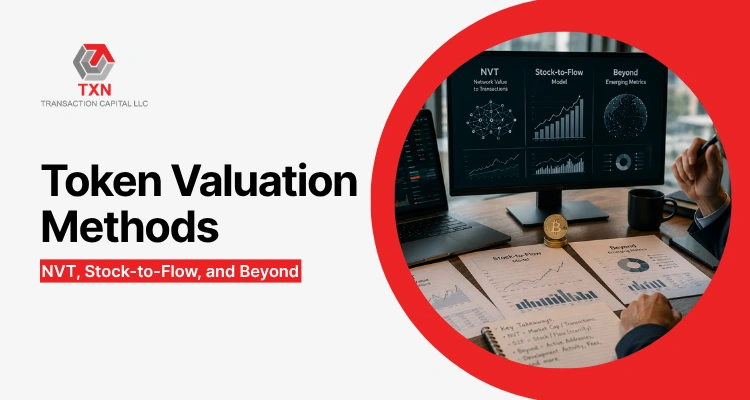
Method 2: Network Value to Transactions (NVT) Ratio
Best for: Mature protocols with consistent on-chain transaction volume.
The NVT Ratio is the blockchain equivalent of a price-to-earnings ratio. It divides the network’s total market capitalization by its daily transaction volume (on-chain economic throughput).
Formula:
NVT Ratio = Market Capitalization ÷ Daily On-Chain Transaction Volume
A high NVT suggests the market is pricing in future growth relative to current economic utility – like a high P/E. A low NVT indicates the network is generating significant economic activity relative to its market cap, suggesting undervaluation or a mature, utility-driven stage.
NVT is particularly useful as a cross-protocol comparison tool. When benchmarked against comparable networks in the same sector, it reveals whether a protocol is priced at a premium or discount relative to its on-chain utility.
Method 3: Token-Based Market Valuation
Best for: Projects with publicly tradeable tokens and established exchange liquidity.
This method analyzes token market dynamics while accounting for critical adjustments that distinguish blockchain assets from liquid equities.
Core formula:
Token Valuation = (Market Cap × Liquidity Adjustment) − Marketability Discount
Liquidity tiers:
Liquidity Level | Daily Volume / Market Cap | Exchange Presence | Typical DLOM |
High | > 2% | 5+ major exchanges | 5–10% |
Moderate | 0.5–2% | 2–3 exchanges | 15–25% |
Low | < 0.5% | 1 exchange or DEX only | 30–45% |
Critical rule: Marketability discounts apply to illiquid tokens — but do not apply to vested tokens. Vesting schedules represent timing restrictions, not ownership limitations. Misapplying a DLOM to vested tokens inflates the discount and understates value.
Method 4: Protocol Revenue Valuation
Best for: Mature protocols with consistent, measurable fee generation and cash flow visibility.
This method adapts the income-based approach to blockchain by treating protocol fee revenue the way traditional valuation treats EBITDA — as the financial anchor of the analysis.
Revenue sources to measure:
- Transaction fees (gas fees, swap fees, bridge fees)
- Staking commissions (validator rewards, delegation fees)
- Protocol fees (governance-directed fee collection)
- Treasury income (DeFi yield, bond issuance, investment returns)
Valuation formula:
Protocol Valuation = Annual Protocol Revenue × Industry Multiple
Industry multiple benchmarks for 2026:
Protocol Type | Revenue Multiple Range | Key Driver |
DeFi Protocols | 8–15x | TVL growth rate, composability |
Layer-1 Blockchains | 10–20x | Ecosystem breadth, validator count |
Layer-2 Solutions | 6–12x | Cost savings vs. L1, dApp adoption |
NFT Marketplaces | 5–10x | Trading volume, creator network |
DePIN Networks | 7–14x | Physical asset utilization, IoT integration |
Blockchain Gaming | 4–8x | Daily active players, in-game economy |
Example: A DeFi protocol generating $3M in annual protocol revenue, with a high-growth trajectory and strong TVL, could reasonably be valued at $3M × 10x = $30 million under a conservative protocol revenue approach.
Method 5: Ecosystem Development Valuation
Best for: Early-stage networks with limited or no revenue but strong developer momentum and partnership traction.
When quantitative financial data is thin, professional valuers pivot to qualitative-quantitative scoring frameworks. This method values the company based on the quality of its ecosystem infrastructure.
Scoring framework (1–10 scale per factor):
Factor | What to Measure | Weight |
Technical Innovation | Novel consensus mechanism, scalability improvements | High |
Developer Adoption | GitHub commits, SDK usage, hackathon participation | High |
Institutional Interest | VC backing, enterprise pilots, grants received | Medium |
Competitive Position | First-mover advantage, protocol market share | Medium |
Partnership Quality | Enterprise partnerships, institutional collaborations, government pilots | High |
Valuation ranges by composite score:
- Score 8–10: $50M–$200M valuation range
- Score 6–8: $20M–$80M valuation range
- Score 4–6: $5M–$30M valuation range
- Score below 4: Elevated risk, limited institutional investability
Advanced Token Valuation: Velocity Model and Staking Analysis
Two additional models are used in sophisticated engagements.
1. Velocity-Based Token Valuation
This model is borrowed from monetary theory. High token velocity (tokens changing hands frequently) suggests that the token is used primarily as a medium of exchange, not a store of value. Lower velocity suggests holding behavior, which supports higher per-token value.
Formula:
Token Value = (Network GDP × Velocity Adjustment) ÷ Token Supply
- Network GDP: Total economic value transacted through the network annually
- Velocity: Average number of times each token changes hands per year
- Insight: Protocols that design token burn mechanisms, staking incentives, or governance lockups to reduce velocity are actively engineering higher token value
2. Staking Yield Analysis
For Proof-of-Stake networks, staking economics are a direct financial input:
- Staking APY: The annualized yield for token holders who stake
- Staking ratio: The percentage of total supply currently staked (higher ratios reduce circulating supply and support price)
- Validator performance metrics: Uptime history, slashing incidents, and commission rates
A protocol where 65% of total supply is actively staked shows strong holder conviction and structural supply constraint — both of which support valuations at the higher end of the applicable range.
Sector-by-Sector Valuation Considerations in 2026
1. DeFi (Decentralized Finance)
DeFi remains the most analytically developed blockchain subsector. Total Value Locked (TVL) is the headline metric — but it should never be evaluated in isolation. A protocol with $500M TVL but declining fee revenue and falling user numbers is deteriorating despite an impressive headline figure.
Key valuation factors:
- TVL sustainability and historical retention rates
- Fee generation per dollar of TVL (protocol efficiency ratio)
- Composability depth — how many other protocols depend on this one
- Liquidity concentration risk (are a few large wallets dominating TVL?)
The DeFi market was valued at $13.8 billion in 2022 and is projected to reach $497.9 billion by 2032. This growth trajectory supports higher revenue multiples for protocols with defensible market positions.
2. DePIN (Decentralized Physical Infrastructure Networks)
DePIN is the fastest-growing emerging sector in 2026. These networks use blockchain to decentralize management of physical infrastructure — energy grids, wireless internet, transportation systems, and IoT sensor networks. The DePIN addressable market is currently estimated at approximately $2.2 trillion and is projected to expand to $3.5 trillion by 2028.
DePIN introduces valuation complexity that no traditional framework handles well. You are essentially valuing a hybrid entity: part software protocol, part physical infrastructure operator. Key metrics include:
- Physical asset utilization rate (network hardware coverage)
- Token incentive efficiency (cost per unit of real-world capacity added)
- IoT device integration depth
- VC deal activity in the sector (which surged from $195M in 2021 to $578M+ in 2022)
3. Blockchain Gaming and Metaverse
The blockchain gaming market was valued at approximately $154.46 billion in 2023 and is projected to reach $614.91 billion by 2030, with a CAGR of 66.5%. This rapid growth creates both opportunity and valuation complexity.
Key valuation signals:
- Daily active players and 30-day retention rates
- In-game asset trading volume and marketplace take rates
- Play-to-earn economics sustainability (can the token economy support itself without inflation?)
- Cross-game asset interoperability
4. NFT Marketplaces
NFT marketplace valuation pivots on gross marketplace volume and the platform’s take rate. A marketplace processing $50M per month in NFT sales at a 2.5% take rate generates $1.25M in monthly revenue — a concrete income figure that supports traditional revenue multiple analysis.
Additional factors: creator adoption of velocity, floor price stability of flagship collections, and royalty enforcement mechanisms.
5. Layer-2 Scaling Solutions
Layer-2 networks derive value from their ability to reduce transaction costs and increase throughput relative to their base Layer-1 chain. Key metrics:
- Transactions per second (TPS) relative to L1 baseline
- Average gas fee savings for users (% reduction)
- Number of dApps deployed on the L2
- Total bridged value (assets locked in the L2 bridge from L1)
Real-World Valuation Example: Eco Layer Protocol
To ground these methodologies in a practical context, consider this hypothetical carbon credit tokenization platform.
Project details:
- Project: EcoLayer (Layer-1 blockchain for carbon credit settlement)
- Native Token: ECO | Total Supply: 1 billion | Circulating: 400 million
- Token price: $0.30
- Treasury: 200 million tokens = $60 million
- Annual Protocol Revenue: $3 million
- Monthly Active Wallets: 50,000
- Strategic Partnership: UN-backed sustainability initiative
Blended valuation results:
Method | Valuation Output |
Token Market Cap (circulating) | $120 million |
Protocol Revenue (8x multiple — ESG sector) | $24 million |
Metcalfe’s Network Effects | ~$200 million |
Ecosystem Premium (UN partnership, regulatory tailwinds) | +$25M uplift |
Weighted blended conclusion:
- Conservative (income-weighted): $100 million
- Moderate (balanced blend): $125 million
- Optimistic (network effects dominant): $150 million
Professional fair value range: $100M – $150M
The wide range reflects genuine uncertainty inherent in early-stage protocol valuation — not analytical imprecision. Communicating this range honestly to investors, auditors, and regulators is part of responsible valuation practices.
M&A Landscape: What Blockchain Acquisitions Tell Us About Value
Understanding recent M&A activity provides essential context for market-based blockchain valuations. Despite market volatility, blockchain M&A activity has shown resilience. Notable 2023 transactions included Coinbase’s acquisition of One River Digital Asset Management, Ripple’s acquisition of Metaco, Bakkt’s acquisition of Apex Crypto, and MIAX’s acquisition of LedgerX.
These deals establish precedent transaction multiples for specific blockchain subsectors — infrastructure platforms, digital asset custodians, and exchange technology companies. When performing a guideline transaction analysis, our ASA and ABV® certified team benchmarks against these recent deals to calibrate multiples.
The M&A trend is accelerating. Established financial institutions are acquiring blockchain infrastructure to gain competitive access to digital asset capabilities — validating the strategic value that founders and early investors have been building. This consolidation dynamic also affects valuation: a protocol with clear acquisition appeal commands a strategic premium over one without obvious acquirer synergies.
FASB 2026 Accounting Update: What Every Blockchain CFO Must Know
The Financial Accounting Standards Board (FASB) introduced significant new guidance for crypto assets, effective for fiscal periods beginning after December 15, 2025. This change materially affects how blockchain company balance sheets are prepared — and how professional valuation inputs into financial reporting.
Key change: Companies must now measure certain crypto assets at fair value, with both increases and decreases recognized in net income for each reporting period. This replaces the previous “impairment-only” approach, which only recognizes losses, never gains.
Assets excluded from fair value requirement:
- Wrapped tokens
- Tokens created or issued by the reporting entity or related parties
- Non-fungible tokens (NFTs)
- Stablecoins and similar assets
This new standard means that public companies and many private companies need quarterly valuations of their booked crypto assets. Privately held companies need minimum annual fair value assessments.
Additionally, purchase price allocations under ASC 805 now explicitly include crypto assets as identifiable intangible assets. When a blockchain company is acquired, the acquirer must separately value smart contracts, DApps, platform interfaces, regulatory licenses, customer data, mining rights, and any crypto assets used as acquisition consideration.
Intellectual property transfers to DAOs: Increased IRS and international tax authority scrutiny now targets intercompany transactions where blockchain and crypto companies transfer IP to foundations, DAOs, or low-tax jurisdiction entities. IP valuations for these transfers must meet Transfer Pricing standards and demonstrate arm-length pricing. Our team supports both the initial IP valuation and the documentation required for audit defense.
When Does a Blockchain Company Need a Professional Valuation?
1. Fundraising and Investor Rounds
Every equity round — Seed, Series A, Series B — requires a documented fair market value to establish a defensible basis for share pricing. If your company also issues tokens, SAFT (Simple Agreement for Future Tokens) offerings require an independent fair value determination of the token being promised to investors.
Investor due diligence increasingly demands audit-ready valuation reports. Institutional investors will not accept founder-asserted valuations without independent certification.
2. 409A Valuation for Employee Token Grants
This is the most missed compliance requirement for blockchain companies. Under IRC Section 409A, stock options and token grants must be issued at or above fair market value. Issuing options below FMV expose your employees to a 20% penalty tax on top of ordinary income tax – even before the options are exercised.
For blockchain companies granting both equity options and token grants, a 409A valuation is essential for every issuance event. Transaction Capital specializes in 409A valuations for token-granting companies, applying the same methodology used for traditional equity — adapted for the token’s liquidity profile and economic structure.
3. ASC 718 Compliance for Employee Token Compensation
When employees receive token compensation, ASC 718 (stock-based compensation) requires recognizing a compensation expense equal to the fair value of the tokens at grant date. Getting this fair value wrong creates financial restatement risk – a serious problem for any company preparing institutional investment or an IPO.
4. IRC Section 83(b) Elections for Token Grants
Founders and early employees who receive restricted tokens should seriously consider a Section 83(b) election – electing to pay tax on the fair market value at grant rather than at vesting. When the token is worth $0.001 at grant and $10.00 at vesting, the tax savings can be substantial. This requires a defensible FMV opinion from a qualified appraiser at a grant date.
5. Tax Compliance: Airdrops, Hard Forks, and Staking Rewards
The IRS treats cryptocurrency as a property. That means every taxable event – receiving an airdrop, a hard for creating new tokens, or earning staking rewards – triggers a requirement to report USD-denominated fair market value at the time of receipt. Without a professional valuation methodology to support these figures, you are exposed to any IRS audit.
6. Estate and Gift Tax Planning
With the TCJA estate tax exemptions scheduled to sunset in 2026, high-net-worth individuals holding significant blockchain assets and token positions face urgent planning windows. Gift and estate tax valuations of token interests can apply Discounts for Lack of Marketability (DLOM) of 20–40%, dramatically reducing the taxable value of transferred assets.
7. Merger and Acquisition Transactions
Strategic blockchain acquisitions require comprehensive enterprise valuations before deal closing. Component valuations may include the protocol itself, the token treasury, smart contracts as intangible assets, user relationships, and any proprietary technology. Our ASC 805 purchase price allocation services cover the full spectrum of blockchain M&A needs.
8. Regulatory and Audit Compliance
ASC 820 fair value measurements for Level 3 blockchain assets require external, independent valuations acceptable to Big 4 auditors. Financial statement audits, SEC reporting, and IFRS compliance all require documented, defensible fair value opinions.
Get Your Audit-Ready Valuation Report in Just 2–5 Business Days
Transaction Capital’s certified valuation team delivers fully compliant, defensible reports starting at $500. Request your quote today and review the draft before making any payment.
Token Classification: Getting the Foundation Right
Accurate valuation depends on correct token classification from the start. Misclassifying a security token as a utility token doesn’t just affect valuation methodology — it creates legal and regulatory exposure.
Token Type | Primary Function | Valuation Approach | Key Metrics |
Utility Token | Network access, transaction fees, service payments | Usage-based demand modeling | Transaction volume, burn rates, staking participation |
Governance Token | Protocol voting rights, treasury access | Voting power premium analysis | Proposal frequency, voter turnout, treasury size |
Security Token | Represents equity or debt instrument | Traditional security valuation with digital adjustments | Dividend yield, asset backing, regulatory compliance |
NFT | Digital ownership, collectibles, utility access | Comparable sales, rarity analysis | Floor prices, trading volume, collection attributes |
Security Token Offerings (STOs) require particularly careful valuation. Since STOs represent regulated securities, valuation must meet the same standards as traditional private equity — including USPAP compliance, qualified appraiser sign-off, and documentation suitable for SEC disclosure review.
Intellectual Property as a Blockchain Valuation Driver
IP is an underappreciated source of blockchain company value. Novel consensus mechanisms, proprietary scaling solutions, unique smart contract architectures, and patented tokenization algorithms represent defensible competitive advantages.
IP valuation for blockchain companies follows established methodologies:
- Relief from Royalty Method: Values IP based on the royalty rates it would command if licensed to third parties
- Multi-Period Excess Earnings Method (MPEEM): Values IP based on the excess earnings attributable to it after accounting for other contributing assets
- Cost-to-Recreate: Values IP based on what it would cost to rebuild from scratch
Blockchain companies that have transferred IP to foundations or DAOs for tax planning purposes need contemporaneous IP valuations that satisfy Transfer Pricing standards. IRS scrutiny of these transactions has increased significantly, and under documented IP transfers are a leading audit trigger for blockchain companies in 2026.
Critical Challenges in Blockchain Company Valuation
Even experienced valuers face genuine methodological difficulties with blockchain companies. Understanding these challenges helps you evaluate the quality of any valuation report you receive.
1. Market volatility and pricing risk. Cryptocurrency markets routinely experience 20–40% daily price swings. Professional valuers use multi-date averaging, volatility adjustments, and beta calculations relative to major cryptocurrencies to produce defensible point-in-time values that hold up under scrutiny.
2. Regulatory uncertainty. The SEC’s Howey Test analysis for token classification is applied inconsistently. Companies operating across multiple jurisdictions face regulatory treatment that varies dramatically by geography – affecting both value and discount rates.
3. Lack of standardized models. No universally accepted framework exists for blockchain valuation. The AICPA and RICS are developing guidance, but the field remains fragmented. Experienced valuers build rigor through methodology selection rationale and sensitivity analysis, not by following a single prescribed standard.
4. Limited comparable data. Few pure-play public blockchain companies exist. Comparable transaction data is often confidential. Professional valuers draw on proprietary databases, disclosed transaction filings, and protocol-specific on-chain data to build comparable sets.
5. Lack of transparency in decentralized operations. DAOs and decentralized protocols may not produce traditional financial statements. This requires on-chain data analysis and direct protocol documentation review to substitute for conventional financial due diligence.
6. Technical risk assessment. Smart contract vulnerabilities, scalability limitations, and the competitive threat from superior technology must be explicitly quantified in the discount rate or scenario of adjustments. A protocol with no third-party security audit is structurally riskier than one with a clean audit from a reputable firm.
7. Market maturity and adoption of uncertainty. Blockchain is still early in its adoption curve for most industry verticals. Revenue forecasts for pre-revenue protocols require assumptions about adoption rates that carry wide uncertainty of bands. Sensitivity analysis — showing how valuation changes across adoption scenarios — is essential for any credible report.
Professional Best Practices for Defensible Blockchain Valuation
Based on 2,500+ completed valuations across 35+ industries, here is what separates a defensible blockchain valuation from one that fails under scrutiny:
1. Always Use a Blended Methodology
Apply at least two methods. Use a third as a sanity check. Document the rationale for method selection explicitly — auditors and courts want to know why you chose certain methods, not just what the outputs were.
2. Engage Credentialed Professionals
The credentials of the signing appraiser directly determine the defensibility of the report. For IRS compliance, litigation, and Big 4 audit acceptance, look for:
- ABV® (Accredited in Business Valuation) — AICPA
- ASA (Accredited Senior Appraiser) — American Society of Appraisers
- CVA® (Certified Valuation Analyst) — NACVA
- MRICS (Member of the Royal Institution of Chartered Surveyors) — for cross-border and institutional engagements
Blockchain-specific experience matters enormously. Ask any appraiser how many digital asset valuations they have completed and which regulatory frameworks they have navigated.
3. Document Everything
Every defensible valuation includes:
- Data sources and collection methodology
- Explicit rationale for valuation approach selection
- Assumption documentation and sensitivity analysis
- Market research and comparable analysis
- Appraiser credentials and independence statement
- USPAP compliance certification
4. Update Valuations Regularly
Blockchain markets move faster than any other asset class. Our recommended update cadence:
- Quarterly: During active fundraising rounds or SAFT processes
- Semi-annually: For established, revenue-generating protocols
- Event-driven: Following major partnerships, token launches, regulatory developments, or significant on-chain metric changes
5. Apply Stage-Appropriate Methodologies
Valuation methods should match company stage:
Stage | Appropriate Methods | Key Focus |
Pre-seed / Idea Stage | Ecosystem scoring, comparable early-stage transactions | Team quality, IP, addressable market |
Seed / Testnet Stage | Ecosystem development model, comparable transactions | Developer activity, technical differentiation |
Series A / Mainnet Launch | Blended (Metcalfe’s + ecosystem) | User growth, early protocol revenue |
Series B / Growth Stage | Protocol revenue + Metcalfe’s | Revenue multiple, TVL growth rate |
Mature Protocol | Protocol revenue + NVT | Cash flow sustainability, competitive moat |
Tips for Founders, Investors, and Legal Teams
Founders: Your narrative must align with your on-chain metrics. Monthly active wallets, transaction volume, and developer activity are verifiable — and sophisticated investors and auditors will check. Build valuation documentation into your fundraising preparation from day one.
Investors: Always demand transparency on token supply, vesting schedules, treasury composition, and off-chain revenue. A blockchain company with a $200M market cap, but 800M tokens still unvested is a fundamentally different investment than one with a fully circulating supply.
Legal teams: Stay current with IRS and SEC guidance on token classification. The Howey Test analysis, Section 83(b) election windows, and IRC Section 409A compliance requirements all have strict timing elements. An untimely valuation is often as useless as an inaccurate one.
Conclusion
Blockchain company valuation is not a simplified version of traditional business valuation — it is a distinct discipline requiring different methodologies, different data sources, and genuine experience with token economics, regulatory frameworks, and on-chain analytics.
The global blockchain technology market is on a rapid growth trajectory, with DeFi expanding toward $497.9 billion, blockchain gaming approaching $614.91 billion, and DePIN networks unlocking a $2.2 trillion infrastructure opportunity. As institutional adoption deepens and regulatory frameworks mature, accurate valuations become even more critical for every stakeholder in the ecosystem.
The path to a defensible blockchain valuation runs through blended methodology, credentialed professionals, and comprehensive documentation – exactly what Transaction Capital LLC delivers on every engagement.
Transaction Capital LLC provides IRS-compliant, audit-ready blockchain and Web3 crypto asset valuations for founders, investors, attorneys, and CFOs. Our ABV®, ASA, MRICS, and CVA® certified team delivers results in 2–5 business days starting at $500 — with a Pay After Draft Review policy, so you verify quality before committing.
Frequently Asked Questions About Blockchain Company Valuation
1. What makes blockchain company valuation different from traditional business valuation?
Blockchain companies derive value from network effects, token economics, and on-chain revenue — factors that standard DCF and EBITDA models completely miss. Specialized frameworks like Metcalfe’s Law and NVT ratios are required instead.
2. How do you value a blockchain company that has no revenue?
Pre-revenue protocols are valued using network effects analysis, ecosystem development scoring, and comparable early-stage transactions. On-chain metrics like wallet growth and developer activity replace traditional financial statements.
3. What is the NVT Ratio and how does it apply to blockchain valuation?
The NVT Ratio divides market capitalization by daily on-chain transaction volume — essentially a P/E ratio for blockchains. A high NVT signals future growth expectations, while a low NVT suggests strong current utility.
4. How does the new FASB guidance affect blockchain company financial reporting?
Companies must now report most crypto assets at fair value for each period, recognizing both gains and losses in net income. This creates new demand for quarterly or annual independent crypto asset valuations.
5. Does a blockchain company need a 409A valuation before issuing token grants to employees?
Yes. Token grants must be issued at or above fair market value under IRC Section 409A. Non-compliance triggers ordinary income tax plus a 20% penalty tax for employees — even before vesting.
6. What documentation is required for an IRS-compliant blockchain valuation?
A compliant report needs appraiser credentials, independence certification, valuation rationale, comparable analysis, sensitivity analysis, and USPAP compliance certification. Credentialed appraiser sign-off shifts the burden of proof to the IRS.
7. How often should a blockchain startup update its valuation?
Quarterly during fundraising, semi-annually for revenue-generating protocols, and immediately after major events like token launches, regulatory changes, or market swings exceeding 30%.
8. What role does intellectual property play in blockchain company valuation?
Novel consensus mechanisms, smart contract architectures, and patented algorithms are identifiable intangible assets under ASC 805. IP transferred to DAOs or foundations requires transfer pricing-compliant valuations to withstand growing IRS scrutiny.